Results by title
172 books match the query 'Legislative Branch' and 11 start with a
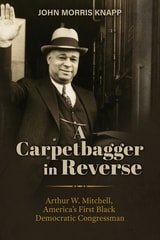
A Carpetbagger in Reverse
Arthur W. Mitchell, America's First Black Democratic CongressmanJohn Morris Knapp
University of Alabama Press, 2025
From Alabama to Congress—Arthur W. Mitchell’s fight for justice rewrote the rules of Black political power.
A Carpetbagger in Reverse offers a landmark reassessment of the life, career, and accomplishments of groundbreaking Congressman Arthur W. Mitchell, the first Black Democrat elected to Congress and the only Black member of Congress during his four terms of service from 1935 to 1943.
Born to former enslaved people in Alabama in 1883, Mitchell studied with Booker T. Washington at Tuskegee Institute and later moved to Washington DC and became a lawyer. He continued his career in Chicago, where the Great Migration had helped transform the city’s South Side into a vibrant, multiracial enclave.
As a congressman, Mitchell helped to create an enduring alliance between Black Americans and the Democratic party. Seeing his primary role as representing the South’s disempowered Black population, his belief that solutions to the region’s racial problems should arise from a new cadre of locally trained leaders brought him into frequent, vituperative conflict with the NAACP, the Republican Party, and the Black press. The first Black lawyer to argue successfully before the Supreme Court, his unanimous victory in Mitchell v. United States would have long-term consequences for the Civil Rights Movement.
A Carpetbagger in Reverse is the first publication significantly based on Mitchell’s papers, an essential and often overlooked source of insights about the development of Black political and culture life in the 1930s and 1940s.
A Fire Bell in the Past
The Missouri Crisis at 200, Volume I, Western Slavery, National ImpasseJeffrey L. Pasley
University of Missouri Press, 2021
Drawing on the participants in two landmark conferences held at the University of Missouri and the City University of New York, this first of two volumes finds myriad new perspectives on the Missouri Crisis. Celebrating Missouri’s bicentennial the scholarly way, with fresh research and unsparing analysis, this eloquent collection of essays from distinguished historians gives the epochal struggle over Missouri statehood its due as a major turning point in American history.
Contributors include the editors, Christa Dierksheide, David N. Gellman, Sarah L. H. Gronningsater, Robert Lee, Donald Ratcliffe, Andrew Shankman, Anne Twitty, John R. Van Atta, and David Waldstreicher.
A Fire Bell in the Past
The Missouri Crisis at 200, Volume II: “The Missouri Question” and Its AnswersJeffrey L. Pasley
University of Missouri Press, 2021
Drawn from the of participants in two landmark conferences held at the University of Missouri and the City University of New York, those who contributed original essays to this second of two volumes—a group that includes young scholars and foremost authorities in the field—answer the Missouri “Question,” in bold fashion, challenging assumptions both old and new in the long historiography by approaching the event on its own terms, rather than as the inevitable sequel of the flawed founding of the republic or a prequel to its near destruction.
This second volume of A Fire Bell in the Past features a foreword by Daive Dunkley. Contributors include Dianne Mutti Burke, Christopher Childers, Edward P. Green, Zachary Dowdle, David J. Gary, Peter Kastor, Miriam Liebman, Matthew Mason, Kate Masur, Mike McManus, Richard Newman, and Nicholas Wood.
A History of American Legislatures, 1619-2024
Peverill Squire
University of Missouri Press, 2026
What might the members of the first Virginia assembly think if they could visit today’s Virginia House of Delegates? The air-conditioning and diversity of the current membership surely would surprise them, but would the legislative process itself strike them as odd?
In his latest work, Peverill Squire demonstrates that the way the modern legislature goes about its work would seem familiar to visitors from the past. Squire traces a nearly uninterrupted path from that first assembly in Virginia in 1619 to the contemporary Virginia General Assembly, and to the U.S. Congress and the other forty-nine state legislatures.
Each chapter examines discrete topics rather than historical eras, distinguishing the book from other studies of American legislatures. Topics covered include the fundamentals of legislative structure and operation, how qualification standards for legislative service became more inclusive, and how legislative professionalization unfolded at both congressional and state levels.
Though covering more than 400 years, Squire manages to present a comprehensive and accessible history of American legislatures that both scholars and students will find valuable.
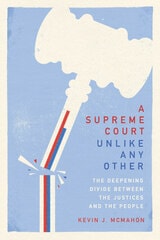
A Supreme Court Unlike Any Other
The Deepening Divide Between the Justices and the PeopleKevin J. McMahon
University of Chicago Press, 2024
A data-rich examination of the US Supreme Court's unprecedented detachment from the democratic processes that buttress its legitimacy.
Today’s Supreme Court is unlike any other in American history. This is not just because of its jurisprudence but also because the current Court has a tenuous relationship with the democratic processes that help establish its authority. Historically, this “democracy gap” was not nearly as severe as it is today. Simply put, past Supreme Courts were constructed in a fashion far more in line with the promise of democracy—that the people decide and the majority rules.
Drawing on historical and contemporary data alongside a deep knowledge of court battles during presidencies ranging from FDR to Donald Trump, Kevin J. McMahon charts the developments that brought us here. McMahon offers insight into the altered politics of nominating and confirming justices, the shifting pool of Supreme Court hopefuls, and the increased salience of the Court in elections. A Supreme Court Unlike Any Other is an eye-opening account of today’s Court within the context of US history and the broader structure of contemporary politics.
A Supreme Court Unlike Any Other
The Deepening Divide Between the Justices and the PeopleKevin J. McMahon
University of Chicago Press, 2024
This is an auto-narrated audiobook version of this book.
A data-rich examination of the US Supreme Court's unprecedented detachment from the democratic processes that buttress its legitimacy.
Today’s Supreme Court is unlike any other in American history. This is not just because of its jurisprudence but also because the current Court has a tenuous relationship with the democratic processes that help establish its authority. Historically, this “democracy gap” was not nearly as severe as it is today. Simply put, past Supreme Courts were constructed in a fashion far more in line with the promise of democracy—that the people decide and the majority rules.
Drawing on historical and contemporary data alongside a deep knowledge of court battles during presidencies ranging from FDR to Donald Trump, Kevin J. McMahon charts the developments that brought us here. McMahon offers insight into the altered politics of nominating and confirming justices, the shifting pool of Supreme Court hopefuls, and the increased salience of the Court in elections. A Supreme Court Unlike Any Other is an eye-opening account of today’s Court within the context of US history and the broader structure of contemporary politics.
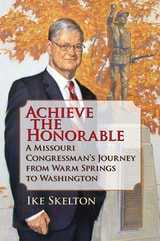
Achieve the Honorable
A Missouri Congressman's Journey from Warm Springs to WashingtonIke Skelton
Southern Illinois University Press, 2013
During his years in the U.S. House of Representatives, Skelton became known as a bipartisan negotiator and a champion of the Armed Services. Throughout the decades, he helped steer the nation through its most dangerous challenges, from Communism to terrorism; took a leading role in the reform of the Department of Defense; dedicated himself to fulfilling the interests of his constituents; and eventually rose to become chair of the House Armed Services Committee during such pivotal events as the wars in Iraq and Afghanistan. In addition to detailing Skelton’s political career and its accompanying challenges and triumphs, Achieve the Honorable provides inside glimpses into the lives of political titans like Harry Truman, Richard Nixon, and Bill Clinton. Along the way, we are treated to Skelton’s engaging humor and shrewd insight into twentieth- and twenty-first-century U.S. politics.
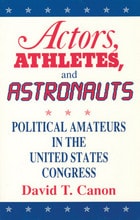
Actors, Athletes, and Astronauts
Political Amateurs in the United States CongressDavid T. Canon
University of Chicago Press, 1990
Written in a lucid style accessible to the nonspecialist, David T. Canon's Actors, Athletes, and Astronauts is a definitive study of political amateurs in elections and in Congress. Canon examines the political conditions that prompt amateurs to run for office, why they win or lose, and whether elected amateurs behave differently from their experienced counterparts. Challenging previous work which presumed stable career structures and progressively ambitious candidates, his study reveals that amateurs are disproportionately elected in periods of high political opportunity, such as the 1930s for Democrats and 1980s for Republicans.
Canon's detailed findings call for significant revision of our prevailing understanding of ambition theory and disarm monolithic interpretations of political amateurs. His unique typology of amateurism differentiates among policy-oriented, "hopeless," or ambitious amateurs. The latter resemble their professional counterparts; "hopeless" amateurs are swept into office by strong partisan motivations and decision-making styles of each type vary, affecting their degree of success, but each type of amateur provides a necessary electoral balance by defeating entrenched incumbents rarely challenged by more experienced politicians.
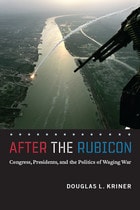
After the Rubicon
Congress, Presidents, and the Politics of Waging WarDouglas L. Kriner
University of Chicago Press, 2010
When the United States goes to war, the nation’s attention focuses on the president. As commander in chief, a president reaches the zenith of power, while Congress is supposedly shunted to the sidelines once troops have been deployed abroad. Because of Congress’s repeated failure to exercise its legislative powers to rein in presidents, many have proclaimed its irrelevance in military matters.
After the Rubicon challenges this conventional wisdom by illuminating the diverse ways in which legislators influence the conduct of military affairs. Douglas L. Kriner reveals that even in politically sensitive wartime environments, individual members of Congress frequently propose legislation, hold investigative hearings, and engage in national policy debates in the public sphere. These actions influence the president’s strategic decisions as he weighs the political costs of pursuing his preferred military course.
Marshalling a wealth of quantitative and historical evidence, Kriner expertly demonstrates the full extent to which Congress materially shapes the initiation, scope, and duration of major military actions and sheds new light on the timely issue of interbranch relations.
Ambition, Competition, and Electoral Reform
The Politics of Congressional Elections Across TimeJamie L. Carson and Jason M. Roberts
University of Michigan Press, 2013
In Ambition, Competition, and Electoral Reform, Jamie L. Carson and Jason M. Roberts present an original study of U.S. congressional elections and electoral institutions for 1872-1944 from a contemporary political science perspective. Using data on late nineteenth and early twentieth century congressional elections, the authors test the applicability in a historical context of modern political science theories, assess the effects of institutional reforms, and identify the factors that shape the competitiveness of elections. They present several key findings: the strategic politicians theory is applicable in an era without candidate-centered campaigns; there was an incumbency advantage prior to the full development of candidate-centered campaigns; institutional reforms have had a significant effect on elections; and the degree of electoral competition frequently correlates with elected officials' responsiveness to citizens.
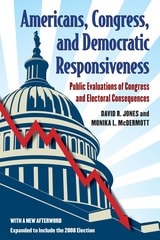
Americans, Congress, and Democratic Responsiveness
Public Evaluations of Congress and Electoral ConsequencesDavid R. Jones and Monika L. McDermott
University of Michigan Press, 2010
rampant in the political science literature, Jones and McDermott show that the people are in control, determining not only the direction of policy in Congress, but also who stays, who retires, and who faces difficult reelection efforts. This book makes an important correction to our understanding of how Congress operates."
---Sean M. Theriault, University of Texas at Austin