Results by title
7 books match the query 'Lesbian couples'

Are You Two Sisters?
The Journey of a Lesbian CoupleSusan Krieger
Temple University Press, 2022
Authored by one of the most respected figures in the field of personal ethnographic narrative, this book serves as both a memoir and a sociological study, telling the story of one lesbian couple’s lifelong journey together.
Are You Two Sisters? is Susan Krieger’s candid, revealing, and engrossing memoir about the intimacies of a lesbian couple. Krieger explores how she and her partner confront both the inner challenges of their relationship and the invisibility of lesbian identity in the larger world.
Using a lively novelistic and autoethnographic approach that toggles back and forth in time, Krieger reflects on the evolution of her forty-year relationship. She describes building a life together, from sharing pets and travels to getting married. Are You Two Sisters? addresses not only questions of gender and sexuality, but also of disability, as Krieger explores how the couple adapts to her increasing blindness.
Krieger’s title comes from a question asked by a stranger outside a remote desert bar as she and her partner traveled in the Southwest. Her apprehension about answering that question suggests how, even after the legalization of gay marriage, lesbianism often remains hidden—an observation that makes Krieger’s poignant narrative all the more moving.
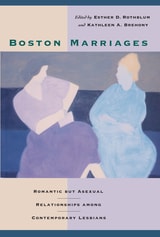
Boston Marriages
Romantic but Asexual Relationships among Contemporary LesbiansEdited by Esther D. Rothblum and Kathleen A. Brehony
University of Massachusetts Press, 1993
For decades the term “Boston marriage” was used to describe single women who lived together and shared their lives. The presumption then was that these partnerships were nonsexual. In recent years, however, the opposite assumption has prevailed, causing some women involved in such relationships to hide the asexual nature of their attachments in the lesbian community.
Convinced that Boston marriages are both legitimate and important, Esther D. Rothblum and Kathleen A. Brehony argue that in a society that defines intimacy by the occurrence of sexual activity, we have no word for—and thus no understanding of—the intensely romantic but asexual relationships that some lesbians form. By bringing these relationships “out of the closet” and discussing them openly, the editors and other contributors to this volume challenge our views about lesbianism and address larger questions concerning the construction of sexuality and sexual identity. How, for example, do we define a lesbian relationship? What constitutes a romantic involvement? If a couple does not engage in sex, are they still considered lovers?
This book includes ten personal accounts by women involved in Boston marriages as well as theoretical essays by Lillian Faderman, Marnie Hall, JoAnn Loulan, Suzanna Rose, Debra Zand, Marie Cini, and Laura Brown.
ON INTIMATE TERMS
The Psychology of Difference in Lesbian RelationshipsBeverly Burch
University of Illinois Press, 1993
"A very thoughtful and thought-provoking piece of work. . . . It will be a strong contribution to the fields of lesbian studies, gender relations, and feminist psychoanalysis." - Diane Ehrensaft, author of Parenting Together: Men and Women Sharing the Care of Their Children
Policy Issues Affecting Lesbian, Gay, Bisexual, and Transgender Families
Sean Cahill and Sarah Tobias
University of Michigan Press, 2010
Lesbian, gay, bisexual, and transgender people face the same family issues as their heterosexual counterparts, but that is only the beginning of their struggle. The LGBT community also encounters legal barriers to government recognition of their same-sex relationships and relationships to their own children. Policy Issues Affecting Lesbian, Gay, Bisexual, and Transgender Families addresses partner recognition, parenting, issues affecting children of LGBT parents, health care, discrimination, senior care and elder rights, and equal access to social services.
Sean Cahill and Sarah Tobias provide up-to-date, accurate analysis of the major policies affecting LGBT people, their same-sex partners, and their children. This valuable resource offers literature reviews of demographic research as well as original research based on the U.S. Census same-sex couple sample. It also provides a look at the 30-year history of right-wing anti-gay activism and the intra-community intellectual debates over the fight for marriage.
"The sheer diversity of gay people and opinion shines through Cahill and Tobias's fact-packed depiction of same-sex couples and their kids, their needs and day-to-day challenges, and the movement for fairness and the freedom to marry. The disparate personal stories and struggles in this informative book underscore the importance of ending discrimination in marriage and ensuring that no family is left behind."
—Evan Wolfson, Founder and Executive Director of the Freedom to Marry Project
"A concise, comprehensive guide to gay-family issues that combines an impassioned progressive sensibility with a firm respect for facts."
—Jonathan Rauch, senior writer and columnist for National Journal,Atlantic Monthly correspondent, and author of Gay Marriage: Why It Is Good for Gays, Good for Straights, and Good for America
"Cahill and Tobias offer readers a thorough and immensely readable guide to the legal problems faced by LGBT families."
—Ellen Andersen, Indiana University–Purdue University at Indianapolis
"For an account of policy issues that frame lesbian, gay, bisexual, and transgender (LGBT) family lives here in the United States, one need look no further. Sean Cahill and Sarah Tobias supply accurate and up-to-date information about the legal and policy contexts of LGBT lives across the country. This book is sure to be a valuable resource for students and scholars, as well as for others seeking to understand and challenge discrimination based on sexual orientation or gender identity."
—Charlotte J. Patterson, University of Virginia
Sean Cahill is Director of the National Gay and Lesbian Task Force Policy Institute.
Sarah Tobias is a feminist theorist and LGBT activist who earned her Ph.D. in Political Science from Columbia University. She has taught Political Theory at colleges in New York and New Jersey, and currently works as Senior Policy Analyst in the Democracy program at Demos, a New York City–based think tank.
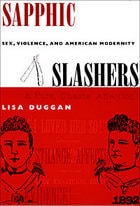
Sapphic Slashers
Sex, Violence, and American ModernityLisa Duggan
Duke University Press, 2000
Situating this story alongside simultaneously circulating lynching narratives (and its resistant versions, such as those of Memphis antilynching activist Ida B. Wells) Duggan reveals how stories of sex and violence were crucial to the development of American modernity. While careful to point out the differences between the public reigns of terror that led to many lynchings and the rarer instances of the murder of one woman by another privately motivated woman, Duggan asserts that dominant versions of both sets of stories contributed to the marginalization of African Americans and women while solidifying a distinctly white, male, heterosexual form of American citizenship. Having explored the role of turn-of-the-century print media—and in particular their tendency toward sensationalism—Duggan moves next to a review of sexology literature and to novels, most notably Radclyffe Hall’s The Well of Loneliness. Sapphic Slashers concludes with two appendices, one of which presents a detailed summary of Ward’s murder, the trial, and Mitchell’s eventual institutionalization. The other presents transcriptions of letters exchanged between the two women prior to the crime.
Combining cultural history, feminist and queer theory, narrative analysis, and compelling storytelling, Sapphic Slashers provides the first history of the emergence of the lesbian in twentieth-century mass culture.
The Erotic as Rhetorical Power
Archives of Romantic Friendship between Women TeachersPamela VanHaitsma
The Ohio State University Press, 2024
Winner, 2025 Marie Hochmuth Nichols Award from the National Communication Association’s Public Address Division
The Erotic as Rhetorical Power offers a queer feminist history of rhetoric that recovers the civic contributions of women teachers in same-sex romantic friendships. Extending perspectives from ancient rhetoric to nineteenth-century progressivism, from Audre Lorde’s Black lesbian feminist theory to its present-day uptakes, Pamela VanHaitsma conceives of the erotic as an interanimation of desires that, in being passionately shared, becomes imbued with the power to forge connection and foment change.
VanHaitsma’s theory of the erotic as rhetorical power emerges from both historiographic and imaginative engagements with more than twenty archives of romantic friendships between women: Sallie Holley and Caroline Putnam, Irene Leache and Anna Wood, Gertrude Buck and Laura Wylie, and Rebecca Primus and Addie Brown. VanHaitsma considers how even as the erotic in these romantic friendships fueled the women’s rhetorical activities toward transformational ends—whether working toward the abolition of slavery, greater educational access, or voting rights—it also energized rhetorical activities that sometimes challenged but also reinforced troubling power dynamics. The Erotic as Rhetorical Power uncovers the erotic’s significance as a conflicted site of power that is central to rhetorical theory and history as well as feminist and LGBTQ+ studies.
Things No Longer There
A Memoir of Losing Sight and Finding VisionSusan Krieger
University of Wisconsin Press, 2005
Krieger's touching memoir explores the ways that outer landscapes may change and sight may be lost, but inner visions persist, giving meaning, jarring the senses with a very different picture than what appears before the eyes. This book will reward both the general reader and those interested in disability studies, feminist ethnography, and lesbian studies.