Results by title
3 books match the query 'Lesbians' writings'

Michael Field
Decadent ModernsSarah Parker
Ohio University Press, 2019
In the last twenty years, Michael Field has emerged as one of the most fascinating poets of the Victorian era. Through their collaborative partnership as “Michael Field,” Katharine Bradley and Edith Cooper engaged in the aesthetic and decadent movements of the fin de siècle, while their poetry and verse drama articulate ideas associated with the New Woman and boldly express queer and lesbian desire. Michael Field: Decadent Moderns extends the focus on these key literary and cultural contexts by emphasizing their continuing significance within twentieth-century literary modernism. Through a series of interdisciplinary essays, this book addresses Michael Field’s energetic engagements with a range of topics including ecology, perfume, tourism, art history, sculpture, formalism, classics, and book history. In doing so, Michael Field: Decadent Moderns highlights the modernity, radicalism, and relevance of their work, both within the nineteenth and twentieth centuries as well as in our own cultural moment.
Contributors: Leire Barrera-Medrano, Joseph Bristow, Jill R. Ehnenn, Sarah E. Kersh, Kristin Mahoney, Catherine Maxwell, Alex Murray, Sarah Parker, Margaret D. Stetz, Kate Thomas, and Ana Parejo Vadillo.
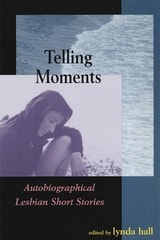
Telling Moments
Autobiographical Lesbian Short StoriesEdited by Lynda Hall
University of Wisconsin Press, 2003
The stories are by well-known contemporary writers—Gloria Anzaldúa, Mary Cappello, Emma Donoghue, Jewelle Gomez, Karla Jay, Anna Livia, Valerie Miner, Lesléa Newman, Minnie Bruce Pratt, Ruthann Robson, Sarah Schulman, and Jess Wells—and exciting newer voices, such as Donna Allegra and Marion Douglas. There are also stories from performance artists Carmelita Tropicana, Peggy Shaw, and Maya Chowdhry. Anna Livia’s protagonist appreciates her mother’s artful garden creation. Ruthann Robson tells of a survivor of the health care system. In Marion Douglas’s story a teenager dances with an alluring classmate. Donna Allegra’s strong construction worker copes with the death of her mother. And Karla Jay sets her character forth to swim with sharks. Most of the stories are accompanied by an author photo, biographical sketch, and—a most significant feature—a commentary from the author on her writing process and the autobiographical nature of her story, illustrating the truth behind the fiction.
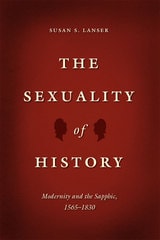
The Sexuality of History
Modernity and the Sapphic, 1565-1830Susan S. Lanser
University of Chicago Press, 2014
In The Sexuality of History, Susan S. Lanser shows how intimacies between women became harbingers of the modern, bringing the sapphic into the mainstream of some of the most significant events in Western Europe. Ideas about female same-sex relations became a focal point for intellectual and cultural contests between authority and liberty, power and difference, desire and duty, mobility and change, order and governance. Lanser explores the ways in which a historically specific interest in lesbians intersected with, and stimulated, systemic concerns that would seem to have little to do with sexuality. Departing from the prevailing trend of queer reading whereby scholars ferret out hidden content in “closeted” texts, Lanser situates overtly erotic representations within wider spheres of interest. The Sexuality of History shows that just as we can understand sexuality by studying the past, so too can we understand the past by studying sexuality.