Results by title
5 books match the query 'Leviathan'

Binding Words
Conscience and Rhetoric in Hobbes, Hegel, and HeideggerKaren Feldman
Northwestern University Press, 2006
In a provactive work that brings new tools to the history of philosophy, Karen S. Feldman offers an elegant account of how philosophical language appears to produce the very thing it claims to describe. She demonstrates that conscience can only be described and understood through tropes and figures of langugae. If description in literal terms is impossible, as Binding Words convincingly argues, perhaps there is no such thing. But if the word "conscience" has no tangible referent, then how can conscience be constructed as binding? Does our conscience move us to do things, or is this yet another figure of speech?
Hobbes's Leviathan, Hegel's Phenomenology of Spirit, and Heidegger's Being and Time dramatize conscience's relation to language and knowledge, morality and duty, and ontology. Feldman investigates how, within these works, conscience is described as binding upon us while at the same time asking how texts themselves may be read as binding.
Hobbes's Leviathan, Hegel's Phenomenology of Spirit, and Heidegger's Being and Time dramatize conscience's relation to language and knowledge, morality and duty, and ontology. Feldman investigates how, within these works, conscience is described as binding upon us while at the same time asking how texts themselves may be read as binding.
[more]
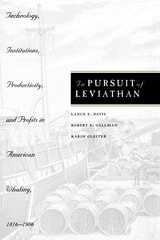
In Pursuit of Leviathan
Technology, Institutions, Productivity, and Profits in American Whaling, 1816-1906Lance E. Davis, Robert E. Gallman, and Karin Gleiter
University of Chicago Press, 1997
In Pursuit of Leviathan traces the American whaling industry from its rise in the 1840s to its precipitous fall at the end of the nineteenth century. Using detailed and comprehensive data that describe more than four thousand whaling voyages from New Bedford, Massachusetts, the leading nineteenth-century whaling port, the authors explore the market for whale products, crew quality and labor contracts, and whale biology and distribution, and assess the productivity of the American fleet. They then examine new whaling techniques developed at the end of the nineteenth century, such as modified clippers and harpoons, and the introduction of darting guns. Despite the common belief that the whaling industry declined due to a fall in whale stocks, the authors argue that the industry's collapse was related to changes in technology and market conditions.
Providing a wealth of historical information, In Pursuit of Leviathan is a classic industry study that will provide intriguing reading for anyone interested in the history of whaling.
Providing a wealth of historical information, In Pursuit of Leviathan is a classic industry study that will provide intriguing reading for anyone interested in the history of whaling.
[more]

Laughing at Leviathan
Sovereignty and Audience in West PapuaDanilyn Rutherford
University of Chicago Press, 2012
For West Papua and its people, the promise of sovereignty has never been realized, despite a long and fraught struggle for independence from Indonesia. In Laughing at Leviathan, Danilyn Rutherford examines this struggle through a series of interlocking essays that drive at the core meaning of sovereignty itself—how it is fueled, formed, and even thwarted by pivotal but often overlooked players: those that make up an audience. Whether these players are citizens, missionaries, competing governmental powers, nongovernmental organizations, or the international community at large, Rutherford shows how a complex interplay of various observers is key to the establishment and understanding of the sovereign nation-state.
Drawing on a wide array of sources, from YouTube videos to Dutch propaganda to her own fieldwork observations, Rutherford draws the history of Indonesia, empire, and postcolonial nation-building into a powerful examination of performance and power. Ultimately she revises Thomas Hobbes, painting a picture of the Leviathan not as a coherent body but a fragmented one distributed across a wide range of both real and imagined spectators. In doing so, she offers an important new approach to the understanding of political struggle.
[more]

The Leviathan in the State Theory of Thomas Hobbes
Meaning and Failure of a Political SymbolCarl Schmitt
University of Chicago Press, 2008
One of the most significant political philosophers of the twentieth century, Carl Schmitt is a deeply controversial figure who has been labeled both Nazi sympathizer and modern-day Thomas Hobbes. First published in 1938, The Leviathan in the State Theory of Thomas Hobbes used the Enlightenment philosopher’s enduring symbol of the protective Leviathan to address the nature of modern statehood. A work that predicted the demise of the Third Reich and that still holds relevance in today’s security-obsessed society, this volume will be essential reading for students and scholars of political science.
“Carl Schmitt is surely the most controversial German political and legal philosopher of this century. . . . We deal with Schmitt, against all odds, because history stubbornly persists in proving many of his tenets right.”—Perspectives on Political Science
“[A] significant contribution. . . . The relation between Hobbes and Schmitt is one of the most important questions surrounding Schmitt: it includes a distinct, though occasionally vacillating, personal identification as well as an association of ideas.”—Telos
[more]

The Limits of Liberty
Between Anarchy and LeviathanJames M. Buchanan
University of Chicago Press, 1977
"The Limits of Liberty is concerned mainly with two topics. One is an attempt to construct a new contractarian theory of the state, and the other deals with its legitimate limits. The latter is a matter of great practical importance and is of no small significance from the standpoint of political philosophy."—Scott Gordon, Journal of Political Economy
James Buchanan offers a strikingly innovative approach to a pervasive problem of social philosophy. The problem is one of the classic paradoxes concerning man's freedom in society: in order to protect individual freedom, the state must restrict each person's right to act. Employing the techniques of modern economic analysis, Professor Buchanan reveals the conceptual basis of an individual's social rights by examining the evolution and development of these rights out of presocial conditions.
James Buchanan offers a strikingly innovative approach to a pervasive problem of social philosophy. The problem is one of the classic paradoxes concerning man's freedom in society: in order to protect individual freedom, the state must restrict each person's right to act. Employing the techniques of modern economic analysis, Professor Buchanan reveals the conceptual basis of an individual's social rights by examining the evolution and development of these rights out of presocial conditions.
[more]