Results by title
6 books match the query 'Levinas'
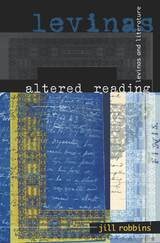
Altered Reading
Levinas and LiteratureJill Robbins
University of Chicago Press, 1999
With an attitude at once respectful and interrogative, closely attentive to Levinas's texts while in dialogue with readings by Derrida, Blanchot, and Bataille, Altered Reading shows how the thread of the literary leads directly to the internal tensions of Levinas's ethical discourse. Jill Robbins provides a comprehensive critical account of Levinas's early and mature philosophy as well as later key transitional essays. In an invaluable appendix, she includes her own translation of an important, previously untranslated essay by Bataille on Levinas.
Altered Reading will interest philosophers, literary critics, scholars of religion, and others drawn to Levinas's work.
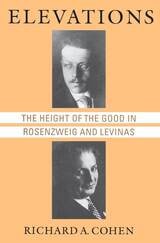
Elevations
The Height of the Good in Rosenzweig and LevinasRichard A. Cohen
University of Chicago Press, 1994
Cohen also explores the ethical philosophy of these two thinkers in relation to Nietzsche, Husserl, Heidegger, Buber, Sartre, and Derrida. The result is one of the most wide-ranging and lucid studies yet written on these crucial figures in philosophy and Jewish thought.

Epoché as a Guideline to (Inter)Subjectivity
On the Extent of Husserl’s Methodological Influence on Levinas and SartreJosef Matoušek
Karolinum Press, 2026
Offers a comparative study of Emmanuel Levinas and Jean-Paul Sartre through the lens of their engagement with Edmund Husserl’s phenomenology.
Focusing on the notions of epoché, phenomenological reduction, intentionality, and the cogito, Josef Matoušek traces how both Emmanuel Levinas and Jean-Paul Sartre appropriate and transform Husserl’s methodological framework in developing their respective accounts of subjectivity, transcendence, and the encounter with the Other. Building on and critically extending Kris Sealey’s influential comparison of both thinkers, Epoché as a Guideline to (Inter)Subjectivity argues that despite their significant philosophical differences, both remain deeply indebted to Husserl’s project and that their mature accounts of le visage and le regard can be better understood through this shared phenomenological background.
Essential Vulnerabilities
Plato and Levinas on Relations to the OtherDeborah Achtenberg
Northwestern University Press, 2014

Levinas on the Primacy of the Ethical
Philosophy as ProphecyJeffrey Bloechl
Northwestern University Press, 2023
The philosophy of Emmanuel Levinas affirms both the urgency of peace and the fact that peace is never finally assured. This tension is a question of responsibility and of the ethical relation in which that responsibility is grounded. Jeffrey Bloechl pursues this prophetic dimension of Levinas’s philosophy—his commitment to phenomenology and to a philosophy of religion—to make the case for the mutual reinforcement and intelligibility of these two threads.
Levinas on the Primacy of the Ethical traces the emergence of Levinas’s early thought in relation to modern political philosophy, his revision of Martin Heidegger’s existential phenomenology, the consolidation of his mature position, his important differences with Freudian psychoanalysis, the turn from metaphysics to language in his later philosophy, and his complex relationship with Christian theology. Starting with an exposition of how positive notions of religious transcendence are already present in some of Levinas’s early phenomenological texts, Bloechl then stakes the reverse claim: that Levinas’s conception of God is dependent on his existential phenomenology. Proceeding chronologically, but with frequent nods to later developments, this book builds toward the ultimate assertion that Levinas offers us a phenomenology of event and of relation without appeal to any foundation, ground, or causal principle. Only in this way is Levinas able to generate an argument—and not merely an exhortation—for the primacy of the ethical as he conceives it.
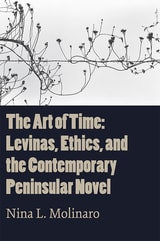
The Art of Time
Levinas, Ethics, and the Contemporary Peninsular NovelNina L. Molinaro
Bucknell University Press, 2019
Academicians and journalists in Spain and abroad have recently fastened on an emerging cluster of peninsular writers who, they argue, pertain to a discernible literary generation, provisionally referred to as Generación X. These writers are distinct from their predecessors; they and their literary texts are closely related to the specific socio-political and historical circumstances in Spain and their novels relate stories of more and less proximity, more and less responsibility, and more and less temporality. In short, they trace the temporal movement of alterity through narrative.
Published by Bucknell University Press. Distributed worldwide by Rutgers University Press.