Results by title
14 books match the query 'Liberia'
Apprenticeship in Critical Ethnographic Practice
Jean Lave
University of Chicago Press, 2011
In this extended meditation, Jean Lave interweaves analysis of the process of apprenticeship among the Vai and Gola tailors of Liberia with reflections on the evolution of her research on those tailors in the late 1970s. In so doing, she provides both a detailed account of her apprenticeship in the art of sustained fieldwork and an insightful overview of thirty years of changes in the empirical and theoretical facets of ethnographic practice. Examining the issues she confronted in her own work, Lave shows how the critical questions raised by ethnographic research erode conventional assumptions, altering the direction of the work that follows.
As ethnography takes on increasing significance to an ever widening field of thinkers on topics from education to ecology, this erudite but accessible book will be essential to anyone tackling the question of what it means to undertake critical and conceptually challenging fieldwork. Apprenticeship in Critical Ethnographic Practice explains how to seriously explore what it means to be human in a complex world—and why it is so important.
Brothers and Strangers
Black Zion, Black Slavery, 1914–1940Ibrahim Sundiata
Duke University Press, 2003
In an account based on extensive archival research, including work in the Liberian National Archives, Sundiata explains how Garvey’s plan collapsed when faced with opposition from the Liberian elite, opposition that belied his vision of a unified Black World. In 1930 the League of Nations investigated labor conditions and, damningly, the United States, land of lynching and Jim Crow, accused Liberia of promoting “conditions analogous to slavery.” Subsequently various plans were put forward for a League Mandate or an American administration to put down slavery and “modernize” the country. Threatened with a loss of its independence, the Liberian government turned to its “brothers beyond the sea” for support. A varied group of white and black anti-imperialists, among them W. E. B. Du Bois, took up the country’s cause. In revealing the struggle of conscience that bedeviled many in the black world in the past, Sundiata casts light on a human rights predicament which, he points out, continues in twenty-first-century African nations as disparate as Sudan, Mauritania, and the Ivory Coast.
Civil War and State Formation
The Political Economy of War and Peace in LiberiaFelix Gerdes
Campus Verlag, 2013
Destiny and Race
Selected Writings, 1840-1898Alexander Crummell
University of Massachusetts Press, 1992
A major reformer and intellectual, Alexander Crummell (1819–1898) was the first black American to graduate from Cambridge University. From 1858 to 1872, he lived in Liberia, where he worked as a farmer, educator, and Episcopal missionary. Returning to America, he established St. Luke’s Episcopal Church in Washington D.C., serving as its pastor until 1894. In 1897 he founded the American Negro Academy, which he intended as a challenge to the accommodationist philosophy of Booker T. Washington.
A prolific writer, Crummell produced pioneering works on black nationalism, black self-determination, and Pan Africanism that influenced W.E.B. Du Bois and other African-American leaders of the time. His surviving papers include over four hundred sermons and political essays and a voluminous correspondence.
Yet despite his importance to American and African-American history, Crummell is little known today, and there have been virtually no modern printings of his writing. This volume is intended to restore Crummell’s voice and to prompt a reevaluation of his work.
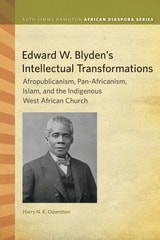
Edward W. Blyden's Intellectual Transformations
Afropublicanism, Pan-Africanism, Islam, and the Indigenous West African ChurchHarry N. K. Odamtten
Michigan State University Press, 2019
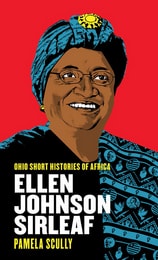
Ellen Johnson Sirleaf
Pamela Scully
Ohio University Press, 2016
In this timely addition to the Ohio Short Histories of Africa series, Pamela Scully takes us from the 1938 birth of Nobel Peace Prize winner and two-time Liberian president Ellen Johnson through the Ebola epidemic of 2014–15. Charting her childhood and adolescence, the book covers Sirleaf’s relationship with her indigenous grandmother and urban parents, her early marriage, her years studying in the United States, and her career in international development and finance, where she developed her skill as a technocrat. The later chapters cover her years in and out of formal Liberian politics, her support for women’s rights, and the Ebola outbreak.
Sirleaf’s story speaks to many of the key themes of the twenty-first century. Among these are the growing power of women in the arenas of international politics and human rights; the ravaging civil wars in which sexual violence is used as a weapon; and the challenges of transitional justice in building postconflict societies. Ellen Johnson Sirleaf is an astute examination of the life of a pioneering feminist politician.
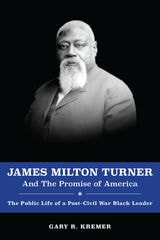
James Milton Turner and the Promise of America
The Public Life of a Post-Civil War Black LeaderGary R. Kremer
University of Missouri Press, 2020
Born a slave, Turner gained freedom when he was a child and received his education in clandestine St. Louis schools, later briefly attending Oberlin College. A self-taught lawyer, Turner earned a statewide reputation and wielded power far out of proportion to Missouri's relatively small black population.
After working nearly a decade in Liberia, Turner never regained the prominence he had enjoyed during Reconstruction.

Life after Guns
Reciprocity and Respect among Young Men in LiberiaHardgrove, Abby
Rutgers University Press, 2017
Download open access ebook here.
Missions for Science
U.S. Technology and Medicine in America's African WorldMcBride, David
Rutgers University Press, 2002
--What specific technologies and medical resources were transferred by U.S. institutions to black populations centers and why?
--How did the professed aims of U.S. technical projects, public health, and military activities differ from their actual effects and consequences?
--Did the U.S. technical transfer amount to a form of political hegemony?
--What lessons can we learn from the history of technology and medicine in these key geographic regions?
Missions for Science is the first book to explain how modern industrial and scientific advances shaped black Atlantic population centers. McBride is the first to provide a historical analysis of how shifting environmental factors and disease-control aid from the United States affected the collective development of these populations. He also discusses how independent black Atlantic republics with close historical links to the United States independently envisioned and attempted to use science and technology to build their nations.
Monrovia Modern
Urban Form and Political Imagination in LiberiaDanny Hoffman
Duke University Press, 2017

Swing Low, Sweet Chariot
The Mortality Cost of Colonizing Liberia in the Nineteenth CenturyAntonio McDaniel
University of Chicago Press, 1995
McDaniel compares the mortality rates of the emigrants to those of other migrants to tropical areas. He finds that, contrary to popular belief, black immigrants during this period died at unprecedented rates. Moreover, he shows that though the emigrant's mortality levels were exceptionally high, their mortality patterns were consistent with those of other populations.
McDaniel concludes that the greater the variance between the environment left and the environment entered, the higher the probability of contracting a new disease, and, in some cases, of death from these diseases. Additionally, a migrant's health can be affected by dietary changes, differences in local pathogens, inappropriate immunities, and increased risk of accidents due to unfamiliar surroundings.
The Brink of Freedom
Improvising Life in the Nineteenth-Century Atlantic WorldDavid Kazanjian
Duke University Press, 2016
The Insistent Call
Rhetorical Moments in Black Anticolonialism, 1929-1937Aric Putnam
University of Massachusetts Press, 2012
Throughout the nineteenth century, African heritage played an important role in black America, as personal memories and cultural practices continued to shape the everyday experience of people of African descent living under the shadow of slavery. Resisting efforts to de-Africanize their values, customs, and beliefs, Black Americans invoked their African roots in public arguments about their identity and place in the “new” world. At the outset of the twentieth century many still saw Africa primarily as the source of a common cultural and spiritual past. But after the 1920s, the meaning of African heritage changed as people of African descent expressed new relationships between themselves, the United States, and the African Diaspora.
In The Insistent Call, Aric Putnam studies the rhetoric of newspapers, literature, and political pamphlets that expressed this shift. He demonstrates that as people of African descent debated the United States' occupation of Haiti, the Liberian labor crisis, and the Italian invasion of Ethiopia, they formed a new collective identity, one that understood the African Diaspora in primarily political rather than cultural terms. In addition to uncovering a neglected period in the history of Black rhetoric, Putnam shows how rhetoric that articulates the interests of a population not defined by the boundaries of a state can still motivate collective action and influence policies.
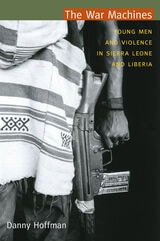
The War Machines
Young Men and Violence in Sierra Leone and LiberiaDanny Hoffman
Duke University Press, 2011
Hoffman argues that in contemporary West Africa, space, sociality, and life itself are organized around making young men available for all manner of dangerous work. Drawing on his ethnographic research over the past nine years, as well as the anthropology of violence, interdisciplinary security studies, and contemporary critical theory, he maintains that the mobilization of West African men exemplifies a global trend in the outsourcing of warfare and security operations. A similar dynamic underlies the political economy of violence in Iraq, Afghanistan, and a growing number of postcolonial spaces. An experienced photojournalist, Hoffman integrates more than fifty of his photographs of young West Africans into The War Machines.