Results by title

5 books match the query 'Libya'
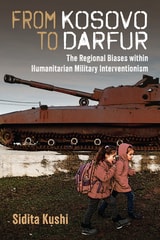
cover of From Kosovo to Darfur: The Regional Biases within Humanitarian Military Interventionism

From Kosovo to Darfur

The Regional Biases within Humanitarian Military Interventionism

Sidita Kushi

University of Michigan Press, 2025

Why are some violent crises more likely to prompt humanitarian military interventions than others? Conventional wisdom says that humanitarian military interventions occur due to national interests, shared values and norms, or economic benefits for the interveners. Yet neither of these factors can fully explain the selectivity of such interventions. The international community continues to ignore the decades-long suffering in Darfur, often dismisses the genocidal policies within Myanmar, and even perpetuates the suffering in contemporary Yemen, while undertaking humanitarian-laden missions in Libya, Syria, and the Balkans.

Using in-depth case studies and new data on all post–Cold War internal armed conflicts matched to third-party responses, From Kosovo to Darfur offers the first regionally sensitive analysis of humanitarian military intervention since the end of the Cold War. It shows that international military interventions in the context of acute humanitarian crises are driven by different pathways within the Western versus the non-Western world and fueled by elite perceptions of the crisis, making interventions closer to the geographic and cultural West most probable and most intense. As our international community becomes increasingly interdependent and aware of human suffering across borders, From Kosovo to Darfur points to new pathways of conflict trajectories and reveals vital implications for leaders, scholars, and nongovernmental actors advocating for or against international military intervention as a policy choice.
[more]
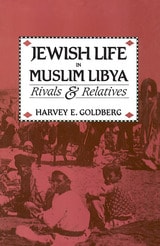
cover of Jewish Life in Muslim Libya: Rivals and Relatives

Jewish Life in Muslim Libya

Rivals and Relatives

Harvey E. Goldberg

University of Chicago Press, 1990

In 1949 more than 35,000 Jews lived in Libya, but close to ninety percent had left before Libya attained its independence in 1952. Jewish Life in Muslim Libya combines historical and anthropological perspectives in depicting the changing relations between Muslims and Jews in Libya from the early nineteenth century up to the middle of the twentieth century.

Harvey E. Goldberg shows that the cultural and religious worlds of the Jewish and Muslim communities in Libya were deeply intertwined in daily life and largely remained so despite political and social changes under successive Ottoman and Italian rule. He documents the intricate symbolic linkages of Jews and Muslims in different periods and in a variety of settings. His accounts of traditional Jewish weddings, of mock fights between Jewish teams that took place in early nineteenth-century Tripoli, and of the profession of street peddling demonstrate that, despite age-old images of Jews as outsiders or infidels, Jews were also an essential and familiar part of the local Islamic society.

Goldberg's narrative continues through the British Military Administration in Libya, a period which saw growing Libyan nationalism and, in 1945, three days of riots in which more than 130 Jews were killed. Goldberg reflects on how these events both expressed and exacerbated a rupture in the social fabric linking Muslims and Jews, setting the scene for the mass emigration of Libyan Jews from their homeland.
[more]
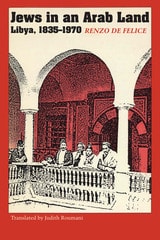
cover of Jews in an Arab Land: Libya, 1835–1970

Jews in an Arab Land

Libya, 1835–1970

By Renzo De Felice; translated by Judith Roumani; foreword by Rafello Fellah

University of Texas Press, 1985

Internationally renowned scholar Renzo De Felice’s pioneering study of the Jews of Libya is, in many ways, a microcosm of the major sources of conflict in the modern Middle East. This is the first English translation of Ebrei in un paese arabo, originally published by Il Mulino, Bologna, in 1978.

The author’s broad-ranging and meticulous research has enabled him to reconstruct the contemporary history of the Jews in Libya with an incredible richness of detail, bringing into vivid relief the social, religious, cultural, and political lives of a people caught between centuries of tradition and a series of governments bent on plunging them headfirst into the modern world. This story—fraught with the passion, drama, tragicomedy, and conflict of a society in transition—will be an invaluable resource for scholars in Middle Eastern studies, Jewish studies, and contemporary European history. The wealth of documentation, much of it previously unknown or unpublished, makes this a particularly useful book.
[more]
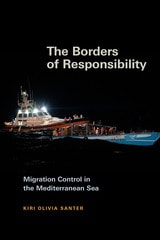
cover of The Borders of Responsibility: Migration Control in the Mediterranean Sea

The Borders of Responsibility

Migration Control in the Mediterranean Sea

Kiri Olivia Santer

Duke University Press, 2026
While migrants face many dangers in attempting to reach Europe by crossing the Mediterranean Sea—from drowning to dying of dehydration—they also confront an elaborate legal system that is designed to return them to their countries of origin. In The Borders of Responsibility, Kiri Olivia Santer outlines the architecture of these legal systems and how they help Europe evade legal responsibility for rescuing migrants. Focusing on legal agreements between Italy and Libya that have resulted in the systematic interception of migrants, Santer shows how Europe’s liberal identity is belied by legal agreements that let migrants die at sea or that send them back to dangerous, exploitative situations in post-Gaddafi Libya or their home countries. Law, she argues, is the tool that enables states to affect control beyond territory, whilst disappearing their responsibility for violence across border assemblages. Through ethnographic fieldwork with migrants, lawyers, policy makers, and humanitarian workers, Santer shows how the law is too often used as an instrument of violence against migrants, who fall outside of conventional structures of legal rights.
[more]
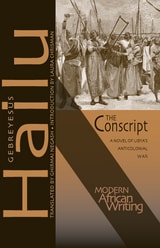
cover of The Conscript: A Novel of Libya’s Anticolonial War

The Conscript

A Novel of Libya’s Anticolonial War

Gebreyesus Hailu

Ohio University Press, 2013

Eloquent and thought-provoking, this classic novel by the Eritrean novelist Gebreyesus Hailu, written in Tigrinya in 1927 and published in 1950, is one of the earliest novels written in an African language and will have a major impact on the reception and critical appraisal of African literature. The Conscript depicts, with irony and controlled anger, the staggering experiences of the Eritrean ascari, soldiers conscripted to fight in Libya by the Italian colonial army against the nationalist Libyan forces fighting for their freedom from Italy’s colonial rule. Anticipating midcentury thinkers Frantz Fanon and Aimé Césaire, Hailu paints a devastating portrait of Italian colonialism. Some of the most poignant passages of the novel include the awakening of the novel’s hero, Tuquabo, to his ironic predicament of being both under colonial rule and the instrument of suppressing the colonized Libyans. The novel’s remarkable descriptions of the battlefield awe the reader with mesmerizing images, both disturbing and tender, of the Libyan landscape—with its vast desert sands, oases, horsemen, foot soldiers, and the brutalities of war—uncannily recalled in the satellite images that were brought to the homes of millions of viewers around the globe in 2011, during the country’s uprising against its former leader, Colonel Gaddafi.
[more]