Results by title
6 books match the query 'Lima (Peru)'
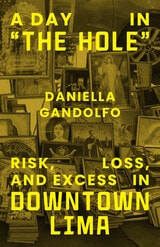
A Day in "The Hole"
Risk, Loss, and Excess in Downtown LimaDaniella Gandolfo
University of Chicago Press, 2025
A single day in a semilegal market in Lima, Peru, reveals a social world that defies conventional economic logic.
In the heart of Lima’s historic center, the markets of El Hueco (“The Hole”) and sprawling Mesa Redonda pulse with life, with thousands of vendors selling everything from knockoff electronics to religious icons. In A Day in “The Hole,” anthropologist Daniella Gandolfo immerses readers in a single, tumultuous day—the thirty-fourth anniversary of a vendors’ cooperative—while examining the dynamics that sustain these marketplaces.
Through a blend of cinematic storytelling and incisive anthropological insight, Gandolfo reveals a world with its own unique codes. She inspects how vendors embrace expenditure over profit and instability over order, and moving through the sights and sounds of El Hueco and Mesa Redonda, she finds a dissident economy that is as much about survival as it is about spectacle. Gandolfo redefines how we think about urban economies and the unexpected ways these defiant communities thrive in this textured portrait of Lima’s markets and the people who animate them.
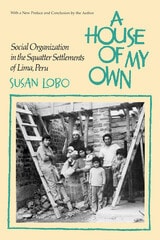
A House of My Own
Social Organization in the Squatter Settlements of Lima, PeruSusan Lobo
University of Arizona Press, 1982
"Whether or not one accepts Susan Lobo's optimistic analysis, her ability to translate the apparent chaos of shanty-town lives into such neat patterns and to help outsiders view life as the inhabitants do are important contributions." —Inter-American Review of Bibliography
"An extremely competent ethnography, simple and straightforward." —Anthropos
"A pleasure to read, a mine of information which will be useful in teaching students to formulate their own hypotheses." —International Journal of Urban & Regional Research
"Very well written and provides a great wealth of the liveliest sort of ethnographic detail." —Latin American Research Review
"Lobo's study of two squatter settlements in Lima provides a solid, well-written, detailed, traditional ethnography of poor families in a Third World urban setting." —Hispanic American Historical Review
"This well-written account . . . has a lot of heart and feeling for the human face of the urban poor." —International Migration Review
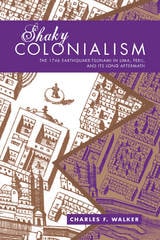
Shaky Colonialism
The 1746 Earthquake-Tsunami in Lima, Peru, and Its Long AftermathCharles F. Walker
Duke University Press, 2008
Through his ambitious rebuilding plan, the Viceroy sought to assert the power of the colonial state over the Church, the upper classes, and other groups. Agreeing with most inhabitants of the fervently Catholic city that the earthquake-tsunami was a manifestation of God’s wrath for Lima’s decadent ways, he hoped to reign in the city’s baroque excesses and to tame the city’s notoriously independent women. To his great surprise, almost everyone objected to his plan, sparking widespread debate about political power and urbanism. Illuminating the shaky foundations of Spanish control in Lima, Walker describes the latent conflicts—about class, race, gender, religion, and the very definition of an ordered society—brought to the fore by the earthquake-tsunami of 1746.
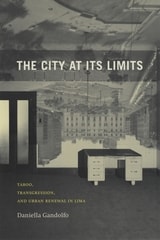
The City at Its Limits
Taboo, Transgression, and Urban Renewal in LimaDaniella Gandolfo
University of Chicago Press, 2009
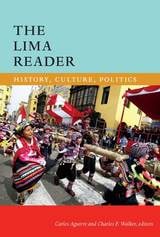
The Lima Reader
History, Culture, PoliticsCarlos Aguirre and Charles F. Walker, editors
Duke University Press, 2017
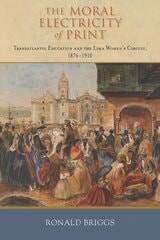
The Moral Electricity of Print
Transatlantic Education and the Lima Women's Circuit, 1876-1910Ronald Briggs
Vanderbilt University Press, 2017
Moral electricity—a term coined by American transcendentalists in the 1850s to describe the force of nature that was literacy and education in shaping a greater society. This concept wasn't strictly an American idea, of course, and Ronald Briggs introduces us to one of the greatest examples of this power: the literary scene in Lima, Peru, in the nineteenth century.
As Briggs notes in the introduction to The Moral Electricity of Print, "the ideological glue that holds the American hemisphere together is a hope for the New World as a grand educational project combined with an anxiety about the baleful influence of a politically and morally decadent Old World that dominated literary output through its powerful publishing interests." The very nature of living as a writer and participating in the literary salons of Lima was, by definition, a revolutionary act that gave voice to the formerly colonized and now liberated people. In the actions of this literary community, as men and women worked toward the same educational goals, we see the birth of a truly independent Latin American literature.