Results by title
3 books match the query 'Lippmann, Walter'
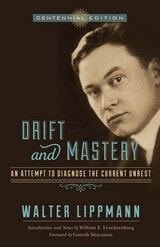
Drift and Mastery
An Attempt to Diagnose the Current UnrestWalter Lippmann, Introduction and notes by William E. Leuchtenburg, Foreword by Ganesh Sitaraman
University of Wisconsin Press, 2015
Lippman’s Drift and Mastery became one of the most important and influential documents of the Progressive Movement. It remains a valuable text for understanding the political thought of early twentieth-century America and a lucid exploration of timeless themes in American government and politics. Distinguished historian Walter Leuchtenberg’s 1986 introduction and notes are retained in this edition.

Five Public Philosophies of Walter Lippmann
By Benjamin F. Wright
University of Texas Press, 1973
Essayist, editor, columnist, author of many books, and winner of a special Pulitzer Prize citation in 1958 for his powers of news analysis, Walter Lippmann both appraised and influenced twentieth-century American politics. No other author of the century dealt with the persistent problems of politics from so many approaches, was so widely read, or varied so widely in his conclusions.
Benjamin F. Wright’s study is the first book devoted to an exposition and analysis of Lippmann’s nine “books of political philosophy,” as James Reston called them. These books provide a fascinating study of changes in the political and economic ideas of the most important journalist of his time.
Lippmann’s books published in 1913 and 1914 reflect the optimism of the Progressive Era, of faith in science and in the ability of people to choose their goals and attain them. In 1922 and 1925, while editor of the New York World, Lippmann wrote searching, often pessimistic analyses of what he believed to be the prevailing assumptions regarding the nature and role of public opinion. Although in the Coolidge era he relegated government to a minor role as mediator, he became an enthusiastic defender of the achievements of the early New Deal. Two years later in a longer look, he found the same New Deal following the path toward totalitarianism. Keynes was discarded and his place taken by the economics of Adam Smith, bolstered by the common law of Coke and the Constitution of the founders. Finally, in 1955, in the extremely popular and very engaging Public Philosophy, there is a lament for the “decline of the West” and a plea to return to the age of civility and natural law.
In a final analytical chapter, Wright presents a critique of Lippmann’s historical understanding and the modern applications of the tradition of natural law. He also assesses Lippmann’s inability to translate the “public philosophy” into programs or institutional changes and the failure to account for the expansion of governmental functions together with the continued strength of constitutional democracy in the West.

Selected Works of Herbert Blumer
A PUBLIC PHILOSOPHY FOR MASS SOCIETYEdited, with Critical Commentary and an Afterword, by Stanford M. Lyman and Arthur J. Vidich
University of Illinois Press, 1988
Balancing essays on Herbert Blumer with Blumer's own writings on race relations, labor and management conflict, urbanization, and popular culture, this volume--originally published as Social Order and the Public Philosophy--establishes Blumer's thought as a basis for a public policy that remains faithful to the essential character of human life in a permanently pluralized and segmented society.
Stanford M. Lyman and Arthur J. Vidich situate Blumer's ideas in the context of earlier public philosophers, such as William Graham Sumner, Herbert Croly, and Walter Lippmann. They consider the implications of Blumer's works for America's most pressing social issues and propose a sophisticated civic sociology of their own based on his studies and methods. Their new afterword affirms the rich harvest Blumer's philosophy continues to yield for postmodern society.