Results by title
14 books match the query 'Literature and folklore'

Blood Brothers and Peace Pipes
Performing the Wild West in German FestivalsA. Dana Weber
University of Wisconsin Press, 2019
This book, based on years of fieldwork observing and studying the festivals, plays, events, and groups that comprise this subculture, addresses a larger, timely issue: cultural transfer and appropriations. Are Germans dressing up in American Indian costumes paying tribute or offending the cultures they are representing? Avoiding simplistic answers, A. Dana Weber considers the complexity of cultural enactments as they relate both to the distinctly German phenomenon as well as to larger questions of cultural representations in American and European live performance traditions."
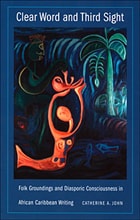
Clear Word and Third Sight
Folk Groundings and Diasporic Consciousness in African Caribbean WritingCatherine A. John
Duke University Press, 2003
Contesting popular discourses about what constitutes culture and maintaining that neglected strains in negritude discourse provide a crucial philosophical perspective on the connections between folk practices, cultural memory, and collective consciousness, John examines the diasporic principles in the work of the negritude writers Léon Damas, Aimé Césaire, and Léopold Senghor. She traces the manifestations and reworkings of their ideas in Afro-Caribbean writing from the eastern and French Caribbean, as well as the Caribbean diaspora in the United States. The authors she discusses include Jamaica Kincaid, Earl Lovelace, Simone Schwarz-Bart, Audre Lorde, Paule Marshall, and Edouard Glissant, among others. John argues that by incorporating what she calls folk groundings—such as poems, folktales, proverbs, and songs—into their work, Afro-Caribbean writers invoke a psychospiritual consciousness which combines old and new strategies for addressing the ongoing postcolonial struggle.
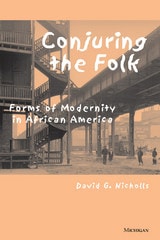
Conjuring the Folk
Forms of Modernity in African AmericaDavid G. Nicholls
University of Michigan Press, 2000
In a series of revisionary readings, Nicholls studies how the "folk" is shaped by the ideology of form. He examines the presence of a spectral "folk" in Toomer's modernist pastiche, Cane. He explores how Hurston presents folklore as a contemporary language of resistance in her ethnography, Mules and Men. In Claude McKay's naturalistic romance, Banana Bottom, Nicholls discovers the figuration of an alternative modernity in the heroine's recovery of her lost "folk" identity. He unearths the individualist ethos of Booker T. Washington in two novels by George Wylie Henderson. And he reveals how Richard Wright's photo-documentary history, 12 Million BlackVoices, places the "folk" in a Marxian narrative of modernization toward class-consciousness.
A provocative rereading of the cultural politics of the Harlem Renaissance, Conjuring the Folk offers a new way of understanding literary responses to migration, modernization, and the concept of the "folk" itself.
David G. Nicholls is a post-doctoral fellow in the Center for the Study of Race, Politics, and Culture, University of Chicago.
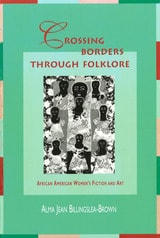
Crossing Borders through Folklore
African American Women's Fiction and ArtAlma Jean Billingslea-Brown
University of Missouri Press, 1999
Examining works by Toni Morrison, Paule Marshall, Faith Ringgold, and Betye Saar, this innovative book frames black women's aesthetic sensibilities across art forms. Investigating the relationship between vernacular folk culture and formal expression, this study establishes how each of the four artists engaged the identity issues of the 1960s and used folklore as a strategy for crossing borders in the works they created during the following two decades.
As a dynamic, open-ended process, folklore historically has enabled African-descended people to establish differential identity, resist dominance, and affirm group solidarity. This book documents the use of expressive forms of folklore in the fiction of Morrison and Marshall and the use of material forms of folklore in the visual representations of Ringgold and Saar. Offering a conceptual paradigm of a folk aesthetic to designate the practices these women use to revise and reverse meanings—especially meanings imposed on images such as Aunt Jemima and Sambo—Crossing Borders through Folklore explains how these artists locate sites of intervention and reconnection. From these sites, in keeping with the descriptive and prescriptive formulations for art during the sixties, Morrison, Marshall, Ringgold, and Saar articulate new dimensions of consciousness and creatively theorize identity.
Crossing Borders through Folklore is a significant and creative contribution to scholarship in both established and still- emerging fields. This volume also demonstrates how recent theorizing across scholarly disciplines has created elastic metaphors that can be used to clarify a number of issues. Because of its interdisciplinary approach, this study will appeal to students and scholars in many fields, including African American literature, art history, women's studies, diaspora studies, and cultural studies.
Folklore in New World Black Fiction
Writing and the Oral Traditional AestheticsChiji Akoma
The Ohio State University Press, 2007
Haunted Greece and Rome
Ghost Stories from Classical AntiquityBy D. Felton
University of Texas Press, 1998
Stories of ghostly spirits who return to this world to warn of danger, to prophesy, to take revenge, to request proper burial, or to comfort the living fascinated people in ancient times just as they do today. In this innovative, interdisciplinary study, the author combines a modern folkloric perspective with literary analysis of ghost stories from classical antiquity to shed new light on the stories' folk roots.
The author begins by examining ancient Greek and Roman beliefs about death and the departed and the various kinds of ghost stories which arose from these beliefs. She then focuses on the longer stories of Plautus, Pliny, and Lucian, which concern haunted houses. Her analysis illuminates the oral and literary transmission and adaptation of folkloric motifs and the development of the ghost story as a literary form. In her concluding chapter, the author also traces the influence of ancient ghost stories on modern ghost story writers, a topic that will interest all readers and scholars of tales of hauntings.
Langston Hughes and the Blues
Steven C. Tracy
University of Illinois Press, 2024
Of Giants
Sex, Monsters, And The Middle AgesJeffrey Jerome Cohen
University of Minnesota Press, 1999
Considers what monsters tell us about identity in the medieval period.
A monster lurks at the heart of medieval identity, and this book seeks him out. Reading a set of medieval texts in which giants and dismemberment figure prominently, Jeffrey Jerome Cohen brings a critical psychoanalytic perspective to bear on the question of identity formation-particularly masculine identity-in narrative representation. The giant emerges here as an intimate stranger, a monster who stands at the limits of selfhood.
Arguing that in the romance tradition of late fourteenth-century England, identity is inscribed on sexed bodies only through the agency of a monster, Cohen looks at the giant as the masculine body writ large. In the giant he sees an uncanny figure, absolutely other and curiously familiar, that serves to define the boundaries of masculine embodiment. Philosophically compelling, the book is also a philologically rigorous inquiry into the phenomenon of giants and giant-slaying in various texts from the Anglo-Saxon period to late Middle English, including Beowulf, Chrétien de Troyes’s The Knight and the Lion, Geoffrey of Monmouth’s History of the Kings of Britain, several works by Chaucer, Sir Gowther, Sir Gawain and the Green Knight, and more.A significant contribution to our understanding of medieval culture, Of Giants also provides surprising insights into questions about the psychosocial work of representation in its key location for the individual: the construction of gender and the social formation of the boundaries of gender identification. It will engage students of the Middle Ages as well as those interested in discourses of the body, social identity, and the grotesque. ISBN 0-8166-3216-2 Cloth £00.00 $47.95xxISBN 0-8166-3217-0 Paper £00.00 $18.95x240 Pages 5 black-and-white photos 5 7/8 x 9 MayMedieval Cultures Series, volume 17Translation inquiries: University of Minnesota Press
Real Folks
Race and Genre in the Great DepressionSonnet H. Retman
Duke University Press, 2011
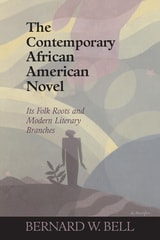
The Contemporary African American Novel
Its Folk Roots and Modern Literary BranchesBernard W. Bell
University of Massachusetts Press, 2004

The TESTED WOMAN PLOT
Women’s Choices, Men’s Judgments, and the Shaping of StoriesLois E. Bueler
The Ohio State University Press, 2001
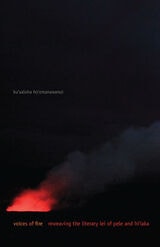
Voices of Fire
Reweaving the Literary Lei of Pele and Hi'iakaku'ualoha ho'omanawanui
University of Minnesota Press, 2014
Stories of the volcano goddess Pele and her youngest sister Hi‘iaka, patron of hula, are most familiar as a form of literary colonialism—first translated by missionary descendants and others, then co-opted by Hollywood and the tourist industry. But far from quaint tales for amusement, the Pele and Hi‘iaka literature published between the 1860s and 1930 carried coded political meaning for the Hawaiian people at a time of great upheaval. Voices of Fire recovers the lost and often-suppressed significance of this literature, restoring it to its primary place in Hawaiian culture.
Ku‘ualoha ho‘omanawanui takes up mo‘olelo (histories, stories, narratives), mele (poetry, songs), oli (chants), and hula (dances) as they were conveyed by dozens of authors over a tumultuous sixty-eight-year period characterized by population collapse, land alienation, economic exploitation, and military occupation. Her examination shows how the Pele and Hi‘iaka legends acted as a framework for a Native sense of community. Freeing the mo‘olelo and mele from colonial stereotypes and misappropriations, Voices of Fire establishes a literary mo‘okū‘auhau, or genealogy, that provides a view of the ancestral literature in its indigenous contexts.
The first book-length analysis of Pele and Hi‘iaka literature written by a Native Hawaiian scholar, Voices of Fire compellingly lays the groundwork for a larger conversation of Native American literary nationalism.
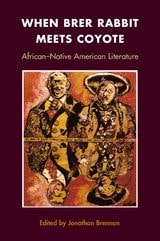
When Brer Rabbit Meets Coyote
AFRICAN-NATIVE AMERICAN LITERATUREEdited by Jonathan Brennan
University of Illinois Press, 2003
Jonathan Brennan, in a sweeping historical and analytical introduction to this collection of essays, surveys several centuries of literature in the context of the historical and cultural exchange and development of distinct African-Native American traditions. Positing a new African-Native American literary theory, he illuminates the roles subjectivity, situational identities, and strategic discourse play in defining African-Native American literatures.
Brennan provides a thorough background to the literary tradition and a valuable overview to topics discussed in the essays. He examines African-Native American political and historical texts, travel narratives, and the Mardi Gras Indian tradition, suggesting that this evolving oral tradition parallels the development of numerous Black Indian literary traditions in the United States and Latin America.
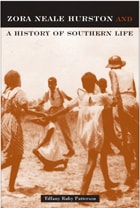
Zora Neale Hurston
And A History Of Southern LifeTiffany Ruby Patterson
Temple University Press, 2005