Results by title

10 books match the query 'Literature and race'
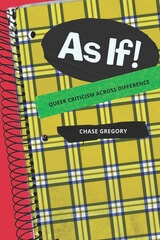
cover of As If!: Queer Criticism Across Difference

As If!

Queer Criticism Across Difference

Chase Gregory

Duke University Press, 2025
In As If!, Chase Gregory explores the stylistically strategic, often campy, and productively fraught cross-identifications of early queer criticism. Gregory calls this form of aids-era criticism as if!—a mode of writing in which authors struggle to read, write, and identify with and across categories of race, sexuality, and gender. Analyzing the work of Robert Reid-Pharr, Deborah E. McDowell, Barbara Johnson, and Eve Kosofsky Sedgwick, Gregory shows how their writing productively challenges fixed ideas of identity and knowledge production. Using these four writers as case studies of a larger trend within early queer criticism, Gregory demonstrates that even when critical attempts at relation are met by impasse, as if! criticism breaks down social relation, especially within those fields influenced by queer theory, deconstructionist feminist theory, and Black feminist theory. By advocating a return to as if! criticism as a politically useful blueprint for contemporary cultural inquiry, Gregory draws attention to the obstacles to forging identification across difference and insists on the impossible project of solidarity across such difference.
[more]
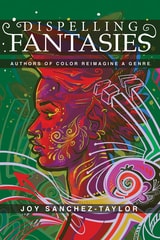
cover of Dispelling Fantasies: Authors of Color Reimagine a Genre

Dispelling Fantasies

Authors of Color Reimagine a Genre

Joy Sanchez-Taylor

The Ohio State University Press, 2025

In Dispelling Fantasies, Joy Sanchez-Taylor examines how authors of color, such as R. F. Kuang, N. K. Jemisin, Nnedi Okorafor, Tomi Adeyemi, Tasha Suri, Aiden Thomas, Nghi Vo, and Marlon James, among others, offer critical counterpoints to the history of white-dominated, Eurocentric fantasy. The traditional fantasy that these authors are writing against reinforces Christian virtues and colonial, white supremacist structures; Sanchez-Taylor argues that its racial tropes are tied to a history of colonization and Christian missionary practices, with popular fantasy narratives often depicting Indigenous groups as primitive, deviant peoples in need of salvation. Such representations are based on a Western binary of rational versus magical and are influenced by tenets of Christianity, ultimately contributing to depictions of “the dark fantastic” or fantasy worlds where dark and othered characters are implicitly portrayed as evil and irredeemable. Organized around four Christian ideals that appear frequently in Western fantasy texts—virtue, envy, patriarchy, and salvation—Dispelling Fantasies demonstrates how non-Eurocentric fantasy worlds offer alternative versions of morality, race, gender, and sexuality and make space for authors to move away from hierarchical, binary systems of good and evil.
[more]
cover of Genre, Race, and the Production of Subjectivity in German Romanticism

Genre, Race, and the Production of Subjectivity in German Romanticism

Stephanie Galasso

Northwestern University Press, 2024

Exposes German Romanticism’s entanglements of aesthetic philosophy with racialized models of humanity

Late Enlightenment philosophers and writers like Herder, Goethe, and Schiller broke with conventions of form and genre to prioritize an idealized, and racially coded, universality. Newly translated literatures from colonial contexts served as the basis for their evaluations of how to contribute to a distinctly “German” national literary tradition, one that valorized modernity and freedom and thus fortified crucial determinants of modern concepts of whiteness. Through close readings of both canonical and less-studied Romantic texts, Stephanie Galasso examines the intimately entwined histories of racialized subjectivity and aesthetic theory and shows how literary genre is both symptomatic and generative of the cultural violence that underpinned the colonial project.

Poetic expression and its generic conventions continue to exert pressure on the framing and reception of the stories that can be told about interpersonal and structural experiences of oppression. Genre, Race, and the Production of Subjectivity in German Romanticism explores how white subjectivity is guarded by symbolic and material forms of violence. 

 
[more]
cover of Left Turns in Brown Study

Left Turns in Brown Study

Sandra Ruiz

Duke University Press, 2024
In Left Turns in Brown Study Sandra Ruiz offers a poetic-theoretical inquiry into the interlacing forms of study and mourning. Drawing on Black and Brown activism and theory, Ruiz interweaves poetry, memoir, lyrical essay, and vignettes to examine study as an emancipatory practice. Proposing “brown study” as key for understanding how Brownness harbors loss and suffering along with the possibility for more abundant ways of living, Ruiz invites readers to turn left into the sounds, phrases, and principles of anticolonial ways of reading, writing, citing, and listening. In doing so, Ruiz engages with a panoply of hauntings, ghosts, and spectral presences, from deceased teachers, illiterate ancestors, and those lost to unnatural disasters to all those victims of institutional and colonial violence. Study is shared movement and Brownness lives in citation. Conceptual, poetic, and unconventional, this book is crucial for all those who theorize minoritarian literary aesthetics and think through utopia, queer possibility, and the entwinement of forms.
[more]
cover of Playing in the Shadows: Fictions of Race and Blackness in Postwar Japanese Literature

Playing in the Shadows

Fictions of Race and Blackness in Postwar Japanese Literature

William Bridges

University of Michigan Press, 2020
Playing in the Shadows considers the literature engendered by postwar Japanese authors’ robust cultural exchanges with African Americans and African American literature. The Allied Occupation brought an influx of African American soldiers and culture to Japan, which catalyzed the writing of black characters into postwar Japanese literature. This same influx fostered the creation of organizations such as the Kokujin kenkyū no kai (The Japanese Association for Negro Studies) and literary endeavors such as the Kokujin bungaku zenshū (The Complete Anthology of Black Literature). This rich milieu sparked Japanese authors’—Nakagami Kenji and Ōe Kenzaburō are two notable examples—interest in reading, interpreting, critiquing, and, ultimately, incorporating the tropes and techniques of African American literature and jazz performance into their own literary works. Such incorporation leads to literary works that are “black” not by virtue of their representations of black characters, but due to their investment in the possibility of technically and intertextually black Japanese literature. Will Bridges argues that these “fictions of race” provide visions of the way that postwar Japanese authors reimagine the ascription of race to bodies—be they bodies of literature, the body politic, or the human body itself.
[more]
cover of Race and Affect in Early Modern English Literature

Race and Affect in Early Modern English Literature

Carole Mejia LaPerle

Arizona Center for Medieval and Renaissance Studies, 2021

This collection brings together critical race studies and affect theory to examine the emotional dimensions of race in early modern literature. 

Race and Affect in Early Modern English Literature puts the fields of critical race studies and affect theory into dialogue. Doing so opens a new set of questions: What are the emotional experiences of racial formation and racist ideologies? How do feelings—through the physical senses, emotional passions, or sexual encounters—come to signify race? What is the affective register of anti-blackness that pervades canonical literature? How can these visceral forms of racism be resisted in discourse and in practice? By investigating how race feels, this book offers new ways of reading and interpreting literary traditions, religious differences, gendered experiences, class hierarchies, sexuality, and social identities. So far scholars have shaped the discussion of race in the early modern period by focusing on topics such as genealogy, language, economics, religion, skin color, and ethnicity. This book, however, offers something new: it considers racializing processes as visceral, affective experiences.

[more]
cover of Race and Romance: Coloring the Past

Race and Romance

Coloring the Past

Margo Hendricks

Arizona Center for Medieval and Renaissance Studies, 2021

This study brings race and the literary tradition of romance into dialogue.

Race and Romance: Coloring the Past explores the literary and cultural genealogy of colorism, white passing, and white presenting in the romance genre. The scope of the study ranges from Heliodorus’ Aithiopika to the short novels of Aphra Behn, to the modern romance novel Forbidden by Beverly Jenkins. This analysis engages with the troublesome racecraft of “passing” and the instability of racial identity and its formation from the premodern to the present. The study also looks at the significance of white settler colonialism to early modern romance narratives. A bridge between studies of early modern romance and scholarship on twenty-first-century romance novels, this book is well-suited for those interested in the romance genre.
[more]
cover of Radical Poetics: Essays on Literature & Culture

Radical Poetics

Essays on Literature & Culture

Khadijah Queen

University of Michigan Press, 2025

Literature has the power to help build a shelter in language for a way of being that holds integrity and love as its root. In the tradition of Audre Lorde, Angela Davis, and many other Black writers and theorists, poet and professor Khadijah Queen observes questions of life and literature, human feeling and behavior, and explores language-based solutions to common cultural conflicts that are often rooted in harmful assumptions. 

Instead of operating from a base of unquestioned thought and systemic tradition, Radical Poetics presents more inclusive and accurate ways of contemplating literary work. Building on ideas and theoretical practices from Édouard Glissant, Toni Morrison, bell hooks, Saidiya Hartman, and Kimberlé Crenshaw, Queen reads for where love is present as well as for where it is absent—tracing systems of thought and aesthetic choices to track how characters are portrayed in terms of race, gender, class, and disability. She analyzes short stories, novels, nonfiction narratives, poetry, and a play from authors such as Herman Melville, Kate Chopin, Dionne Brand, Frances Ellen Watkins Harper, Ma-ka-tai-me-she-kia-kiak, Sor Juana Inés de la Cruz, Natasha Trethewey, and Muriel Rukeyser. Queen’s essays offer shifts in thinking about language—beyond calling out the ways language punishes vulnerability, entrenches harm, and suppresses true intercultural communication. Her intuitive approach aims to correct inaccuracies that have served as a foundation for the discriminatory thinking that undergirds American institutions and culture, particularly the continued glorification of violence. Radical Poetics makes a case for the imperative and practical value of understanding poetics beyond artistic and academic spaces and into everyday life.
[more]
cover of Relative Races: Genealogies of Interracial Kinship in Nineteenth-Century America

Relative Races

Genealogies of Interracial Kinship in Nineteenth-Century America

Brigitte Fielder

Duke University Press, 2020

In Relative Races, Brigitte Fielder presents an alternative theory of how race is ascribed. Contrary to notions of genealogies by which race is transmitted from parents to children, the examples Fielder discusses from nineteenth-century literature, history, and popular culture show how race can follow other directions: Desdemona becomes less than fully white when she is smudged with Othello's blackface, a white woman becomes Native American when she is adopted by a Seneca family, and a mixed-race baby casts doubt on the whiteness of his mother. Fielder shows that the genealogies of race are especially visible in the racialization of white women, whose whiteness often depends on their ability to reproduce white family and white supremacy. Using black feminist and queer theories, Fielder presents readings of personal narratives, novels, plays, stories, poems, and images to illustrate how interracial kinship follows non-heteronormative, non-biological, and non-patrilineal models of inheritance in nineteenth-century literary culture.
[more]
cover of The Latinx Files: Race, Migration, and Space Aliens

The Latinx Files

Race, Migration, and Space Aliens

Matthew David Goodwin

Rutgers University Press, 2021

In The Latinx Files, Matthew David Goodwin traces how Latinx science fiction writers are reclaiming the space alien from its xenophobic legacy in the science fiction genre. The book argues that the space alien is a vital Latinx figure preserving Latinx cultures by activating the myriad possible constructions of the space alien to represent race and migration in the popular imagination. The works discussed in this book, including those of H.G. Wells, Gloria Anzaldúa, Junot Diaz, André M. Carrington, and many others, often explicitly reject the derogatory correlation of the space alien and Latinxs, while at other times, they contain space aliens that function as a source of either enlightenment or horror for Latinx communities. Throughout this nuanced analysis, The Latinx Files demonstrates how the character of the space alien has been significant to Latinx communities and has great potential for future writers and artists. 
 
[more]