Results by title
42 books match the query 'Portrait'

"Write Nothing about Politics"
A Portrait of Hans Bernd von HaeftenBarbara von Haeften
Michigan State University Press, 2018
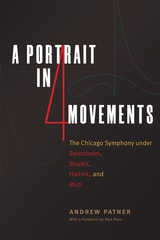
A Portrait in Four Movements
The Chicago Symphony under Barenboim, Boulez, Haitink, and MutiAndrew Patner
University of Chicago Press, 2019
The Chicago Symphony Orchestra has been led by a storied group of conductors. And from 1994 to 2015, through the best work of Daniel Barenboim, Pierre Boulez, Bernard Haitink, and Riccardo Muti, Andrew Patner was right there. As a classical music critic for the Chicago Sun-Times and WFMT radio, Patner was able to trace the arc of the CSO’s changing repertories, all while cultivating a deep rapport with its four principal conductors.
This book assembles Patner’s reviews of the concerts given by the CSO during this time, as well as transcripts of his remarkable radio interviews with these colossal figures. These pages hold tidbits for the curious, such as Patner’s “driving survey” that playfully ranks the Maestri he knew on a scale of “total comfort” to “fright level five,” and the observation that Muti appears to be a southpaw on the baseball field. Moving easily between registers, they also open revealing windows onto the sometimes difficult pasts that brought these conductors to music in the first place, including Boulez’s and Haitink’s heartbreaking experiences of Nazi occupation in their native countries as children. Throughout, these reviews and interviews are threaded together with insights about the power of music and the techniques behind it—from the conductors’ varied approaches to research, preparing scores, and interacting with other musicians, to how the sound and personality of the orchestra evolved over time, to the ways that we can all learn to listen better and hear more in the music we love. Featuring a foreword by fellow critic Alex Ross on the ethos and humor that informed Patner’s writing, as well as an introduction and extensive historical commentary by musicologist Douglas W. Shadle, this book offers a rich portrait of the musical life of Chicago through the eyes and ears of one of its most beloved critics.
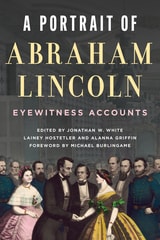
A Portrait of Abraham Lincoln
Eyewitness AccountsEdited by Jonathan W. White, Lainey Hostetler, and Alanna Griffin, with a foreword by Michael Burlingame
University of Illinois Press, 2027
Deeply researched and accessible, A Portrait of Abraham Lincoln is a valuable collection for anyone interested in a towering historical figure.

A Portrait of the Artist as a Political Dissident
The Life and Work of Aleksandar PetrovicVlastimir Sudar
Intellect Books, 2013
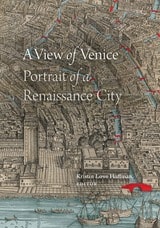
A View of Venice
Portrait of a Renaissance CityKristin Love Huffman, editor
Duke University Press, 2024
Contributors. Karen-edis Barzman, Andrea Bellieni, Patricia Fortini Brown, Valeria Cafà, Stanley Chojnacki, Tracy E. Cooper, Giada Damen, Julia A. DeLancey, Piero Falchetta, Ludovica Galeazzo, Maartje van Gelder, Jonathan Glixon, Richard Goy, Anna Christine Swartwood House, Kristin Love Huffman, Holly Hurlburt, Claire Judde de Larivière, Blake de Maria, Martina Massaro, Cosimo Monteleone, Monique O’Connell, Mary Pardo, Giorgio Tagliaferro, Saundra Weddle, Bronwen Wilson, Rangsook Yoon

Alexander William Doniphan
Portrait of a Missouri ModerateRoger D. Launius
University of Missouri Press, 1997
Alexander William Doniphan (1808-1887)--Missouri attorney, military figure, politician, and businessman--is one of the most significant figures in antebellum Missouri. From the 1830s to the 1880s, Doniphan was active in a variety of affairs in Missouri and held firm to several underlying principles, including loyalty, hard work, the sanctity of the republic, and commitment to Christian charity. However, the key to Doniphan's importance was his persistent moderation on the critical issues of his day.
Doniphan became a household name when he served as the commanding officer of the famed First Missouri Mounted Volunteers during the Mexican-American War. It was during this time that he won two battles, established an Anglo-American-based democracy in New Mexico, and paved the way for the annexation of the territory that became New Mexico and Arizona. He is also recognized by the Mormons for his assistance to their beleaguered church during Missouri's "Mormon War" and for his refusal to execute Joseph Smith when ordered to do so by his commanding officer.
Although Doniphan was a slaveholding unionist, he sought a middle ground to stave off war in the 1850s and early 1860s and served as a delegate to the Washington Peace Conference in 1861. When conflict escalated along the western border of Missouri in 1862, Doniphan moved to St. Louis, where he worked as a lawyer with the Missouri Claims Commission, seeking pensions for refugees.
Doniphan early adopted the Whig ideal of the "positive liberal state" and sought to use the power of government to remake society into something better. Once he saw the heavy-handed use of state power during Reconstruction, however, Doniphan reversed his views on the role of the government in society. For the rest of his life, he resisted government incursions into the lives of the people and sought to restore a healthy Union.
Alexander William Doniphan will be of interest to academic specialists and general readers alike, especially those interested in Mormon studies, Missouri history, military history, and Western history.
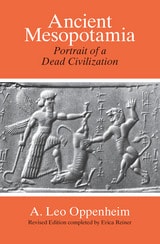
Ancient Mesopotamia
Portrait of a Dead CivilizationA. Leo Oppenheim
University of Chicago Press, 1977
Ancient Mesopotamia—the area now called Iraq—has always received less attention from scholars and the general public than ancient Egypt and other long-extinct and more spectacular civilizations. But numerous small clay tablets buried in the desert soil for thousands of years make it possible for us to know more about the people of ancient Mesopotamia than any other land in the early Near East.
A. Leo Oppenheim, who studied these tablets for more than thirty years, used his intimate knowledge of long-dead languages to put together a distinctively personal picture of the Mesopotamians of some three thousand years ago. At the time of his death in 1974, Oppenheim was working on revisions of the manuscript that, with the help of Erica Reiner, who used the author's revision outline, completed the work that became this book. In the decades since, it has become the definitive work on Ancient Mesopotamia.
Ben Thompson
Portrait of a GunfighterThomas C. Bicknell
University of North Texas Press, 2018
Camus
Portrait of a MoralistStephen Eric Bronner
University of Chicago Press, 2009
Decades after his death, Albert Camus (1913–1960) is still regarded as one of the most influential and fascinating intellectuals of the twentieth century. This biography by Stephen Eric Bronner explores the connections between his literary work, his philosophical writings, and his politics.
Camus illuminates his impoverished childhood, his existential concerns, his activities in the antifascist resistance, and the controversies in which he was engaged. Beautifully written and incisively argued, this study offers new insights—and above all—highlights the contemporary relevance of an extraordinary man.
“A model of a kind of intelligent writing that should be in greater supply. Bronner manages judiciously to combine an appreciation for the strengths of Camus and nonrancorous criticism of his weaknesses. . . . As a personal and opinionated book, it invites the reader into an engaging and informative dialogue.”—American Political Science Review
“This concise, lively, and remarkably evenhanded treatment of the life and work of Albert Camus weaves together biography, philosophical analysis, and political commentary.”—Science & Society

Camus
portrait of a moralistStephen Eric Bronner
University of Minnesota Press, 1999

Carol and John Steinbeck
Portrait of a MarriageSusan Shillinglaw
University of Nevada Press, 2024

Charles IV
Portrait of a Medieval RulerVáclav Žurek
Karolinum Press, 2023
Charles IV, King of Bohemia and Holy Roman Emperor, has been called “one of the most learned and diplomatically skillful sovereigns” of the fourteenth century. Having moved the seat of the Holy Roman Empire to Prague and founding the first university in Central Europe, Charles IV is a towering figure in Czech history and a crucial character in the story of medieval Europe.
Recent research, especially in art history, has tended to present Charles IV in a purely positive, unblemished light: viewing him and his imperial court as the engine behind a flourishing of culture in the region. This book views Charles IV through a more critical lens, examining the careful construction that went into the way he presented himself and the characteristic manifestations of Charles’ execution of royal power. The first part of the book offers a chronological description of Charles’ life within the broader context of the times and the House of Luxembourg. The second part provides a close look into Charles IV’s style of rule while focusing on phenomena that reveal his personal conception of power and how it was wielded.
Don't Whisper Too Much and Portrait of a Young Artiste from Bona Mbella
Ekotto, Frieda
Bucknell University Press, 2019
Published by Bucknell University Press. Distributed worldwide by Rutgers University Press.
Gaillard in Deaf America
A Portrait of the Deaf Community, 1917, Henri GaillardHenri Gaillard
Gallaudet University Press, 2002
In 1917, Henri Gaillard led a delegation of deaf French men to the United States for the centennial celebration of the American School for the Deaf (ASD). The oldest school for deaf students in America, ASD had been cofounded by renowned deaf French teacher Laurent Clerc, thus inspiring Gaillard’s invitation. Gaillard visited deaf people everywhere he went and recorded his impressions in a detailed journal. His essays present a sharply focused portrait of the many facets of Deaf America during a pivotal year in its history.
Gaillard crossed the Atlantic only a few weeks after the United States entered World War I. In his writings, he reports the efforts of American deaf leaders to secure employment for deaf workers to support the war effort. He also witnesses spirited speeches at the National Association of the Deaf convention decrying the replacement of sign language by oral education. Gaillard also depicts the many local institutions established by deaf Americans, such as Philadelphia’s All Souls Church, founded in 1888 by the country’s first ordained deaf pastor, and the many deaf clubs established by the first wave of deaf college graduates in their communities. His journal stands as a unique chronicle of the American Deaf community during a remarkable era of transition.

Insane Therapy
Portrait of a Psychotherapy CultMarybeth F. Ayella
Temple University Press, 1998
Ayella's personal experience fueled her interest in studying the cult phenomenon. This book focuses on her analysis of one community in southern California, The Center for Feeling Therapy, which opened in 1971 as an offshoot of Arthur Janov's Primal Scream approach. The group attracted mostly middle-class, college-educated clients interested in change through intense sessions led by licensed therapists. At the time of the Center's collapse in 1980, there were three hundred individuals living in the therapeutic community and another six hundred outpatients.
Through interviews with twenty-one former patients, the author develops a picture of the positive changes they sought, the pressures of group living, and the allegations of abuse against therapists. Many patients contended that they were beaten, made to strip before the group and to engage in forced sex, forced to have abortions and give up children, and coerced to donate money and to work in business affiliated with the Center.
The close of the Center brought yet more trauma to the patients as they struggled to readjust to mainstream life. Ayella recounts the stories of these individuals, again and again returning to the question of how personal identity is formed and the power of social influences. This book is a key to understanding how "normal" people wind up in cults.

Israelite Prophecy and the Deuteronomistic History
Portrait, Reality, and the Formation of a HistoryMignon R. Jacobs
SBL Press, 2013
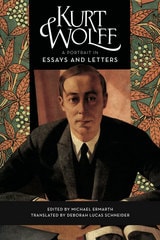
Kurt Wolff
A Portrait in Essays and LettersKurt Wolff
University of Chicago Press, 1991

Life on the Rocks
A Portrait of the American Mountain GoatBruce L. Smith
University Press of Colorado, 2014
Color photographs and accounts of Smith's personal experiences living in Montana's Selway-Bitterroot Wilderness Area accompany descriptions of the American mountain goat's natural history. Smith explores their treacherous habitat, which spans the perilous cliffs and crags of the Rocky, Cascade, and Coast mountain ranges. The physical and behavioral adaptations of these alpine athletes enable them to survive a host of dangers, including six-month-long winters, scarce food sources, thunderous avalanches, social strife, and predators like wolves, bears, lions, wolverines, and eagles. Smith also details the challenges these animals face as their territory is threatened by expanding motorized access, industrial activities, and a warming climate.
Life on the Rocks showcases the elegance and charm of this little-known creature, thriving in some of North America's harshest wilderness. Smith's volume will appeal to wildlife enthusiasts, wildland travelers, and conservationists interested in the future of the American mountain goat.

Lion and Lamb
A Portrait of British Moral DualityMihir Bose
Haus Publishing, 2018
In Britain’s Eternal Dilemma, Mihir Bose shows how those who voted to leave the E.U. want Britain to roar like a lion. In contrast, the Remainers saw Brexit as a self-inflicted wound, believing the only option is to live symbiotically with the rest of Europe for a common future. Writing from the unique perspective of an immigrant, Bose personifies this ongoing debate: He has experienced racism in his near half century in Britain, but he has also been provided unimaginable opportunities to become a writer, opportunities he would never have had in his native India. This timely book demonstrates that Britain is still wresting with its two-sided identity while also showing that Brexit is still the number one priority on the European political agenda.
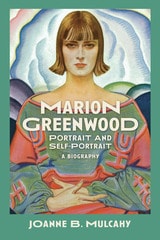
Marion Greenwood
Portrait and Self-Portrait—A BiographyJoanne B. Mulcahy
University of Alabama Press, 2025
This new biography reveals Marion Greenwood's central place in the pantheon of history’s remarkable women artists.
Marion Greenwood: Portrait and Self-Portrait—A Biography brings to life a woman who blazed through the twentieth-century art world. Born in Brooklyn in 1909, Greenwood thrived at storied institutions and arts centers such as the Art Students League, the studio of German modernist Winold Reiss, the Woodstock Colony, and Yaddo. In 1933, she catapulted to international fame as the first woman to paint a public mural in Mexico. Diego Rivera celebrated Greenwood as one of “the world’s greatest living women mural painters.” She traveled the globe to create award-winning portraits of people from diverse backgrounds, crossing racial, cultural, and class lines to reflect her vision for a more just world.
This biography, the first about Greenwood, is based on a decade of research and interviews. Author Joanne B. Mulcahy integrates the artist’s adventuresome personal life with her journey to artistic glory. Greenwood comes alive as a notable and spirited part of the heady art scenes of 1920s and 1930s Mexico, New York City, and Paris, and as one of two women artist-correspondents during World War II. After social realism and portraiture fell from favor, Greenwood doggedly stuck with what she called “the human thing” in art. Her freewheeling romantic life and independent spirit defied expectations for women, and she dismissed sexist critics who mixed acclaim for her work with commentary on her stunning beauty.
A feminist pioneer, Greenwood made a living as an artist in a time when few women could. In following Greenwood’s maverick path and artistic achievements, this book reveals her central place in the pantheon of history’s remarkable women artists.
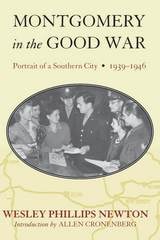
Montgomery in the Good War
Portrait of a Southern City, 1939-1946Wesley Phillips Newton
University of Alabama Press, 2000
One city. One war. A story of transformation at home and abroad.
Using newspaper accounts, interviews, letters, journals, and his own memory of the time, Wesley Newton reconstructs wartime-era Montgomery, Alabama--a sleepy southern capital that was transformed irreversibly during World War II.
The war affected every segment of Montgomery society: black and white, rich and poor, male and female, those who fought in Europe and the Pacific and those who stayed on the home front. Newton follows Montgomerians chronologically through the war from Pearl Harbor to Hiroshima as they experience patriotism, draft and enlistment, rationing, scarcity drives, and the deaths of loved ones. His use of small vignettes based on personal recollections adds drama and poignancy to the story.
Montgomery in the Good War is an important reminder that wars are waged at home as well as abroad and that their impact reverberates well beyond those who fight on the front lines. Those who came of age during the war will recognize themselves in this moving volume. It will also be enlightening to those who have lived in times of relative peace.

Old Capitol
Portrait of an Iowa LandmarkMargaret N. Keyes
University of Iowa Press, 1988
Built between 1839 and 1842, the domed structure of Iowa City's Old Capitol served as the third territorial capitol and the first state capitol of Iowa. In 1857, when the state government was moved to Des Moines, Old Capitol became the first building of the new University of Iowa. It remains today the centerpiece of this handsome campus. The story of its history and restoration, told in this elegantly illustrated book, is an intriguing account of historical architectural detection.
Using primary sources, including manuscripts, vouchers, account books, newspaper stories, correspondence, and documents from the National Archives and Iowa repositories, Margaret Keyes portrays the major events of the total history of Old Capitol since its site was determined.

Pella Dutch
Portrait of a Language in an Iowa Community, An Expanded EditionPhilip E. Webber
University of Iowa Press, 1988
Portrait of Us Burning
PoemsSebastián H. Páramo
Northwestern University Press, 2024
Sebastián H. Páramo renders a semi-autobiographical collection, utilizing self-portraiture and memory to uncover how his Texan, working-class, Mexican American identity shapes his relationship to his half brother and to his family’s burning desire to become American.
Portrait of Us Burning begins with the humble picture of an immigrant American family. This picture starts to disintegrate—and, ultimately, burns—with the need to understand an inciting event that haunts the family throughout the second half of the collection. As the poems gather force and the picture dissolves further, Páramo asks us again and again: What does it mean to burn while becoming a part of a whole?
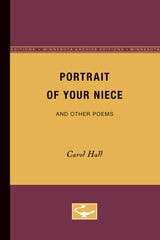
Portrait of Your Niece
And Other PoemsCarol Hall
University of Minnesota Press, 1959

Portrait of a Greek Imagination
An Ethnographic Biography of Andreas NenedakisMichael Herzfeld
University of Chicago Press, 1997
Herzfeld explores how personal vision intersects with national cultures by examining the Greek author's novels and recollections as historical accounts. Bringing together the methods of the novelist and the anthropologist in their common concern with both social and lived experience, Herzfeld shows how different perspectives shape the historical record. Nenedakis has endured persecution, exile, imprisonment, and torture under Greece's military dictatorship, and his novels—excerpted here in English for the first time—offer an individual version of historical events. As one of his characters ask, "For was not his life, and are not the lives of all of us, a novel?"
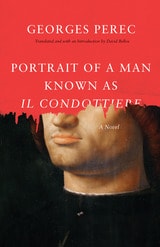
Portrait of a Man Known as Il Condottiere
Georges Perec
University of Chicago Press, 2015
Before embarking on these experiments, however, Perec tried his hand at a relatively straightforward novel, Portrait of a Man. His first book, it was rejected by publishers when he submitted it in 1960, after which he filed it away. Decades after Perec’s death, David Bellos discovered the manuscript, and through his translation we have a chance to enjoy it in English for the first time. What fans will find here is a thriller that combines themes that would remain prominent in Perec’s later work, such as art forgery, authenticity, and murder, as well as craftsman Gaspard Winckler, who whose namesakes play major roles in Life A User’s Manual and W or The Memory of Childhood.
Engaging and entertaining on its own merits, and gaining additional interest when set in the context of Perec’s career, Portrait of a Man is sure to charm the many fans of this postmodern master.
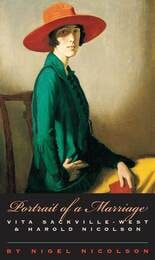
Portrait of a Marriage
Vita Sackville-West and Harold NicolsonNigel Nicolson
University of Chicago Press, 1998
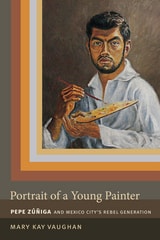
Portrait of a Young Painter
Pepe Zuniga and Mexico City's Rebel GenerationMary Kay Vaughan
Duke University Press, 2015

Rare Integrity
A Portrait of L. W. Payne, Jr.Hansen Alexander
University of North Texas Press, 1986
Robert M. Hutchins
Portrait of an EducatorMary Ann Dzuback
University of Chicago Press, 1991

Seeing Baya
Portrait of an Algerian Artist in ParisAlice Kaplan
University of Chicago Press, 2024
On a flower farm in colonial Algeria, a servant and field worker known as Baya escaped the drudgery of her labor by coloring the skirts in fashion magazines. Three years later, in November 1947, her paintings and fanciful clay beasts were featured in a solo show in Paris. She wasn’t yet sixteen years old. In this first biography of Baya, Alice Kaplan tells the story of a young woman seemingly trapped in subsistence who becomes a sensation in the French capital, then mysteriously fades from the history of modern art—only to reemerge after independence as an icon of Algerian artistic heritage.
The toast of Paris for the 1947 season, Baya inspired colonialist fantasies about her “primitive” genius as well as genuine appreciation. She was featured in newspapers, on the radio, and in a newsreel; her art was praised by Breton and Camus, Marchand and Braque. At the dawn of Algerian liberation, her appearance in Paris was used to stage the illusion of French-Algerian friendship, while horrific French massacres in Algeria were still fresh in memory.
Kaplan uncovers the central figures in Baya’s life and the role they played in her artistic career. Among the most poignant was Marguerite Caminat-McEwen-Benhoura, who took Baya from her sister’s farm to Algiers, where Baya worked as Marguerite’s maid and was given paint and brushes. A complex and endearing character, Marguerite—and her Pygmalion ambitions—was decisive in shaping Baya’s destiny. Kaplan also looks closely at Baya’s earliest paintings with an eye to their themes, their palette and design, and their enduring influence.
In vivid prose that brings Baya’s story into the present, Kaplan’s book, the fruit of scrupulous research in Algiers, Blida, Paris, and Provence, allows us to see in a whole new light the beloved artist who signed her paintings simply “Baya.”
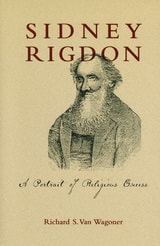
Sidney Rigdon
A Portrait of Religious ExcessRichard S. Van Wagoner
Signature Books, 2006
In the late 1820s a fiery young minister in western Ohio converted nearly 1,000 proselytes to the Reformed Baptist Movement. As these schismatics organized themselves into the new Disciples of Christ church, the Reverend Sidney Rigdon was already aligning himself with another, more radical movement, the Latter-day Saints, where he quickly became the LDS prophet’s principal advisor and spokesman. He served Joseph Smith loyally for the next fourteen years, even through a brief spat over the prophet’s romantic interest in his teenage daughter.
Next to Smith, Rigdon was the most influential early Mormon. He imported Reformed Baptist teachings into Latter-day Saint theology, wrote the canonized Lectures on Faith, championed communalism and isolationism, and delivered many of the most significant early sermons, including the famous Salt Sermon and the Ohio temple dedicatory address.
Following Smith’s death, Rigdon parted company with Brigham Young to lead his own group of some 500 secessionists Mormons in Pennsylvania. Rigdon’s following gradually dwindled, as the one-time orator took to wandering the streets, taunting indifferent passersby with God’s word. He was later recruited by another Mormon faction. Although he refused to meet with them, he agreed to be their prophet and send revelations by mail. Before long he had directed them to settle far-off Iowa and Manitoba, among other things. At his death, his followers numbered in the hundreds, and today they number about 10,000, mostly in Pennsylvania.
“Rigdon is a biographer’s dream,” writes Richard Van Wagoner. Intellectually gifted, manic-depressive, an eloquent orator and social innovator but a chronic indigent, Rigdon aspired to altruism but demanded advantage and deference. When he lost prominence, his early attainments were virtually written out of the historical record.
Correcting this void, Van Wagoner has woven the psychology of religious incontinence into the larger fabric of social history. In doing so, he reminds readers of the significance of this nearly-forgotten founding member of the LDS First Presidency. Nearly ten million members in over one hundred churches trace their heritage to Joseph Smith. Many are unaware of the importance of Rigdon’s contributions to their inherited theology.

Southern Paiute
A PortraitLogan Hebner
Utah State University Press, 2010
Now little recognized by their neighbors, Southern Paiutes once had homelands that included much of the vast Colorado Plateau, Great Basin, and Mojave Desert. From the Four Corners’ San Juan River to California’s lower Colorado, from Death Valley to Canyonlands, from Capitol Reef to the Grand Canyon, Paiutes lived in many small, widespread communities. They still do, but the communities are fewer, smaller, and mostly deprived of the lands and resources that sustained traditional lives.
To portray a people and the individuals who comprise it, William Logan Hebner and Michael L. Plyler relay Paiute voices and reveal Paiute faces, creating a space for them to tell their stories and stake claim to who they once were and now are.

The Mississippi Kite
Portrait of a Southern HawkBy Eric Bolen and Dan Flores
University of Texas Press, 1993
Floating on air currents over rural countryside and open city spaces, the Mississippi Kite presents a familiar sight to many people across the southern United States, although this graceful hawk is not well known by name. This engaging natural history, illustrated with superb color photographs, provides all a bird watcher needs to become acquainted with the kite, its life cycle, and its fascinating history with humans.
Under various folk names, including Blue Darter, Grasshopper Hawk, and Mosquito Hawk, the Mississippi Kite ranges throughout the southern United States from the coasts of the Carolinas to the plains of the Southwest. The authors describe all aspects of the kite's life cycle, from breeding and nesting, raising young, and hunting and feeding to the kite's annual winter migration to South America. They also trace its intriguing relationship with humans, from its discovery by Europeans in the nineteenth century to the present day.
For bird lovers and ornithologists alike, The Mississippi Kite will be an essential introduction to a bird well worth knowing. A special section on conservation and a selection of references for further reading complement the text.

The Poetry of Asher Reich
Portrait of a Hebrew PoetYair Mazor
University of Wisconsin Press, 2004
Asher Reich’s poetry has been characterized as vivid, vibrant, passionate, and expressionistic. Dominated by themes of stormy sensuality and frank sexuality, his dramatic imagery and metaphors interweave Mishnaic, Talmudic, and Biblical references in a colorful, complex poetic texture. The beautiful simplicity of Kovner’s drawings—depicting female figures and natural landscapes—resonates throughout the book. Tender, stark, and striking, the drawings illustrate life’s fragility and grace with a subtlety and dignity that complements Reich’s sensitive style.
Presenting contemporary Hebrew poetry, modern Israeli art, and informed literary commentary in an engaging format, this book promises to delight a broad audience of readers.
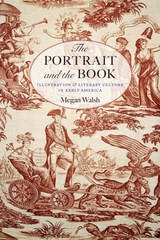
The Portrait and the Book
Illustration and Literary Culture in Early AmericaMegan Walsh
University of Iowa Press, 2017
Illustrations played a key role in American literary culture despite the fact there was little demand for books by American writers. Indeed, most of the illustrated books bought, sold, and shared by Americans were either imported British works or reprinted versions of those imported editions. As a result, in addition to embellishing books, illustrations provided readers with crucial information about the country’s status as a former colony.
Through an examination of readers’ portrait-collecting habits, writers’ employment of ekphrasis, printers’ efforts to secure American-made illustrations for periodicals, and engravers’ reproductions of British book illustrations, Walsh uncovers in late eighteenth-century America a dynamic but forgotten visual culture that was inextricably tied to the printing industry and to the early US literary imagination.
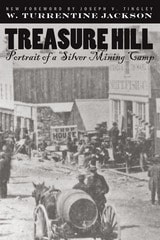
Treasure Hill
Portrait Of A Silver Mining CampW. Turrentine Jackson
University of Nevada Press, 2000
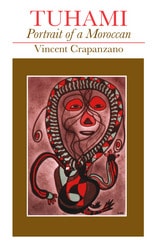
Tuhami
Portrait of a MoroccanVincent Crapanzano
University of Chicago Press, 1980
In a sensitive and bold experiment in interpretive ethnography, Crapanzano presents Tuhami's bizarre account of himself and his world. In so doing, Crapanzano draws on phenomenology, psychoanalysis, and symbolism to reflect upon the nature of reality and truth and to probe the limits of anthropology itself. Tuhami has become one of the most important and widely cited representatives of a new understanding of the whole discipline of anthropology.

Up North in Michigan
A Portrait of Place in Four SeasonsJerry Dennis
University of Michigan Press, 2021
And yet the essence of this region, known to many as simply “Up North,” has proved remarkably perennial. Millions of acres of state and national forests and other public lands remain intact. Small towns peppered across the rural countryside have changed little over the decades, pushing back the machinery of progress with the help of dedicated land conservancies, conservation organizations, and other advocacy groups.
Up North in Michigan, the new collection from celebrated nature writer Jerry Dennis, captures its author’s lifelong journey to better know this place he calls home by exploring it in every season, in every kind of weather, on foot, on bicycle, in canoes and cars. The essays in this book are more than an homage to a particular region, its people, and its natural wonders. They are a reflection on the Up North that can only be experienced through your feet and fingertips, through your ears, mouth, and nose—the Up North that makes its way into your bones as surely as sand makes its way into wood grain.
The paperback contains a new chapter by Jerry Dennis that has been written since the publication of the hardcover.

Wisconsin Land and Life
A Portrait of the StateRobert C. Ostergren
University of Wisconsin Press, 1997
These are images of Wisconsin's land and life, images that evoke a strong sense of place. This book, Wisconsin Land and Life, is an exploration of place, a series of original essays by Wisconsin geographers that offers an introduction to the state's natural environment, the historical processes of its human habitation, and the ways that nature and people interact to create distinct regional landscapes. To read it is to come away with a sweeping view of Wisconsin's geography and history: the glaciers that carved lakes and moraines; the soils and climate that fostered the prairies and great northern pine forests; the early Native Americans who began to shape the landscape and who established forest trails and river portages; the successive waves of Europeans who came to trade in furs, mine for lead and iron, cut the white pines, establish farms, work in the lumber and paper mills, and transform spent wheatfields into pasture for dairy cattle.
Readers will learn, too, about the platting and naming of Wisconsin's towns, the establishment of county and township governments, the growth of urban neighborhoods and parishes, the role of rivers, railroads, and religion in shaping the state's growth, and the controversial reforestation of the cutover lands that eventually transformed hardscrabble farms and swamps into a sportsman's paradise.
Abundantly illustrated with photos and maps, this book will richly reward anyone who wishes to learn more about the land and life of the place we know as Wisconsin.
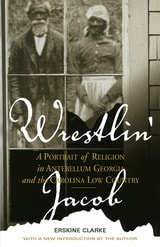
Wrestlin' Jacob
A Portrait of Religion in Antebellum Georgia and the Carolina Low CountryErskine Clarke
University of Alabama Press, 2000
Wrestling with God, scripture, and conscience in the nineteenth‑century South
First published in 1979, Wrestlin’ Jacob offers important insights into the intersection of black and white religious history in the South. Erskine Clarke provides two arenas—one urban and one rural—that show what happened when white ministers tried to bring black slaves into the fold of Christianity. Clarke illustrates how the good intentions—and vain illusions—of the white preachers, coupled with the degradation and cultural strength of the slaves, played a significant role in the development of black churches in the South.
From 1833 to 1847, Reverend Charles Colcock Jones served as an itinerant minister to slaves on the rice and cotton plantations in Liberty County, Georgia. The aim of Jones, and of the largely Puritan-descended slave owners, was to harvest not only good Christians but also obedient and hard-working slaves. At the same time, similar efforts were under way in cosmopolitan Charleston, South Carolina. Charleston permitted blacks to worship only under the supervision of whites, and partially as a result, whites and blacks worshiped together in ways that would be unheard of later in the segregated South.
Clarke examines not only the white ministers’ motivation in their missionary work but also the slaves’ reasons for becoming a part of the church. He addresses the important issue of the continuity of African traditions with the religious life of slaves and provides a significant introduction to the larger issues of slavery and religion in the South.