Results by title
2 books match the query 'Living Up'
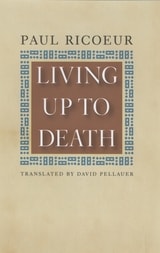
Living Up to Death
Paul Ricoeur
University of Chicago Press, 2009
When French philosopher Paul Ricoeur died in 2005, he bequeathed to the world a highly regarded, widely influential body of work which established him as one of the greatest thinkers of our time. He also left behind a number of unfinished projects that are gathered here and translated into English for the first time.
Living Up to Death consists of one major essay and nine fragments. Composed in 1996, the essay is the kernel of an unrealized book on the subject of mortality. Likely inspired by his wife’s approaching death, it examines not one’s own passing but one’s experience of others dying. Ricoeur notes that when thinking about death the imagination is paramount, since we cannot truly experience our own passing. But those we leave behind do, and Ricoeur posits that the idea of life after death originated in the awareness of our own end posthumously resonating with our survivors.
The fragments in this volume were written over the course of the last few months of Ricoeur’s life as his health failed, and they represent his very last work. They cover a range of topics, touching on biblical scholarship, the philosophy of language, and the idea of selfhood he first addressed in Oneself as Another. And while they contain numerous philosophical insights, these fragments are perhaps most significant for providing an invaluable look at Ricoeur’s mind at work.
As poignant as it is perceptive, Living Up to Death is a moving testimony to Ricoeur’s willingness to confront his own mortality with serious questions, a touching insouciance, and hope for the future.

Living Up to the Ads
Gender Fictions of the 1920sSimone Weil Davis
Duke University Press, 2000
Materials from advertising firms—including memos, manuals, meeting minutes, and newsletters—are considered alongside the fiction of Sinclair Lewis, Nella Larsen, Bruce Barton, F. Scott Fitzgerald, and Zelda Fitzgerald. Davis engages such books as Babbitt, Quicksand, and Save Me the Waltz in original and imaginative ways, asking each to participate in her discussion of commodity culture, gender, and identity. To illuminate the subjective, day-to-day experiences of 1920s consumerism in the United States, Davis juxtaposes print ads and industry manuals with works of fiction. Capturing the maverick voices of some of the decade’s most influential advertisers and writers, Davis reveals the lines that were drawn between truths and lies, seduction and selling, white and black, and men and women.
Davis’s methodology challenges disciplinary borders by employing historical, sociological, and literary practices to discuss the enduring links between commodity culture, gender, and identity construction. Living Up to the Ads will appeal to students and scholars of advertising, American studies, women’s studies, cultural studies, and early-twentieth-century American history.