Results by title
4 books match the query 'Livy'
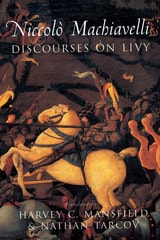
Discourses on Livy
Niccolò Machiavelli
University of Chicago Press, 1998
Discourses on Livy is the founding document of modern republicanism, and Harvey C. Mansfield and Nathan Tarcov have provided the definitive English translation of this classic work. Faithful to the original Italian text, properly attentive to Machiavelli's idiom and subtlety of thought, it is eminently readable. With a substantial introduction, extensive explanatory notes, a glossary of key words, and an annotated index, the Discourses reveals Machiavelli's radical vision of a new science of politics, a vision of "new modes and orders" that continue to shape the modern ethos.
"[Machiavelli] found in Livy the means to inspire scholars for five centuries. Within the Discourses, often hidden and sometimes unintended by their author, lie the seeds of modern political thought. . . . [Mansfield and Tarcov's] translation is careful and idiomatic."—Peter Stothard, The Times
"Translated with painstaking accuracy—but also great readability."—Weekly Standard
"A model of contemporary scholarship and a brave effort at Machiavelli translation that allows the great Florentine to speak in his own voice."—Choice
[more]
Discourses on Livy
Niccolò Machiavelli
University of Chicago Press, 1996
Discourses on Livy is the founding document of modern republicanism, and Harvey C. Mansfield and Nathan Tarcov have provided the definitive English translation of this classic work. Faithful to the original Italian text, properly attentive to Machiavelli's idiom and subtlety of thought, it is eminently readable. With a substantial introduction, extensive explanatory notes, a glossary of key words, and an annotated index, the Discourses reveals Machiavelli's radical vision of a new science of politics, a vision of "new modes and orders" that continue to shape the modern ethos.
"[Machiavelli] found in Livy the means to inspire scholars for five centuries. Within the Discourses, often hidden and sometimes unintended by their author, lie the seeds of modern political thought. . . . [Mansfield and Tarcov's] translation is careful and idiomatic."—Peter Stothard, The Times
"Translated with painstaking accuracy—but also great readability."—Weekly Standard
"A model of contemporary scholarship and a brave effort at Machiavelli translation that allows the great Florentine to speak in his own voice."—Choice
"[Machiavelli] found in Livy the means to inspire scholars for five centuries. Within the Discourses, often hidden and sometimes unintended by their author, lie the seeds of modern political thought. . . . [Mansfield and Tarcov's] translation is careful and idiomatic."—Peter Stothard, The Times
"Translated with painstaking accuracy—but also great readability."—Weekly Standard
"A model of contemporary scholarship and a brave effort at Machiavelli translation that allows the great Florentine to speak in his own voice."—Choice
[more]

Livy's Written Rome
Mary Jaeger
University of Michigan Press, 1997
The modern age is not the only one in which Romans and visitors to Rome have been fascinated with the city's striking juxtapositions of past and present. Rome's wealth of history also captured the imagination of the ancients. Livy's Written Rome, by Mary Jaeger, shows how one writer explored the relationship between events in Roman history, the landscape in which they occurred, and the monuments that commemorated them. While Augustus reconstructed the physical city to reflect the ideology of the Empire, the historian Livy created a written Rome and taught his readers to look beyond the city's dramatically altered landscape. In so doing, they gained insight into the lessons of the lost Republic. Drawing upon modern discourse on the connection between private mental spaces and public civic spaces, this first in-depth study of Livy's use of the urban landscape offers discerning views on his interpretation of ancient theories of historiography. Livy's Written Rome discusses the Roman idea of the monument as a place where memory and space intersect and includes fresh readings of several historical episodes, including the battle over the Sabine Women, the sedition of Marcus Manlius, and the trials of the Scipios. Scholars have long criticized Livy as a historian because his work is not in accord with modern historiographical standards. Yet even his critics agree that Livy is a masterful literary artist, and recent work on Livy has argued for the complexity and originality of his thought. Across the humanities, recent scholarship has focused on the role of memory in civic consciousness and identity. This book explores the ways in which Livy's texts question traditional assumptions about the preservation and use of the past. In doing so, it identifies a new and important facet of Livy's representation of urban Rome. Livy's Written Rome will be of interest to classicists and historians, students of ancient historiography and classical rhetoric, as well as general readers interested in memory, monuments, and historical narrative.
[more]
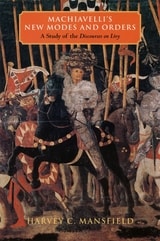
Machiavelli's New Modes and Orders
A Study of the Discourses on LivyHarvey C. Mansfield
University of Chicago Press, 2001
Machiavelli's New Modes and Orders is the only full-length interpretive study on Machiavelli's controversial and ambiguous work, Discourses on Livy. These discourses, considered by some to be Machiavelli's most important work, are thoroughly explained in a chapter-by-chapter commentary by Harvey C. Mansfield, one of the world's foremost interpreters of this remarkable philosopher.
Mansfield's aim is to discern Machiavelli's intention in writing the book: he argues that Machiavelli wanted to introduce new modes and orders in political philosophy in order to make himself the founder of modern politics. Mansfield maintains that Machiavelli deliberately concealed part of his intentions so that only the most perceptive reader could see beneath the surface of the text and understand the whole of his book. Previously out of print, Mansfield's penetrating study brings to light the hidden thoughts lurking in the details of the Discourses on Livy to inform and challenge its readers at every step along the way.
Mansfield's aim is to discern Machiavelli's intention in writing the book: he argues that Machiavelli wanted to introduce new modes and orders in political philosophy in order to make himself the founder of modern politics. Mansfield maintains that Machiavelli deliberately concealed part of his intentions so that only the most perceptive reader could see beneath the surface of the text and understand the whole of his book. Previously out of print, Mansfield's penetrating study brings to light the hidden thoughts lurking in the details of the Discourses on Livy to inform and challenge its readers at every step along the way.
[more]