Results by title
7 books match the query 'Long Island'
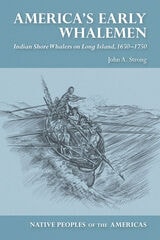
America's Early Whalemen
Indian Shore Whalers on Long Island, 1650–1750John A. Strong
University of Arizona Press, 2018
America’s Early Whalemen examines this early chapter of an iconic American historical experience. John A. Strong’s research draws on exhaustive sources, domestic and international, including little-known documents such as the whaling contracts of 340 Native American whalers, personal accounting books of whaling company owners, London customs records, estate inventories, and court records. Strong addresses labor relations, the role of alcohol and debt, the patterns of cultural accommodations by Native Americans, and the emergence of corporate capitalism in colonial America.
When Strong began teaching at Long Island University in 1964, he found little mention of the local Indigenous people in history books. The Shinnecocks and the neighboring tribes of Unkechaugs and Montauketts were treated as background figures for the celebratory narrative of the “heroic” English settlers. America’s Early Whalemen highlights the important contributions of Native peoples to colonial America.
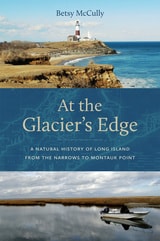
At the Glacier’s Edge
A Natural History of Long Island from the Narrows to Montauk PointBetsy McCully
Rutgers University Press, 2024
Combining science writing, environmental history, and first-hand accounts from a longtime resident, At the Glacier’s Edge offers a unique narrative natural history of Long Island. Betsy McCully tells the story of how the island was formed at the end of the last ice age, how its habitats evolved, and how humans in the last few hundred years have radically altered and degraded its landscape. Yet as she personally recounts the habitat losses and species declines she has witnessed over the past few decades, she describes the vital efforts that environmental activists are making to restore and reclaim this land—from replanting salt marshes, to preserving remaining grasslands and forests, to cleaning up the waters. At the Glacier’s Edge provides an in-depth look at the flora, fauna and geology that make Long Island so special.
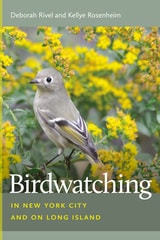
Birdwatching in New York City and on Long Island
Deborah Rivel and Kellye Rosenheim
University Press of New England, 2016
This easy-to-use guide gives seasonal information for both popular birding sites and those off the beaten path. Precise directions to the best viewing locations within the region’s diverse habitats enable birdwatchers to efficiently explore urban and wild birding hotspots. Over 500 species of birds can be seen in New York City’s five boroughs and on Long Island, one of the most densely populated and urbanized regions in North America, which also happens to be situated directly on the Atlantic Flyway. In this fragmented environment of scarce resources, birds concentrate on what’s available. This means that high numbers of birds are found in small spaces. In fact, Central Park alone attracts over 225 species of birds, which birders from around the world flock to see during spring and fall migration. Beyond Central Park, the five boroughs and Long Island have numerous wildlife refuges of extraordinary scenic beauty where resident and migratory birds inhabit forests, wetlands, grasslands, and beaches. These special places present an opportunity to see a wide array of songbirds, endangered nesting shorebirds, raptors, and an unprecedented number and variety of waterfowl. Including the latest information on the seasonal status and distribution of more than 400 species, with 39 maps and over 50 photographs, this full-color guide features information essential to planning a birding visit. It will become the go-to book for both the region’s longtime birders and those exploring the area for the first time.
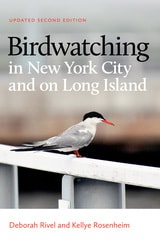
Birdwatching in New York City and on Long Island
Second EditionDeborah Rivel and Kellye Rosenheim
Brandeis University Press, 2025
Over five hundred species of birds can be seen in New York City’s five boroughs and on Long Island, one of the most densely populated and urbanized regions in North America, which also happens to be situated directly on the Atlantic Flyway. In this fragmented environment where resources are scarce, birds congregate in small spaces—Central Park alone attracts over 225 species of birds (not to mention birders from around the world who flock to the park during spring and fall migration). Beyond Central Park, the five boroughs and Long Island boast numerous wildlife refuges of extraordinary scenic beauty where resident and migratory birds inhabit forests, wetlands, grasslands, and beaches. These places present a unique opportunity to see a wide array of songbirds, endangered nesting shorebirds, raptors, and an unprecedented number and variety of waterfowl.
The fully updated edition of this easy-to-use guide provides year-round information for both popular birding sites as well as those off the beaten path. Precise directions to the best viewing locations within the region’s diverse habitats enable birdwatchers to explore urban and wild birding hot spots. Including the latest information on the seasonal status and distribution of more than four hundred species, and featuring thirty-nine maps and over fifty photographs, this full-color guide offers information essential to locals and visitors alike. This is the go-to book for both longtime birders and those exploring the area for the first time.
Crabgrass Catholicism
How Suburbanization Transformed Faith and Politics in Postwar AmericaStephen M. Koeth
University of Chicago Press, 2025
The 1960s in America were a time of revolt against the stifling conformism embodied in the sprawling, uniform suburbs of the 1950s. Typically, the reforms of the Catholic Church’s Second Vatican Council, which aimed to make the Church more modern and accessible, are seen as one result of that broader cultural liberalization. Yet in Crabgrass Catholicism, Stephen M. Koeth demonstrates that the liberalization of the Church was instead the product of the mass suburbanization that began some fifteen years earlier. Koeth argues that postwar suburbanization revolutionized the Catholic parish, the relationship between clergy and laity, conceptions of parochial education, and Catholic participation in US politics, and thereby was a significant factor in the religious disaffiliation that only accelerated in subsequent decades.
A novel exploration of the role of Catholics in postwar suburbanization, Crabgrass Catholicism will be of particular interest to urban historians, scholars of American Catholicism and religious studies, and Catholic clergy and laity.
In Levittown’s Shadow
Poverty in America’s Wealthiest Postwar SuburbTim Keogh
University of Chicago Press, 2023
There is a familiar narrative about American suburbs: after 1945, white residents left cities for leafy, affluent subdivisions and the prosperity they seemed to embody. In Levittown’s Shadow tells us there’s more to this story, offering an eye-opening account of diverse, poor residents living and working in those same neighborhoods. Tim Keogh shows how public policies produced both suburban plenty and deprivation—and why ignoring suburban poverty doomed efforts to reduce inequality.
Keogh focuses on the suburbs of Long Island, home to Levittown, often considered the archetypal suburb. Here military contracts subsidized well-paid employment welding airplanes or filing paperwork, while weak labor laws impoverished suburbanites who mowed lawns, built houses, scrubbed kitchen floors, and stocked supermarket shelves. Federal mortgage programs helped some families buy orderly single-family homes and enter the middle class but also underwrote landlord efforts to cram poor families into suburban attics, basements, and sheds. Keogh explores how policymakers ignored suburban inequality, addressing housing segregation between cities and suburbs rather than suburbanites’ demands for decent jobs, housing, and schools.
By turning our attention to the suburban poor, Keogh reveals poverty wasn’t just an urban problem but a suburban one, too. In Levittown’s Shadow deepens our understanding of suburbia’s history—and points us toward more effective ways to combat poverty today.
Living with Long Island's South Shore
Larry McCormick, William Neal, Orrin Pilkey Jr., and Orrin Pilkey, Sr.
Duke University Press, 1984
The south shore of Long Island, one of New York's greatest recreational assets, is receding at the rate of up to six feet per year. In many cases, efforts to halt this erosion actually have increased it. Buildings cone thought safely constructed back from high tidemarks today protrude far into the water.
Even more, the number of homes an facilities built too close to the sea's edge has dramatically increased, making the south shore probably less ready to withstand a major storm than at the time of the cataclysmic hurricane of 1938.
Thus, the question of what to do now to overcome and avoid these hazards takes on real urgency. Pointing to past mistakes, many Long Islanders insist that only by acting in an informed reasonable way can safe and environmentally sound development be possible for everyone.