Results by title
4 books match the query 'Lupton, Julia Reinhard'
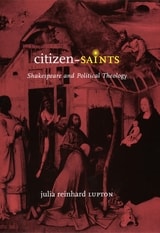
Citizen-Saints
Shakespeare and Political TheologyJulia Reinhard Lupton
University of Chicago Press, 2005
Turning to the potent idea of political theology to recover the strange mix of political and religious thinking during the Renaissance, this bracing study reveals in the works of Shakespeare and his sources the figure of the citizen-saint, who represents at once divine messenger and civil servant, both norm and exception. Embodied by such diverse personages as Antigone, Paul, Barabbas, Shylock, Othello, Caliban, Isabella, and Samson, the citizen-saint is a sacrificial figure: a model of moral and aesthetic extremity who inspires new regimes of citizenship with his or her death and martyrdom.
Among the many questions Julia Reinhard Lupton attempts to answer under the rubric of the citizen-saint are: how did states of emergency, acts of sovereign exception, and Messianic anticipations lead to new forms of religious and political law? What styles of universality were implied by the abject state of the pure creature, at sea in a creation abandoned by its creator? And how did circumcision operate as both a marker of ethnicity and a means of conversion and civic naturalization?
Written with clarity and grace, Citizen-Saints will be of enormous interest to students of English literature, religion, and early modern culture.
[more]
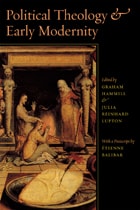
Political Theology and Early Modernity
Edited by Graham Hammill and Julia Reinhard Lupton
University of Chicago Press, 2012
Political theology is a distinctly modern problem, one that takes shape in some of the most important theoretical writings of the twentieth and twenty-first centuries. But its origins stem from the early modern period, in medieval iconographies of sacred kinship and the critique of traditional sovereignty mounted by Hobbes and Spinoza. In this book, Graham Hammill and Julia Reinhard Lupton assemble established and emerging scholars in early modern studies to examine the role played by sixteenth- and seventeenth-century literature and thought in modern conceptions of political theology.
Political Theology and Early Modernity explores texts by Shakespeare, Machiavelli, Milton, and others that have served as points of departure for such thinkers as Schmitt, Strauss, Benjamin, and Arendt. Written from a spectrum of positions ranging from renewed defenses of secularism to attempts to reconceive the religious character of collective life and literary experience, these essays probe moments of productive conflict, disavowal, and entanglement in politics and religion as they pass between early modern and modern scenes of thought. This stimulating collection is the first to answer not only how Renaissance and baroque literature help explain the persistence of political theology in modernity and postmodernity, but also how the reemergence of political theology as an intellectual and political problem deepens our understanding of the early modern period.
[more]
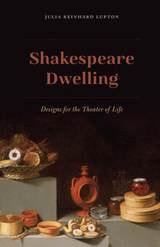
Shakespeare Dwelling
Designs for the Theater of LifeJulia Reinhard Lupton
University of Chicago Press, 2018
Great halls and hovels, dove-houses and sheepcotes, mountain cells and seaside shelters—these are some of the spaces in which Shakespearean characters gather to dwell, and to test their connections with one another and their worlds. Julia Reinhard Lupton enters Shakespeare’s dwelling places in search of insights into the most fundamental human problems.
Focusing on five works (Romeo and Juliet, Macbeth, Pericles, Cymbeline, and The Winter’s Tale), Lupton remakes the concept of dwelling by drawing on a variety of sources, including modern design theory, Renaissance treatises on husbandry and housekeeping, and the philosophies of Hannah Arendt and Martin Heidegger. The resulting synthesis not only offers a new entry point into the contemporary study of environments; it also shows how Shakespeare’s works help us continue to make sense of our primal creaturely need for shelter.
Focusing on five works (Romeo and Juliet, Macbeth, Pericles, Cymbeline, and The Winter’s Tale), Lupton remakes the concept of dwelling by drawing on a variety of sources, including modern design theory, Renaissance treatises on husbandry and housekeeping, and the philosophies of Hannah Arendt and Martin Heidegger. The resulting synthesis not only offers a new entry point into the contemporary study of environments; it also shows how Shakespeare’s works help us continue to make sense of our primal creaturely need for shelter.
[more]
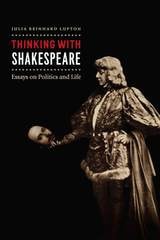
Thinking with Shakespeare
Essays on Politics and LifeJulia Reinhard Lupton
University of Chicago Press, 2011
What is a person? What company do people keep with animals, plants, and things? Such questions—bearing fundamentally on the shared meaning of politics and life—animate Shakespearean drama, yet their urgency has often been obscured. Julia Reinhard Lupton gently dislodges Shakespeare’s plays from their historical confines to pursue their universal implications. From Petruchio’s animals and Kate’s laundry to Hamlet’s friends and Caliban’s childhood, Lupton restages thinking in Shakespeare as an embodied act of consent, cure, and care. Thinking with Shakespeare encourages readers to ponder matters of shared concern with the playwright by their side. Taking her cue from Hannah Arendt, Lupton reads Shakespeare for fresh insights into everything from housekeeping and animal husbandry to biopower and political theology.
[more]