Results by title
11 books match the query 'Lyrics'

Anthem Quality
National Songs: A Theoretical SurveyChristopher Kelen
Intellect Books, 2014
Thought of most often in the context of the Olympics or other sporting events, national anthems are a significant way for a nation and its citizens to express their identity and unity. Despite their prevalence, anthems as an expression of national self-image and culture have rarely been examined—until now. Anthem Quality analyzes the lyrics of many anthems in order to explore their historical and contemporary context. Christopher Kelen’s research reveals how many of the world’s most famous and best-known national anthems, including “The Marseillaise,” “The Star-Spangled Banner,” and “God Save the Queen” deal with such topics as authority, religion, and political devotion.
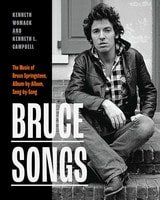
Bruce Songs
The Music of Bruce Springsteen, Album-by-Album, Song-by-SongKenneth Womack
Rutgers University Press, 2024
Bruce Songs is an authoritative guide that offers an in-depth exploration of Bruce Springsteen's musical legacy. Covering Springsteen's entire discography, from Greetings from Asbury Park, N.J. to Only the Strong Survive, this unique book combines historical context, literary analysis, and meticulous research.
Unlike any other resource, it provides detailed analyses of each album, essays on their historical significance, and a chronological examination of every studio song. Discover the stories behind the recordings and gain insight into Springsteen's creative process.
Rich with contemporary reviews, insider accounts, photographs, and special sections highlighting pivotal moments and key figures, Bruce Songs is an indispensable companion for fans and scholars. It offers an immersive journey through the music of the Boss, making it an essential read for anyone captivated by Springsteen's enduring musical legacy.
Clowns in the Burying Ground
The Grateful Dead, Literature, and the Limits of PhilosophyChristopher K. Coffman
Duke University Press, 2026
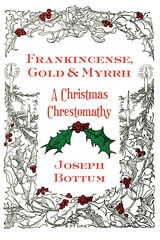
Frankincense, Gold, and Myrrh
A Christmas ChrestomathyJoseph Bottum
St. Augustine's Press, 2024
There’s the comic: “Tinsel. No one needs tinsel. Even the word is a tinselly kind of word.” There’s the sentimental: “Her hair was the same thin shade of gray as the weather-beaten pickets of the fence around her frozen garden.” There’s the reminiscent: “Christmas was books, and books Christmas, in those days now mostly washed down to the cold sea.” Along the way, there’s the theological, the learned, the mystical, and the musical.
“Tastefulness is just small-mindedness pretending to be art,” he writes in praise of mad and cluttered holidays. “Christmas will not be defined by our failures to apply its lessons and carols,” he explains about Yuletide poetry. To see these essays and short stories gathered in one place—in a beautiful illustrated edition from St. Augustine’s Press—is to see the whole of the vision that Joseph Bottum has been painting for decades: a picture of Christmas as a thin place in the wall between the natural and the numinous, where a burning grace slips into a cold winter world.
Lyrics and Borrowed Tunes of the American Temperance Movement
Edited & Compiled by Paul D. Sanders
University of Missouri Press, 2006
Cold water is the drink for me / Of all the drinks the best, sir; / Your grog, of whate’er name it be, / I dare not for to taste, sir.
Such a lyric, sung to the tune of “Yankee Doodle,” was typical ammunition in the temperance movement’s battle against alcohol. By the 1830s, Americans drank an average of 9.5 gallons of hard liquor each year. From the 1840s until the beginning of Prohibition, well over one hundred temperance songbooks were published in which inspirational lyrics were set to mostly borrowed tunes in the hope of persuading citizens to put down the bottle.
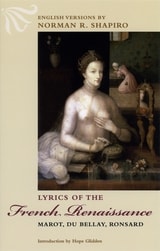
Lyrics of the French Renaissance
Marot, Du Bellay, RonsardEdited by Norman R. Shapiro
University of Chicago Press, 2006
Hope Glidden’s accessible introduction, along with the notes she and Shapiro provide on specific poems, will increase readers’ enjoyment and illuminate the historical and linguistic issues relating to this wealth of more than 150 lyric poems.
“A marvelous micro-anthology of sixteenth-century French letters. Representing the pinnacle of French Renaissance verse, the poems singled out here are sensitively interpreted in rhymed English versions. . . . There is a pleasant and inspiring craftsmanship in these interpretations.”—Virginia Quarterly Review

My Song is My Own
100 Women's SongsKathy Henderson
Pluto Press, 1979
With full sheet music for every song, and accompanying lyrics, this is perfect for singers as well as readers. Each section is introduced with a a brief thematic history, showing how the music has developed over time.
From ballads to industrial songs written for the mine and factory, from folk revivals to children's songs for the street and playground, this book reveals the hidden culture and history of women for us today.
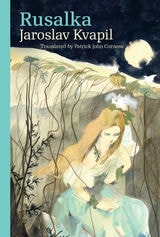
Rusalka
A Lyrical Fairy-tale in Three ActsJaroslav Kvapil
Karolinum Press, 2020
Transposed into the folkloric topos of a landlocked Bohemia, the mermaid is rendered here as a Slavic rusalka—a dangerous water nymph—who must choose between love and immortality. Thus, Rusalka, while certainly paying homage to the original story’s Scandinavian roots, is still a distinct work of modern Czech literature. Newly translated by Patrick Corness, Kvapil’s work will now find a fresh group of readers looking to get lost in one of Europe’s great lyrical fairy tale traditions.

The Erotic Muse
American Bawdy SongsEd Cray
University of Illinois Press, 1992
Ever wanted to know the "correct" words to "Roll Me Over?" Wondered where the melody of "Sweet Betsy from Pike" came from? Ed Cray ranges from "The Cod Fish Song" to "Hallelujah I'm a Bum" in a tireless quest to answer such questions and restore bawdy to an esteemed place in our folk music canon.
Extensively revised and including forty more songs than its predecessor, the second edition of The Erotic Muse is a unique collection of bawdy and even forbidden American folksongs. Cray presents the full texts of some 125 works with melodies for most and detailed annotations for all. In addition, he adds lively commentary that places the songs in historical, social, and, where appropriate, psychological context.

Thomas Hardy'S Tragic Poetry
The Lyrics And The DynastsKatherine K. Maynard
University of Iowa Press, 1991
Contrary to some scholars, tragic poetry did not die with the rise of melodrama in nineteenth-century theater or the glowing secularism spread by the proliferation of liberal-scientific philosophies. Rather, artists found alternative means to portray tragic situations.Thomas Hardy's Tragic Poetry convincingly argues that Hardy's lyric poetry and The Dynasts occupy a pivotal place in the development of modern tragic poetry and drama, crystallizing the tragic feeling that surfaces intermittently in Romantic and Victorian poems and plays.
Many scholars have noted the tragic forms and themes of Thomas Hardy's novels, but the tragic quality of his lyric poems has received less critical attention. Katherine Maynard remedies that situation by tracing the emergence of the Hardyean figure—tragically isolated against the backdrop of a stark landscape, neutral universe, or indifferent social milieu—through both a review of critical opinion about tragedy's place within modern literature and a survey of the frustrated attempts by major nineteenth-century poets to write tragic drama. Hardy's epic-drama The Dynasts is seen as a fulcrum work, bearing many of the flaws of its dramatic forebears but also illustrating his use of contemporary science and philosophy in the service of dramatic irony. Maynard examines a significant sample of lyrics to identify the contribution of Hardy's poetry to our understanding of tragic literature. She places the thematic and formal innovations of Hardy's tragic poetry squarely within the main lines of development from Wordsworth's Solitary to Beckett's lone figures waiting in a desert for a Godot who never arrives.
Ultimately, Thomas Hardy's Tragic Poetry calls for a rereading of Hardy's poetry as "tragic," arguing that he was able, paradoxically, to incorporate these literary and philosophical conventions of his time which some critics insist signaled the death of tragic literature. This study will prove fascinating for Hardyists, students of nineteenth-century literature, and all those interested in the ongoing development of poetry.
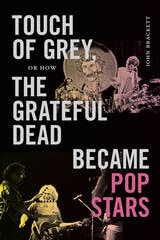
Touch of Grey, or How the Grateful Dead Became Pop Stars
John Brackett
Duke University Press, 2026
Touch of Grey, or How the Grateful Dead Became Pop Stars tells the story of how one song transformed the popular legacy of one of rock’s most iconic musical groups. John Brackett traces the history of the song “Touch of Grey,” beginning with songwriter Robert Hunter’s lyrical sketches and the Grateful Dead’s earliest live arrangements, culminating in the group’s popular renaissance following the release of “Touch of Grey” and the album In the Dark in the summer of 1987. Brackett details how particular recording technologies, notable musical characteristics, modes of attending and listening, and the mechanics of the contemporary music industry shaped this defining moment in the group’s career. Drawing on extensive archival research, Touch of Grey examines how the band and their label worked to produce a hit record, a dynamic music video, and an effective promotional campaign that would propel the Grateful Dead from a group with a devoted cult following to become a pop culture phenomenon.