Results by title
30 books match the query 'Under'
Stories From Under The Sky
John Madson
University of Iowa Press, 2006
Whatever the topic, Madson’s love of nature shines through, be it coon hunting or an explanation of the incredible bird machine. His obvious affection is tempered with the recognition that not everything “natural” is a pretty sight. All of which leaves readers with a better understanding of life under the sky.

UNDER THE FLAG OF THE NATION
DIARIES AND LETTERS OF OWEN JOHNSTON HOPKINS, A YANKEE VOLUNTEER IN THE CIVIL WAROwen Johnston Hopkins
The Ohio State University Press, 1998
Owen Hopkins was a young man brought to maturity by the agony of war, but in spite of the horror of battle and the tedium of life in camp, he maintained a lively sense of humor and a constant devotion to the ideals for which he fought. The Civil War in these pages is a savage, vindictive conflict fought with canister, "minnie balls," grapeshot, the Enfield rifle, and the bayonet. Only seventeen when he enlisted in 1861, Hopkins was a foot soldier and a witness to the action that took place on the field of battle.
A vital part of Hopkins's life in the army was his correspondence with Julia Allison, who lived in his hometown of Bellefontaine. They began writing each other in 1863, and their friendship deepened into love. Each was a fervent patriot, and their shared devotion to their country was a significant fact of their relationship. They were married in 1865.
An epilogue tells what happened to Hopkins after June of 1865: his career, his family, and his death in 1902. Originally published in1961, this work is now available for the first time in paperback.
Under The Mountain
Molly Flagg Knudtsen
University of Nevada Press, 1982
This collection of vignettes about life in Central Nevada is much more than a historical document. According to author Molly Knudtsen, “These are the stories neighbors and families tell, where fact grows just a little larger than life. This is the stuff of legend.” The book focuses on a time when splendorous houses decorated the windswept valleys of Central Nevada; where fearless, stouthearted men and women braved the elements to survive and seek their fortune; and when people who loved the land clung to it and gave it a character all its own. These tales capture the spirit and folklore of early-day Central Nevada and illustrate the effect on its present-day inhabitants. Molly Knudtsen shares the experience of riding horseback through some of the great archaeological finds of the valley. She divulges the secret of converting flour, yeast, and potato water into a perfect loaf of bread. And through colorful anecdotes, she passes along the legendary accounts of Colonel Dave Buel.
Under a Bad Sign
Criminal Self-Representation in African American Popular CultureJonathan Munby
University of Chicago Press, 2011
What accounts for the persistence of the figure of the black criminal in popular culture created by African Americans? Unearthing the overlooked history of art that has often seemed at odds with the politics of civil rights and racial advancement, Under a Bad Sign explores the rationale behind this tradition of criminal self-representation from the Harlem Renaissance to contemporary gangsta culture.
In this lively exploration, Jonathan Munby takes a uniquely broad view, laying bare the way the criminal appears within and moves among literary, musical, and visual arts. Munby traces the legacy of badness in Rudolph Fisher and Chester Himes’s detective fiction and in Claude McKay, Julian Mayfield, and Donald Goines’s urban experience writing. Ranging from Peetie Wheatstraw’s gangster blues to gangsta rap, he also examines criminals in popular songs. Turning to the screen, the underworld films of Oscar Micheaux and Ralph Cooper, the 1970s blaxploitation cycle, and the 1990s hood movie come under his microscope as well. Ultimately, Munby concludes that this tradition has been a misunderstood aspect of African American civic life and that, rather than undermining black culture, it forms a rich and enduring response to being outcast in America.
Under a Bad Sun
Police, Politics, and Corruption in AustraliaPaul Bleakley
Michigan State University Press, 2021
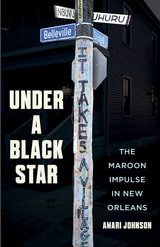
Under a Black Star
The Maroon Impulse in New OrleansAmari Johnson
University of Minnesota Press, 2025
Uncovering the spirit of freedom and self-determination in New Orleans
In Under a Black Star, Amari Johnson explores what he defines as the “maroon impulse” among the BlackStar Community in the Algiers neighborhood of New Orleans. This community sought autonomy for Black people facing systemic marginalization through denied employment, insufficient education, and a housing crisis following Hurricane Katrina, establishing initiatives such as Kamali Academy, a homeschool collective, and BlackStar Books and Caffé, a bookstore and gathering place. Instead of appealing to the city, they built the community they desired by employing legacies of marronage: disengagement, flight, and reengagement.
An active participant in the physical and ideological development of these autonomous spaces, Johnson provides nuanced insights into the community’s work toward liberation and self-determination. Demonstrating that marronage is a cultural tradition throughout the African Diaspora, he focuses on the transtemporal maroon process to show how it is central to the pursuit of autonomy, community, and freedom.
From the swamps of southeastern Louisiana, across urban obstacles, and into BlackStar’s creative spaces, Johnson’s path leads him to ask: How did the New Orleans community mobilize the tradition of marronage to create autonomous spaces amid gentrification? What forms might the maroon impulse take in the twenty-first century? This dynamic ethnographic memoir ultimately illuminates marronage as a potent form of liberatory potential, offering strategies for similar communities across the country and around the world.

Under a Glass Bell
Anaïs Nin
Ohio University Press, 2013
Under a Pannonian Sky
Ten Women Poets from HungaryEdited by Ottilie Mulzet
Seagull Books, 2025
Under a Pannonian Sky is a landmark anthology that brings the voices of ten extraordinary Hungarian women poets to English readers. Edited by award-winning translator Ottilie Mulzet, this collection spans generations, offering a rare glimpse into the rich and complex world of Hungarian poetry. The anthology features renowned poets like Ágnes Nemes Nagy and Zsuzsa Rakovszky, whose works have been celebrated internationally, alongside voices such as Gizella Hervay and Magda Székely, who are introduced in-depth to English readers for the first time. Through original and lyrical language, these poets chronicle the traumas of World War II, the Hungarian Holocaust, and the societal upheavals of the 1989 regime change, exploring themes of identity and resilience. Their poems reflect deeply personal confrontations with their roles as citizens, daughters, mothers, and witnesses to turbulent and often disorienting historical epochs.
Under a Pannonian Sky is an essential collection for readers seeking to discover the richness of Hungarian poetry and its profound engagement with the personal and political landscapes of the twentieth century and beyond.
Under the Campus, the Land
Anishinaabe Futuring, Colonial Non-Memory, and the Origin of the University of MichiganAndrew Herscher
University of Michigan Press, 2025
Under the Campus, the Land narrates the University of Michigan’s place in both Anishinaabe and settler history, tracing the university’s participation in the colonization of Anishinaabe homelands, Anishinaabe efforts to claim their right to an education, and the university’s history of disavowing, marginalizing, and minimizing its responsibilities and obligations to Anishinaabe people. Continuing the public conversations of the same name on U-M’s campus in 2023, Under the Campus, the Land provides a new perspective on the relationship between universities and settler colonialism in the US. Members of the U-M community, scholars of Midwest history, and those interested in Indigenous studies will find this book compelling.

Under the Canopy
The Archaelogy of Tropical Rain ForestsMercader, Julio
Rutgers University Press, 2002
Did our ancestors live in tropical forests? Although we see the rainforest as a bountiful environment teeming with life forms, most anthropologists and archaeologists have long viewed these areas as too harsh for human occupation during the pre-agricultural stages of hominid development.
Under the Canopy turns conventional wisdom on its head by providing a well-documented, geographically diverse overview of Stone Age sites in the wet tropics. New research indicates that, as humanity and its precursors increased their geographical and ecological ranges, rainforests were settled at a much earlier period than had previously been thought.
Featuring the work of leading scholars from Australia, Brazil, Canada, Colombia, France, Malaysia, Panama, Spain, and the United States, Under the Canopy creates a new niche in paleolithic studies: the archaeology of tropical rainforests. This book provides the first synthesis of archaeological research in early foraging sites across the rainforest zone, and indicates that tropical forests could harbor important clues to human evolution, origins of modern behavior, cultural diversity, and human impact on tropical ecosystems.

Under the Counter
Britain's Trade in Hardcore Pornographic 8mm FilmsOliver Carter
Intellect Books, 2022
Prior to 2000, it was a criminal offense to sell hardcore pornography in Britain. Despite this, there was a thriving alternative economy producing and distributing such material “under the counter” of Soho’s bookshops and via mail-order. British entrepreneurs circumvented obscenity laws to satisfy the demand for uncensored adult films and profit from their enterprise, with corrupt members of the Metropolitan Police’s Obscene Publications Squad permitting them to trade.
By the late 1960s, Britain had developed an international reputation for producing “rollers,” short hardcore films distributed on 8mm, which were smuggled out of Britain for sale in Western Europe. Following an exposé by Britain’s tabloid press, a crackdown on police corruption, and several high-profile obscenity trials, the trade was all but decimated, with pornography smuggled in from Europe dominating the market.
Drawing on extensive archival research, including the use of legal records, police files, media reportage, and interviews with those who were involved in the business, Under the Counter tells the story of Britain’s trade in 8mm hardcore pornographic films and its regulation.

Under the Cover of Chaos
Trump and the Battle for the American RightLawrence Grossberg
Pluto Press, 2018
Lawrence Grossberg shows that the truth is bigger and more frightening. Locating Trumpism in the long struggle among traditional conservatism, the new right and the reactionary right, he suggests that the chaos is far more significant and strategic ... and dangerous. Taking the arguments of the reactionary right seriously, he projects a possible, nightmarish future: a cultural nationalism governed by a popular corporatocracy.
He lays bare how contemporary political struggles are being shaped by a changing national landscape of moods and feelings, marked by a growing absolutism of judgement and belief, and new forms of anxiety, alienation and narcissism.s—and lays out a possible nightmare future: a vision of a political system controlled by corporate interests, built on a deliberate dismantling of modern politics.
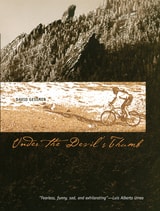
Under the Devil's Thumb
David Gessner
University of Arizona Press, 1999
In the West Gessner began to rewrite his life. Under the Devil's Thumb is a story of rugged determination and sweat, as well as humor, adventure and hope. In and around his new hometown of Boulder, Colorado, Gessner hiked hard and ran alongside flooded creeks. He found that the West was a place of stories—stories that grow out of the ground, flow out of the dirt, work their way through one's limbs, and drive people to push their physical limits. Hiking up scree slopes toward the Devil's Thumb, a massive outcrop of orange rock that attracts climbers, hikers, and contemplaters, Gessner reflects on the illness he has so recently survived. He pushes his physical limits, hoping to outrun death, to outrun dread. He finds momentary transcendence in the joys and self-inflicted pain of mountain biking. "Nothing but the hardest ride has the power to flush out worry, mind clutter, and dread." In tranquil moments he seeks a chance to recover an animal self that is strong and powerful enough to conquer mountains, but also still and quiet enough to see things human beings ignore.
In the mountain West, Gessner finds what Wallace Stegner called "the geography of hope." He finds within himself an interior landscape that is healthy and strong. Combining memoir, nature writing, and travel writing, Under the Devil's Thumb is one man's journey deep into a place of healing.
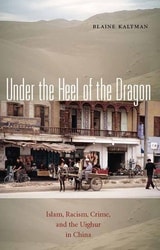
Under the Heel of the Dragon
Islam, Racism, Crime, and the Uighur in ChinaBlaine Kaltman
Ohio University Press, 2007
The Turkic Muslims known as the Uighur have long faced social and economic disadvantages in China because of their minority status. Under the Heel of the Dragon: Islam, Racism, Crime, and the Uighur in China offers a unique insight into current conflicts resulting from the rise of Islamic fundamentalism and the Chinese government’s oppression of religious minorities, issues that have heightened the degree of polarization between the Uighur and the dominant Chinese ethnic group, the Han.
Author Blaine Kaltman’s study is based on in-depth interviews that he conducted in Chinese without the aid of an interpreter or the knowledge of the Chinese government. These riveting conversations expose the thoughts of a wide socioeconomic spectrum of Han and Uighur, revealing their mutual prejudices. The Uighur believe that the Han discriminate against them in almost every aspect of their lives, and this perception of racism motivates Uighur prejudice against the Han.
Kaltman reports that criminal activity by Uighur is directed against their perceived oppressors, the Han Chinese. Uighur also resist Han authority by flouting the laws—such as tax and licensing regulations or prohibitions on the use or sale of hashish—that they consider to be imposed on them by an alien regime. Under the Heel of the Dragon offers a unique insight into a misunderstood world and a detailed explanation of the cultural perceptions that drive these misconceptions.
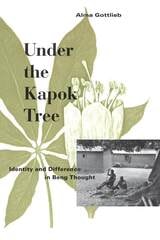
Under the Kapok Tree
Identity and Difference in Beng ThoughtAlma Gottlieb
University of Chicago Press, 1996
explores ideology and social practices among the Beng people of Côte
d'Ivoire. Employing symbolic and postmodern perspectives, she highlights
the dynamically paired notions of identity and difference, symbolized by
the kapok tree planted at the center of every Beng village.
"This book merits a number of readings. . . . An experiment in
ethnography that future projects might well emulate." —Clarke K. Speed,
American Anthropologist
"[An] evocative, rich ethnography. . . . Gottlieb does anthropology a
real service." —Misty L. Bastian, American Ethnologist
"Richly detailed. . . . This book offers a nuanced descriptive analysis
which commands authority." —Elizabeth Tonkin, Man
"Exemplary. . . . Gottlieb's observations on identity and difference are
not confined to rituals or other special occasions; rather she shows
that these principles emerge with equal force during daily social life."
—Monni Adams, Journal of African Religion
"[An] excellent study." —John McCall, Journal of Folklore
Research
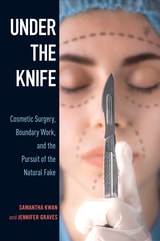
Under the Knife
Cosmetic Surgery, Boundary Work, and the Pursuit of the Natural FakeSamantha Kwan and Jennifer Graves
Temple University Press, 2020
Samantha Kwan and Jennifer Graves reveal how women negotiate their “unnatural”—but hopefully (in their view) natural-looking—surgically-altered bodies. Based on in-depth interviews with forty-six women who underwent cosmetic surgery to enhance their appearance, the authors investigate motivations for surgery as well as women’s thoughts about looking natural after the procedures. Under the Knife dissects the psychological and physical strategies these women use to manage the expectations, challenges, and disappointments of cosmetic surgery while also addressing issues of agency and empowerment. It shows how different cultural intersections can produce varied goals and values around body improvement.
Under the Knife highlights the role of deep-seated yet contradictory gendered meanings about women’s bodies, passing, and boundary work. The authors also consider traditional notions of femininity and normalcy that trouble women’s struggle to preserve an authentic moral self.

Under the Mask
A Guide to Feeling Secure and Comfortable During Anesthesia and SurgeryCottrell, James M.D.
Rutgers University Press, 2001
Every year, about forty million Americans require surgery. Few truly understand what happens to them during the procedure-especially what the anesthesiologist does to ensure their survival and well being. An anesthesiologist disarms your entire nervous system with the most effective drugs for your body chemistry; keeps you alive while you're subjected to manipulations that would otherwise kill you; and ensures your safe return to consciousness. Yet despite their crucial role, anesthesiologists are often the unseen doctors. Under the Mask, written by a compassionate practitioner, demystifies the surgical process with detailed information that will make you a better-informed consumer.
Part One describes the development and current scope of anesthesiology, the medications and techniques used, and what the anesthesiologist does both in and outside the operating room. It explains your-the patient's- rights and advises you how to use the preoperative consultation with the anesthesiologist to your best advantage, specifying what information you need provide and what questions you should ask.
Part Two details the most common surgical and diagnostic procedures requiring anesthesia or conscious sedation. Using clear language, it explains each procedure, the possible risks, and the choices to make if there is more than one option. It also covers the anesthesiologist's crucial role in controlling pain caused by chronic conditions. The last chapter describes the newest anesthetic and pain control techniques available.
The author also helps you understand anesthesiology within the managed care system and explains what you can expect and what to do if you aren't getting what you need. This book enables you to make informed decisions regarding surgical anesthesia and subsequent pain control within the managed care system to protect your well-being and hasten your recovery.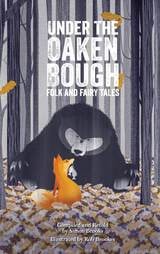
Under the Oaken Bough
Folk and Fairy TalesSimon Brooks
Parkhurst Brothers, Inc., 2017
Uncommon folktales and a few old favorites revived and retold for young people and tradition keepers. Folk and fairy tales celebrate different cultures and ways to see the world.
A collection of the author’s favorite folktales from his professional storytelling repertoire, retold in contemporary jargon for young reader, UNDER THE OAKEN BOUGH is an anthology which breathes new life into the folk and fairy tales of old. Professional storyteller, Simon Brooks, has written the stories he loves to tell in the style he uses on stage, whether at a library, school, college, private event or festival. Each story concludes with brief notes about the tale. This wonderful little book is a must have, not just for young people entering the realm of folk and fairy tales for themselves, but for parents who love to read to their children, teachers and librarians. The book includes a Q & A section with the author, a guide on how to tell stories, suggested reading, and a list of vocabulary words and their meanings. Half of the eighteen stories come from Europe, the remainder from the rest of the world. Some of these stories are old favorites, but inside you will find stories which can be hard to find, and seldom told. Join Simon Under the Oaken Bough and step into another realm, far, far away.
Under the Radar
Cancer and the Cold WarLeopold, Ellen
Rutgers University Press, 2008
In Under the Radar, Ellen Leopold shows how nearly every aspect of our understanding and discussion of cancer bears the imprint of its Cold War entanglement. The current biases toward individual rather than corporate responsibility for rising incidence rates, research that promotes treatment rather than prevention, and therapies that can be patented and marketed all reflect a largely hidden history shaped by the Cold War. Even the language we use to describe the disease, such as the guiding metaphor for treatment, "fight fire with fire," can be traced back to the middle of the twentieth century.
Writing in a lucid style, Leopold documents the military, governmental, industrial, and medical views of radiation and atomic energy to examine the postwar response to cancer through the prism of the Cold War. She explores the role of radiation in cancer therapies today, using case studies and mammogram screening, in particular, to highlight the surprising parallels. Taking into account a wide array of disciplines, this book challenges our understanding of cancer and how we approach its treatment.
- Examines the postwar response to cancer through the prism of the Cold War
- Goes beyond medical science to look at the influence of Cold War policies on the way we think about cancer today
- Links the experience of postwar cancer patients with the broader evolution of what have become cancer industries
- Traces the history of human-made radiation as a state-sponsored environmental toxin

Under the Radar
Tracking Western Radio Listeners in the Soviet UnionR. Eugene Parta
Central European University Press, 2022
Western democracy is currently under attack by a resurgent Russia, weaponizing new technologies and social media. How to respond? During the Cold War, the West fought off similar Soviet propaganda assaults with shortwave radio broadcasts. Founded in 1949, the US-funded Radio Free Europe/Radio Liberty broadcast uncensored information to the Soviet republics in their own languages. About one-third of Soviet urban adults listened to Western radio. The broadcasts played a key role in ending the Cold War and eroding the communist empire.
R. Eugene Parta was for many years the director of Soviet Area Audience Research at RFE/RL, charged among others with gathering listener feedback. In this book he relates a remarkable Cold War operation to assess the impact of Western radio broadcasts on Soviet listeners by using a novel survey research approach. Given the impossibility of interviewing Soviet citizens in their own country, it pioneered audacious interview methods in order to fly under the radar and talk to Soviets traveling abroad, ultimately creating a database of 51,000 interviews which offered unparalleled insights into the media habits and mindset of the Soviet public. By recounting how the “impossible” mission was carried out, Under the Radar also shows how the lessons of the past can help counter the threat from a once and current adversary.
Under the Rainbow
Nature and Supernature among the Panare IndiansBy Jean-Paul Dumont
University of Texas Press, 1976
This ethnographic study of the Panare Indians of Venezuela is the first extensive look at a tribe of this region of the Amazonia. It is an important book not only because it delves into the myth-filled Panare culture, but also because the author has used a modified version of the structural analysis of Claude Lévi-Strauss in examining the Panare.
Lévi-Strauss applied his method of structural analysis to the mythology of many societies in Amazonia, but never to any single society. Jean-Paul Dumont has filled that gap and has shown how the approach works in practice when applied to the intensive study of a single, small-scale culture. His book significantly expands the discussion of the strengths and weaknesses of the method.
The work deals specifically with the implicit mythology of the Panare and is concerned with the symbolic activities manifested in the daily behavior of this group. The analysis of the symbolism, explains Dumont, allows for the discovery of the conceptual system through which the Panare conceive of themselves.
The study is organized into two parts: a presentation of the data and an analysis. The presentation includes a geographical and historical account of the Panare and a general ethnological profile. The analysis is organized into the conceptual categories of inhabited space, time, astrosexuality, hearing, and taste. A concluding chapter summarizes the analysis.
Under the Rainbow will be of interest and of value not only to anthropologists but also to linguists, philosophers, psychologists, and others interested in the general intellectual movement represented by French structuralism. The fieldwork for Under the Rainbow was conducted in Venezuelan Guiana from September 1967 to July 1969.
Under the Rattlesnake
Cherokee Health and ResiliencyEdited by Lisa J. Lefler, with a foreword by Susan Leading Fox
University of Alabama Press, 2009
For the Cherokee, health is more than the absence of disease; it includes a fully confident sense of a smooth life, peaceful existence, unhurried pace, and easy flow of time. The natural state of the world is to be neutral, balanced, with a similarly gently flowing pattern. States of imbalance, tension, or agitation are indicative of physical, mental, emotional, or spiritual illness and whether caused intentionally through omission or commission, or by outside actions or influences, the result affects and endangers the collective Cherokee.

Under the Rug
The (Not So) Hidden History of Men and Their HairpiecesWendy A. Woloson
University of Chicago Press, 0
False hair can reveal honest truths—about the past, gender, identity, and the stories men tell about themselves.
History has seen its share of famous toupees. John Wayne’s. Frank Sinatra’s. Humphrey Bogart’s. Hairpieces can reveal a wearer’s inner motivations, reinforce gender norms, cause embarrassment, and even provoke disgust. Although false, they can create real meaning.
In Wendy A. Woloson’s hands, the toupee helps us see how men have understood themselves and fashioned their identities over time. Starting in the late eighteenth century, when men stopped wearing white powdered wigs, and moving to the 1920s, when toupees could be easily mass-produced, Woloson tells the story of the “Toupee Age.” She investigates why balding was considered such a problem in the first place, how hair became entangled with anxieties about aging, and the ways that looking old posed a threat to manhood. She details the bear’s grease pomades, brush-on dyes, elixirs, false whiskers, and hairpieces that were created to meet shifting notions of masculinity and style. Under the Rug also introduces readers to the people who styled and traded hair, made wigs, and hawked baldness cures. Drawing on business records, advertisements, graphic images, and a host of other primary sources, Woloson incisively explains how such trades seeded fears about thinning hair and sold men solutions. This vanity project continues today, as hair transplants, medications to stimulate hair growth, and Toupee TikTok encourage people to reinvent the way they’re seen—by others and themselves.

Under the Shadow of Napoleon
The US Army’s Doctrine, Education, and Theory of Victory from 1814 to 1941. Second EditionMichael A. Bonura
University of North Texas Press, 2026

Under the Sky of My Africa
Alexander Pushkin and BlacknessCatherine Nepomnyashchy
Northwestern University Press, 2006
Roughly in the year 1705, a young African boy, acquired from the seraglio of the Turkish sultan, was transported to Russia as a gift to Peter the Great. This child, later known as Abram Petrovich Gannibal, was to become Peter's godson and to live to a ripe old age, having attained the rank of general and the status of Russian nobility. More important, he was to become the great-grandfather of Russia's greatest national poet, Alexander Pushkin. It is the contention of the editors of this book, borne out by the essays in the collection, that Pushkin's African ancestry has played the role of a "wild card" of sorts as a formative element in Russian cultural mythology; and that the ways in which Gannibal's legacy has been included in or excluded from Pushkin's biography over the last two hundred years can serve as a shifting marker of Russia's self-definition.
The first single volume in English on this rich topic, Under the Sky of My Africa addresses the wide variety of interests implicated in the question of Pushkin's blackness-race studies, politics, American studies, music, mythopoetic criticism, mainstream Pushkin studies. In essays that are by turns biographical, iconographical, cultural, and sociological in focus, the authors-representing a broad range of disciplines and perspectives-take us from the complex attitudes toward race in Russia during Pushkin's era to the surge of racism in late Soviet and post-Soviet contemporary Russia. In sum, Under the Sky of My Africa provides a wealth of basic material on the subject as well as a series of provocative readings and interpretations that will influence future considerations of Pushkin and race in Russian culture.
Under the Spell of Orpheus
The Persistence of a Myth in Twentieth-Century ArtJudith E. Bernstock. Foreword by Peter Selz
Southern Illinois University Press, 1991
This comprehensive view of the Orpheus myth in modern art focuses on an extremely rich artistic symbol and cuts through all the clichés to explore truly significant problems of meaning. The author takes a new approach to the iconography of major modern artists by incorporating psychological and literary analysis, as well as biography.
The three parts of the book explore the ways in which artists have identified with different aspects of the often paradoxical Orpheus myth. The first deals with artists such as Paul Klee, Carl Milles, and Barbara Hepworth. In the second, Max Beckmann, Oskar Kokoschka, and Isamu Noguchi are discussed. Artists examined in the final part include Pablo Picasso, Jacques Lipchitz, Ethel Schwabacher, and Cy Twombly. The author documents her argument with more than sixty illustrations.
Under the Spell
A NovelBenjamin Hedin
Northwestern University Press, 2021
Unmoored and seeking connection, Sandra also meets Lee, a single mother with a drinking problem, and begins babysitting her daughter. But Sandra can’t stop herself from continuing the correspondence with Ryan, in the process uncovering more about her husband—and Ryan herself. A novel that forces us to question how much of a person, even those closest to us, remains obscure, Under the Spell reveals the astonishing, transformative power of grief. This compelling study in bereavement joins classics such as Don DeLillo’s The Body Artist and Joan Didion’s The Year of Magical Thinking.
Under the Sun
A Black Journalist's JourneyHarold Jackson
University of Alabama Press, 2025
A determined journalist’s account of rising to Pulitzer Prize–winning heights
Under the Sun: A Black Journalist’s Journey is Harold Jackson’s powerful memoir that chronicles his path from a Birmingham, Alabama, housing project in the 1950s and ’60s to becoming a Pulitzer Prize–winning journalist. Growing up in the segregated South, Jackson didn’t see a writing career as feasible, especially with the financial struggles his family faced after his father’s death. However, his freshman English teacher’s encouragement set him on a course that would change his life.
Jackson’s journey began in high school, where he became one of the first Black students in the University of Alabama’s summer journalism workshop. It was there that he discovered his unique voice as a writer, setting the stage for a remarkable forty-five-year career as a newspaper writer and editor. Despite the pervasive racial prejudices of the time, Jackson learned to navigate the complexities of being Black in a predominantly white profession. He reflects on the duality of living as a Black person in America, a concept W. E. B. Du Bois described as “double consciousness,” and the ways journalism allowed Jackson to connect with people from all walks of life.
Through his work at prominent news venues such as the Birmingham Post-Herald, United Press International, the Philadelphia Inquirer, the Birmingham News, the Baltimore Sun, and the Houston Chronicle, Jackson’s story is not just one of professional success but also of personal growth and understanding. Under the Sun is a testament to his resilience, his ability to see past racial barriers, and his unwavering commitment to giving a voice to those who need it most.
Under the Western Sky
Essays on the Fiction and Music of Willy VlautinNeil Campbell
University of Nevada Press, 2018
Brutally honest, raw, gritty, down to earth, compassionate and affecting, Willy Vlautin’s writing evokes a power in not only theme, but in methodology. Vlautin’s novels, The Motel Life, Northline, Lean on Pete and The Free (2006-2014) chart the dispossessed lives of young people struggling to survive in difficult economic times and in regions of the U.S. West and Pacific Northwest traditionally viewed as affluent and abundant. Yet as his work shows, are actually highly stratified and deprived.
Likewise, Vlauntin’s songs, penned as lead singer of the Americana band Richmond Fontaine chart a related territory of blue-collar landscapes of the American West and Northwest with a strong emphasis on narrative and affective soundscapes evocative of the similar worlds defined in his novels.
Featuring an interview with Vlautin himself, this edited collection aims to develop the first serious, critical consideration of the important novels and songs of Willy Vlautin by exploring relations between region, music, and writing through the lens of critical regionality and other interdisciplinary, cultural, and theoretical methodologies. In so doing, it will situate his work within its regional frame of the American New West, and particularly the city of Reno, Nevada and the Pacific Northwest, whilst showing how he addresses wider cultural and global issues such as economic change, immigration shifts, gender inequality, and the loss of traditional mythic identities.
The essays take different positions in relation to considerations of both novels and music, looking for links and relations across genres, always mindful of their specificity. Under the Western Sky shows how although apparently rooted in place, Vlautin’s work traces diverse lines of contemporary cultural enquiry, engaging in an effective and troubling examination of regional haunting.
Under
StoriesGlen Pourciau
Four Way Books, 2025