Results by title
8 books match the query 'Māori (New Zealand people)'
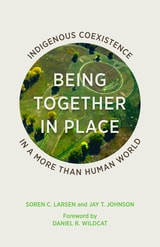
Being Together in Place
Indigenous Coexistence in a More Than Human WorldSoren C. Larsen
University of Minnesota Press, 2017
Being Together in Place explores the landscapes that convene Native and non-Native people into sustained and difficult negotiations over their radically different interests and concerns. Grounded in three sites—the Cheslatta-Carrier traditional territory in British Columbia; the Wakarusa Wetlands in northeastern Kansas; and the Waitangi Treaty Grounds in Aotearoa/New Zealand—this book highlights the challenging, tentative, and provisional work of coexistence around such contested spaces as wetlands, treaty grounds, fishing spots, recreation areas, cemeteries, heritage trails, and traditional village sites. At these sites, activists learn how to articulate and defend their intrinsic and life-supportive ways of being, particularly to those who are intent on damaging or destroying these places.
Using ethnographic research and a geographic perspective, Soren C. Larsen and Jay T. Johnson show how the communities in these regions challenge the power relations that structure the ongoing (post)colonial encounter in liberal democratic settler-states. Emerging from their conversations with activists was a distinctive sense that the places for which they cared had agency, a “call” that pulled them into dialogue, relationships, and action with human and nonhuman others. This being-together-in-place, they find, speaks in a powerful way to the vitalities of coexistence: where humans and nonhumans are working to decolonize their relationships; where reciprocal guardianship is being stitched back together in new and unanticipated ways; and where a new kind of “place thinking” is emerging on the borders of colonial power.
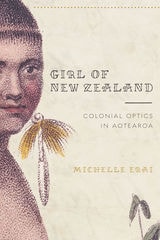
Girl of New Zealand
Colonial Optics in AotearoaMichelle Erai
University of Arizona Press, 2020
Viewed through Māori, feminist, queer, and film theories, Erai shows how images such as Girl of New Zealand (1793) and later images, cartoons, and travel advertising created and deployed a colonial optic. Girl of New Zealand reveals how the phantasm of the Māori woman has shown up in historical images, how such images shape our imagination, and how impossible it has become to maintain the delusion of the “innocent eye.” Erai argues that the process of ascribing race, gender, sexuality, and class to imagined bodies can itself be a kind of violence.
In the wake of the Me Too movement and other feminist projects, Erai’s timely analysis speaks to the historical foundations of negative attitudes toward Indigenous Māori women in the eyes of colonial “others”—outsiders from elsewhere who reflected their own desires and fears in their representations of the Indigenous inhabitants of Aotearoa, New Zealand. Erai resurrects Māori women from objectification and locates them firmly within Māori whānau and communities.
Indigenous Homelessness
Perspectives from Canada, Australia, and New ZealandEvelyn J. Peters
University of Manitoba Press, 2016
Magical Arrows
The Maori, The Greeks, And The Folklore Of The UniverseGregory A. Schrempp
University of Wisconsin Press, 1992
Schrempp suggests that perhaps the most noteworthy Zenoian insight is that paradox is intrinsic to cosmological speculation. But he points out that there are many other characteristics of Zeno’s approach, including the strategy of juxtaposing concrete images to mathematical forms of representation, that reappear persistently in Western intellectual history. Schrempp proceeds through a series of juxtapositions—between Zeno, Kant, Lovejoy, and Lévi-Strauss, and between Western cosmologists and those from other cultures—to highlight subtle similarities and differences among intellectual traditions and to examine the conceptual apparatus of Western social science.
Schrempp concludes that a meaningful comparative cosmology is possible and that the tradition of Zeno provides a propitious starting point for such a perspective.
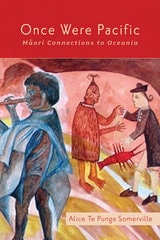
Once Were Pacific
Maori Connections to OceaniaAlice Te Punga Somerville
University of Minnesota Press, 2012
Native identity is usually associated with a particular place. But what if that place is the ocean? Once Were Pacific explores this question as it considers how Māori and other Pacific peoples frame their connection to the ocean, to New Zealand, and to each other through various creative works. Māori scholar Alice Te Punga Somerville shows how and when Māori and other Pacific peoples articulate their ancestral history as migratory seafarers, drawing their identity not only from land but also from water.
Although Māori are ethnically Polynesian, and Aotearoa New Zealand is clearly a part of the Pacific region, in New Zealand the terms “Māori” and “Pacific” are colloquially applied to two distinct communities: Māori are Indigenous, and “Pacific” refers to migrant communities from elsewhere in the region. Asking how this distinction might blur historical and contemporary connections, Te Punga Somerville interrogates the relationship between indigeneity, migration, and diaspora, focusing on texts: poetry, fiction, theater, film, and music, viewed alongside historical instances of performance, journalism, and scholarship.
In this sustained treatment of the Māori diaspora, Te Punga Somerville provides the first critical analysis of relationships between Indigenous and migrant communities in New Zealand.
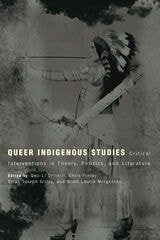
Queer Indigenous Studies
Critical Interventions in Theory, Politics, and LiteratureEdited by Qwo-Li Driskill, Chris Finley, Brian Joseph Gilley, and Scott Lauria Morgensen
University of Arizona Press, 2011
The bold opening to Queer Indigenous Studies invites new dialogues in Native American and Indigenous studies about the directions and implications of queer Indigenous studies. The collection notably engages Indigenous GLBTQ2 movements as alliances that also call for allies beyond their bounds, which the co-editors and contributors model by crossing their varied identities, including Native, trans, straight, non-Native, feminist, Two-Spirit, mixed blood, and queer, to name just a few.
Rooted in the Indigenous Americas and the Pacific, and drawing on disciplines ranging from literature to anthropology, contributors to Queer Indigenous Studies call Indigenous GLBTQ2 movements and allies to center an analysis that critiques the relationship between colonialism and heteropatriarchy. By answering critical turns in Indigenous scholarship that center Indigenous epistemologies and methodologies, contributors join in reshaping Native studies, queer studies, transgender studies, and Indigenous feminisms.
Based on the reality that queer Indigenous people “experience multilayered oppression that profoundly impacts our safety, health, and survival,” this book is at once an imagining and an invitation to the reader to join in the discussion of decolonizing queer Indigenous research and theory and, by doing so, to partake in allied resistance working toward positive change.
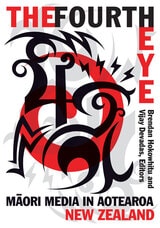
The Fourth Eye
Maori Media in Aotearoa New ZealandBrendan Hokowhitu
University of Minnesota Press, 2013
From the signing of the Treaty of Waitangi between Indigenous and settler cultures to the emergence of the first-ever state-funded Māori television network, New Zealand has been a hotbed of Indigenous concerns. Given its history of colonization, coping with biculturalism is central to New Zealand life. Much of this “bicultural drama” plays out in the media and is molded by an anxiety surrounding the ongoing struggle over citizenship rights that is seated within the politics of recognition. The Fourth Eye brings together Indigenous and non-Indigenous scholars to provide a critical and comprehensive account of the intricate and complex relationship between the media and Māori culture.
Examining the Indigenous mediascape, The Fourth Eye shows how Māori filmmakers, actors, and media producers have depicted conflicts over citizenship rights and negotiated the representation of Indigenous people. From nineteenth-century Māori-language newspapers to contemporary Māori film and television, the contributors explore a variety of media forms including magazine cover stories, print advertisements, commercial images, and current Māori-language newspapers to illustrate the construction, expression, and production of indigeneity through media.
Focusing on New Zealand as a case study, the authors address the broader question: what is Indigenous media? While engaging with distinct themes such as the misrepresentation of Māori people in the media, access of Indigenous communities to media technologies, and the use of media for activism, the essays in this much-needed new collection articulate an Indigenous media landscape that converses with issues that reach far beyond New Zealand.
Contributors: Sue Abel, U of Auckland; Joost de Bruin, Victoria U of Wellington; Suzanne Duncan, U of Otago; Kevin Fisher, U of Otago; Allen Meek, Massey U; Lachy Paterson, U of Otago; Chris Prentice, U of Otago; Jay Scherer, U of Alberta; Jo Smith, Victoria U of Wellington; April Strickland; Stephen Turner, U of Auckland.

The Tourist State
Performing Leisure, Liberalism, and Race in New ZealandMargaret Werry
University of Minnesota Press, 2011
No longer the dreary sheep farm at the end of the world, the New Zealand of the new millennium is a hot global ticket, heralded for its bicultural dynamism, laid-back lifestyle, and scenery extraordinary enough to pass for Tolkien’s Middle Earth. How this image was crafted is the story The Tourist State tells. In a series of narratives that address the embodied dimensions of biopolitics and explore the collision of race, performance, and the cultural poetics of the state, Margaret Werry exposes the real drama behind the new New Zealand, revealing how a nation was sold to the world—and to itself.
The story stretches back to the so-called Liberal Era at the beginning of the twentieth century, in which the young settler colony touted itself as the social laboratory of the world. Focusing on where tourism and liberal governmentality coincide, The Tourist State takes us from military diplomacy at the dawn of the American Pacific to the exotic blandishments of Broadway and Coney Island, from landscape preservation to health reform and town planning, from blockbuster film to knowledge economy policy.
Weaving together interpretive history, performance ethnography, and cultural criticism, Werry offers new ways to think about race and indigeneity—and about the role of human agency in state-making.