Results by title
8 books match the query 'Mahābhārata'
Boundaries of the Text
Epic Performances in South and Southeast AsiaJoyce Burkhalter Flueckiger and Laurie Sears, Editors
University of Michigan Press, 1991
Mahabharata
Adapted and edited by David R. Slavitt
Northwestern University Press, 2015
Within its 200,000 verse lines in Sanskrit the Mahabharata takes on many roles: epic poem, foundational text of Hinduism, and, more broadly, the engaging story of a dynastic struggle and the passing of an age when man and gods intermingled. David R. Slavitt’s sparkling new edition condenses the epic for the general reader.
At its core, the Mahabharata is the story of the rivalry between the Pandavas and the Kauravas, two related noble families who are struggling for control of a kingdom in ancient northern India. Slavitt’s readable, plot-driven, single-volume account describes an arc from the conception and birth of Bhishma to that hero's death, while also introducing the four goals of life at the center of Hinduism: dharma (righteousness, morality, duty), artha (purpose), kāma (pleasure), and moksa (spiritual liberation). The Mahabharata is engaging, thrilling, funny, charming, and finally awesome, with a range in timbre from the impish naivete of fairy tales to the solemnity of our greatest epics, and this single-volume edition is the best introduction available.
Rethinking India's Oral and Classical Epics
Draupadi among Rajputs, Muslims, and DalitsAlf Hiltebeitel
University of Chicago Press, 1999
Using his own fieldwork as a starting point, Alf Hiltebeitel analyzes how the oral tradition of the south Indian cult of the goddess Draupadi and five regional martial oral epics compare with one another and tie in with the Sanskrit epics. Drawing on literary theory and cultural studies, he reveals the shared subtexts of the Draupadi cult Mahabharata and the five oral epics, and shows how the traditional plots are twisted and classical characters reshaped to reflect local history and religion. In doing so, Hiltebeitel sheds new light on the intertwining oral traditions of medieval Rajput military culture, Dalits ("former Untouchables"), and Muslims.
Breathtaking in scope, this work is indispensable for those seeking a deeper understanding of South Asia's Hindu and Muslim traditions.
This work is the third volume in Hiltebeitel's study of the Draupadi cult. Other volumes include Mythologies: From Gingee to Kuruksetra (Volume One), On Hindu Ritual and the Goddess (Volume Two), and Rethinking the Mahabharata (Volume Four).
Rethinking the Mahabharata
A Reader's Guide to the Education of the Dharma KingAlf Hiltebeitel
University of Chicago Press, 2001
This work is the fourth volume in Hiltebeitel's study of the Draupadi cult. Other volumes include Mythologies: From Gingee to Kuruksetra (Volume One), On Hindu Ritual and the Goddess (Volume Two), and Rethinking India's Oral and Classical Epics (Volume Three).
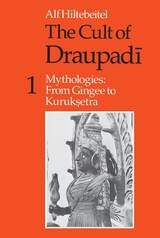
The Cult of Draupadi, Volume 1
Mythologies: From Gingee to KuruksetraAlf Hiltebeitel
University of Chicago Press, 1988
Volume 1 focuses on the Draupadī cult’s own double mythology, moving from its stories about Draupadī’s “primal temple” near the capital of the medieval South Indian Kingdom of Gingee to its version of the Mahābhārata war on the North Indian plain of Kurukṣetra. Throughout, Hiltebeitel intertwines “regional” data, gathered from both oral and written sources, with the “epic,” drawn from the cult’s own performative traditions as well as from classical versions of the Mahābhārata in both Tamil and Sanskrit. Pivotal to the overlap of these Gingee and Kurukṣetra mythologies are two folk figures unknown to classical epic traditions: Draupadī’s two guardians, Pōttu Rāja and Muttāl Rāvuttaṉ.
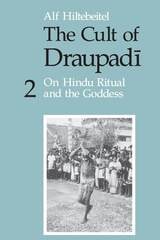
The Cult of Draupadi, Volume 2
On Hindu Ritual and the GoddessAlf Hiltebeitel
University of Chicago Press, 1991
Volume 2 looks at the cultic rituals and argues that these rituals cannot be interpreted independent of other Hindu traditions. Hiltebeitel draws upon his recent fieldwork to demonstrate the remarkable regional and local variations in the practice of the Draupadī cult rituals, from the core area around the ancient center of gingee to the thanjavur area just to the south. He brings to the forefront the differences between the complex rituals of cities, towns, and villages and discusses variations related to their proximity to the central temple in gingee and to the castes from which their customs are derived. using as its model the festival of the Tindivanam temple, Hiltebeitel’s study follows the order of the festival itself and investigates in turn the festival’s four interrelated arenas: the Draupadī temple, a drama stage, a ritual battlefield (paṭukaḷam), and a firewalking area. He explains how the Draupadī festival orchestrates movements back and forth between these arenas to produce a “ritual of battle” in which Draupadī emerges as the victorious goddess.
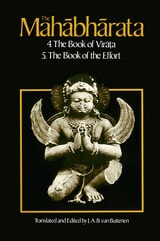
The Mahabharata, Volume 3
Book 4: The Book of the Virata; Book 5: The Book of the EffortEdited by J. A. B. van Buitenen
University of Chicago Press, 1978
The Mahabharata
A Shortened Modern Prose Version of the Indian EpicR. K. Narayan
University of Chicago Press, 2013
Centuries of listeners and readers have been drawn to The Mahabharata, which began as disparate oral ballads and grew into a sprawling epic. The modern version is famously long, and at more than 1.8 million words—seven times the combined lengths of the Iliad and Odyssey—it can be incredibly daunting.
Contemporary readers have a much more accessible entry point to this important work, thanks to R. K. Narayan’s masterful translation and abridgement of the poem. Now with a new foreword by Wendy Doniger, as well as a concise character and place guide and a family tree, The Mahabharata is ready for a new generation of readers. As Wendy Doniger explains in the foreword, “Narayan tells the stories so well because they’re all his stories.” He grew up hearing them, internalizing their mythology, which gave him an innate ability to choose the right passages and their best translations.
In this elegant translation, Narayan ably distills a tale that is both traditional and constantly changing. He draws from both scholarly analysis and creative interpretation and vividly fuses the spiritual with the secular. Through this balance he has produced a translation that is not only clear, but graceful, one that stands as its own story as much as an adaptation of a larger work.