Results by title
8 books match the query 'Restitution'
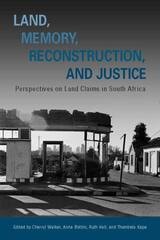
Land, Memory, Reconstruction, and Justice
Perspectives on Land Claims in South AfricaCherryl Walker
Ohio University Press, 2010
Land is a significant and controversial topic in South Africa. Addressing the land claims of those dispossessed in the past has proved to be a demanding, multidimensional process. In many respects the land restitution program that was launched as part of the county’s transition to democracy in 1994 has failed to meet expectations, with ordinary citizens, policymakers, and analysts questioning not only its progress but also its outcomes and parameters.
Land, Memory, Reconstruction, and Justice brings together a wealth of topical material and case studies by leading experts in the field who present a rich mix of perspectives from politics, sociology, geography, social anthropology, law, history, and agricultural economics. The collection addresses both the material and the symbolic dimensions of land claims, in rural and urban contexts, and explores the complex intersection of issues confronting the restitution program, from the promotion of livelihoods to questions of rights, identity, and transitional justice.
A valuable contribution to the field of land and agrarian studies, both in South Africa and internationally, it is undoubtedly the most comprehensive treatment to date of South Africa’s postapartheid land claims process and will be essential reading for scholars and students of land reform for years to come.
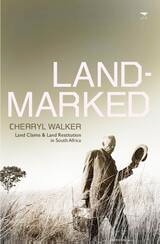
Landmarked
Land Claims and Land Restitution in South AfricaCherryl Walker
Ohio University Press, 2008
The year 2008 is the deadline set by President Mbeki for the finalization of all land claims by people who were dispossessed under the apartheid and previous white governments. Although most experts agree this is an impossible deadline, it does provide a significant political moment for reflection on the ANC government’s program of land restitution since the end of apartheid.
Land reform (and land restitution within that) remains a highly charged issue in South Africa, one that deserves more in–depth analysis. Drawing on her experience as Rural Land Claims Commissioner in KwaZulu–Natal from 1995 to 2000, Professor Cherryl Walker provides a multilayered account of land reform in South Africa, one that covers general critical commentary, detailed case material, and personal narrative. She explores the master narrative of loss and restoration, which has been fundamental in shaping the restitution program; offers a critical overview of the achievements of the program as a whole; and discusses what she calls the “non–programmatic limits to land reform,” including urbanization, environmental constraints and the impact of HIV/AIDS.
Post-Communist Restitution and the Rule of Law
Csongor Kuti
Central European University Press, 2009
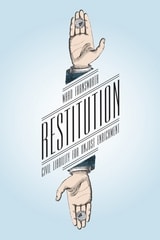
Restitution
Civil Liability for Unjust EnrichmentWard Farnsworth
University of Chicago Press, 2014
In Restitution, Ward Farnsworth presents a guide to this body of law that is compact, lively, and insightful—the first treatment of its kind that the American law of restitution has received. The book explains restitution doctrines, remedies, and defenses with unprecedented clarity and illustrates them with vivid examples. Farnsworth demonstrates that the law of restitution is guided by a manageable and coherent set of principles that have remarkable versatility and power. Restitution makes a complex and important area of law accessible, understandable, and interesting to any reader.
Ruin and Restitution
Reinterpreting Romanticism in SpainPhilip W. Silver
Vanderbilt University Press, 1997
Some Measure of Justice
The Holocaust Era Restitution Campaign of the 1990sMichael R. Marrus; Foreword by William A. Schabas
University of Wisconsin Press, 2009
Writings on the subject of Holocaust reparations have largely come from participants, lawyers, philosophers, journalists, and social scientists specializing in restitution. In Some Measure of Justice Michael Marrus takes up the issue as a historian deeply involved with legal issues. He engages with larger questions about historical understanding and historical interpretation as they enter the legal arena. Ultimately this book asks, What constitutes justice for a great historic wrong? And, Is such justice possible?

The Properties of Loss
Riot and Restitution in Civil War New YorkJoanna Cohen
University of Chicago Press, 0
A powerful account of the claims made by victims of the 1863 Draft Riots reveals how Americans’ emotional and legal responses to loss informed the development of contemporary capitalism.
The right to property has been central to America’s history, but for Joanna Cohen, loss of property has been powerful, too, not as a right but as an emotion. In The Properties of Loss, Cohen focuses on the aftermath of Manhattan’s infamous Draft Riots in July 1863, where Civil War draft protests fomented anti-Black terrorism that set the city aflame. In the wake of this destruction, nearly 2,000 people filed claims against the city, seeking reparation. But they found that the city chose not to value their property or imagine their losses as they did. Beyond the individual stories of suffering and struggle, these claims serve as a nexus for understanding how the conception of loss, the value of property, and the obligations of restitution changed in the nineteenth century. Charting these changes by focusing closely on emotions, Cohen shows how these changes shaped contemporary capitalism and underpin a surprising array of today’s discriminatory forces.
Unrepayable Debt
Law, Redress, Reconciliation, and the Unmaking of EmpireYukiko Koga
University of Chicago Press, 2026
What does it mean, and take, to repay the unrepayable?
Unrepayable Debt explores belated attempts to reckon with the savage plundering of labor and life under the Japanese empire. Located within global conversations on reparations for colonialism and slavery, and centered on slave labor lawsuits brought by Chinese victims seeking overdue justice in Japanese courts, Yukiko Koga traces a sea change in the legal sphere propelled by an unprecedented transnational redress movement. The lawsuits exposed not only the original violence but also a structure of transitional injustice etched onto the unmaking of the Japanese empire, which left victims silenced and unredressable for decades.
Challenging the idea of reckoning as a discrete event that brings closure through settlements, apology, or compensation, Koga’s ethnography details the slow and messy intergenerational work of reconciliation on the ground. The book shows how the re-pairing of severed relations, separated by lineages of victimhood and perpetration, lies at the core of repair. By bringing to the surface the prolonged and entangled processes of decolonization and deimperialization, Unrepayable Debt compels a rethinking of what redress, repair, and reconciliation mean, how they are practiced, and where accountability lies.