Results by title
9 books match the query 'Mainstream'
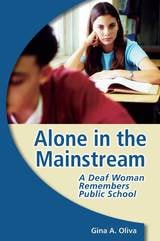
Alone in the Mainstream
A Deaf Woman Remembers Public SchoolGina A. Oliva
Gallaudet University Press, 2004
When Gina Oliva first went to school in 1955, she didn’t know that she was “different.” If the kindergarten teacher played a tune on the piano to signal the next exercise, Oliva didn’t react because she couldn’t hear the music. So began her journey as a “solitary,” her term for being the only deaf child in the entire school. Gina felt alone because she couldn’t communicate easily with her classmates, but also because none of them had a hearing loss like hers. It wasn’t until years later at Gallaudet University that she discovered that she wasn’t alone and that her experience was common among mainstreamed deaf students. Alone in the Mainstream recounts Oliva’s story, as well as those of many other solitaries.
In writing this important book, Oliva combined her personal experiences with responses from the Solitary Mainstream Project, a survey that she conducted of deaf and hard of hearing adults who attended public school. Oliva matched her findings with current research on deaf students in public schools and confirmed that hearing teachers are ill-prepared to teach deaf pupils, they don’t know much about hearing loss, and they frequently underestimate deaf children. The collected memories in Alone in the Mainstream add emotional weight to the conviction that students need to be able to communicate freely, and they also need peers to know they are not alone.
Alone in the Mainstream
Looking Back on Public School as a Deaf or Hard of Hearing ChildGina A. Oliva
Gallaudet University Press, 2024
In Alone in the Mainstream, author Gina A. Oliva documents her experience as a “solitaire,” the only deaf or hard of hearing student in her school. Oliva felt alone because she couldn’t communicate easily with her classmates and because she had no peers who shared a similar experience. As an adult, when she began her career at Gallaudet University, she realized that she wasn’t alone and that her experience was widely shared with other mainstreamed students. She decided to write about this commonality and invited other solitaires to reflect on their own experiences in emails and essays. Collective themes of isolation, low expectations, and low self-esteem emerged. Alone in the Mainstream blends Oliva’s personal narrative with the reflections of sixty other solitaires and makes the case that deaf and hard of hearing children need each other.
This twentieth anniversary edition is a reminder that little has changed for deaf and hard of hearing students in public school settings. Oliva brings this new edition up to date with observations, resources, and discussion questions that accompany her appeal for all deaf and hard of hearing children and their families to have access to sign language, to develop a deaf identity, and to be part of a deaf community.

Doing Development in Arkansas
Using Credit to Create Opportunity for Entrepreneurs Outside the MainstreamRichard Taub
University of Arkansas Press, 2004
Doing Development in Arkansas is a history of that program as its creators tried to find their footing in new terrain, establish trust, work with borrowers despite legal pitfalls in doing so, and attempted to create new loan and technical assistance products. It is the story of the towns themselves in which Southern tried to have a substantial impact, including Arkadelphia, Hope, Malvern, Hot Springs, and Pine Bluff. Southern was an experiment and many of its achievements were the results in some cases of trying new ideas and in others of transporting programs successful in one setting to new locations. The most dramatic example of such a move is the development of the Good Faith Fund in Pine Bluff, based on a model of the Grameen Bank in Bangladesh.
Ethnic Historians and the Mainstream
Shaping America's Immigration StoryAlan M. Kraut and David A. Gerber
Rutgers University Press, 2013
Do historians “write their biographies” with the subjects they choose to address in their research? In this collection, editors Alan M. Kraut and David A. Gerber compiled eleven original essays by historians whose own ethnic backgrounds shaped the choices they have made about their own research and writing as scholars. These authors, historians of American immigration and ethnicity, revisited family and personal experiences and reflect on how their lives helped shape their later scholarly pursuits, at times inspiring specific questions they asked of the nation’s immigrant past. They address issues of diversity, multiculturalism, and assimilation in academia, in the discipline of history, and in society at large. Most have been pioneers not only in their respective fields, but also in representing their ethnic group within American academia. Some of the women in the group were in the vanguard of gender diversity in the discipline of history as well as on the faculties of the institutions where they have taught.
The authors in this collection represent a wide array of backgrounds, spanning Europe, Africa, Asia, the Middle East, and Latin America. What they have in common is their passionate engagement with the making of social and personal identities and with finding a voice to explain their personal stories in public terms.
Contributors: Theresa Alfaro-Velcamp, John Bodnar, María C. García, David A. Gerber, Violet M. Showers Johnson, Alan M. Kraut, Timothy J. Meagher, Deborah Dash Moore, Dominic A. Pacyga, Barbara M. Posadas, Eileen H. Tamura, Virginia Yans, Judy Yung

From the Far Right to the Mainstream
Islamophobia in Party Politics and the MediaEdited by Humayun Ansari and Farid Hafez
Campus Verlag, 2012

Here on the Edge
How a Small Group of World War II Conscientious Objectors Took Art and Peace from the Margins to the MainstreamSteve McQuiddy
Oregon State University Press, 2013
They worked six days a week—planting trees, crushing rock, building roads, and fighting forest fires—in exchange for only room and board. At night, they published books under the imprint of the Untide Press. They produced plays, art, and music—all during their limited non-work hours, with little money and few resources. This influential group included poet William Everson, later known as Brother Antoninus, “the Beat Friar”; violinist Broadus Erle, founder of the New Music Quartet; fine arts printer Adrian Wilson; Kermit Sheets, co-founder of San Francisco’s Interplayers theater group; architect Kemper Nomland, Jr.; and internationally renowned sculptor Clayton James.
After the war, camp members went on to participate in the San Francisco Poetry Renaissance of the 1950s, which heavily influenced the Beat Generation of Jack Kerouac, Allen Ginsberg, and Gary Snyder—who in turn inspired Ken Kesey and his Merry Pranksters, leading the way to the 1960s upheavals epitomized by San Francisco’s Summer of Love.
As camp members engaged in creative acts, they were plowing ground for the next generation, when a new set of young people, facing a war of their own in Vietnam, would populate the massive peace movements of the 1960s.
Twenty years in the making and packed with original research, Here on the Edge is the definitive history of the Fine Arts Group at Waldport, documenting how their actions resonated far beyond the borders of the camp. It will appeal to readers interested in peace studies, World War II history, influences on the 1960s generation, and in the rich social and cultural history of the West Coast.
Post-Weird
Fragmentation, Community, and the Decline of the MainstreamCalum Lister Matheson
Rutgers University Press, 2026
An ambitious look at rhetoric and psychosis that explores how communities form when society collapses
American society seems to have fractured. Common touchpoints of authority have receded in recent decades and beliefs that were once taboo are now openly shared, from neo-Nazism to occultism to conspiracy thinking. In this book, Calum Lister Matheson goes beyond the fraying of contemporary American culture to ask how splinter communities form in our current media environment, what keeps them together, and what they build from the ruins of shared language.
In his stirring exploration of how people communicate when old forms of authority and meaning collapse, Matheson examines far-flung groups that have departed the mainstream—Sandy Hook deniers, Appalachian serpent handlers, pro-anorexia bloggers, incels, transvestigators, pseudoscientific reactionaries, and more—and finds unexpected similarities among their many differences. Key among their parallels is the insistence that the symbols shared by each community represent a hidden truth that cannot be questioned or interpreted but is revealed through signs—words, images, videos, and texts. By documenting American fringe cultures, extremism, and the social functions of language, this book rethinks concepts like irony, psychosis, propriety, and what it means to be normal in weird times.

The Sixties, Center Stage
Mainstream and Popular Performances in a Turbulent DecadeEdited by James M. Harding and Cindy Rosenthal
University of Michigan Press, 2017

Women's Leadership in Marginal Religions
EXPLORATIONS OUTSIDE THE MAINSTREAMEdited by Catherine Wessinger
University of Illinois Press, 1993