Results by title

12 books match the query 'Manhood'
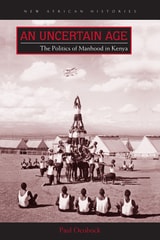
cover of An Uncertain Age: The Politics of Manhood in Kenya

An Uncertain Age

The Politics of Manhood in Kenya

Paul Ocobock

Ohio University Press, 2017

In twentieth-century Kenya, age and gender were powerful cultural and political forces that animated household and generational relationships. They also shaped East Africans’ contact with and influence on emergent colonial and global ideas about age and masculinity. Kenyan men and boys came of age achieving their manhood through changing rites of passage and access to new outlets such as town life, crime, anticolonial violence, and nationalism. And as they did, the colonial government appropriated masculinity and maturity as means of statecraft and control.

In An Uncertain Age, Paul Ocobock positions age and gender at the heart of everyday life and state building in Kenya. He excavates in unprecedented ways how the evolving concept of “youth” motivated and energized colonial power and the movements against it, exploring the masculinities boys and young men debated and performed as they crisscrossed the colony in search of wages or took the Mau Mau oath. Yet he also considers how British officials’ own ideas about masculinity shaped not only young African men’s ideas about manhood but the very nature of colonial rule.

An Uncertain Age joins a growing number of histories that have begun to break down monolithic male identities to push the historiographies of Kenya and empire into new territory.

[more]
cover of Brutal: Manhood and the Exploitation of Animals

Brutal

Manhood and the Exploitation of Animals

Brian Luke

University of Illinois Press, 2007

The first integrated theory of manhood's relationship to hunting, animal experimentation, and animal sacrifice

In Brutal, Brian Luke explores the gender divide over our treatment of animals, exposing the central role of masculinity in systems of animal exploitation. Employing philosophical analysis, reference to empirical research, and relevant personal experience, Luke develops a new theory of how exploitative institutions do not work to promote human flourishing but instead merely act as support for a particular construction of manhood. The resulting work is of significant interest both to animal advocates and opponents of sexism.
[more]
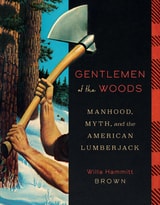
cover of Gentlemen of the Woods: Manhood, Myth, and the American Lumberjack

Gentlemen of the Woods

Manhood, Myth, and the American Lumberjack

Willa Hammitt Brown

University of Minnesota Press, 2025

Lumberjacks: the men, the myth, and the making of an American legend

The folk hero Paul Bunyan, burly, bearded, wielding his big ax, stands astride the story of the upper Midwest—a manly symbol of the labor that cleared the vast north woods for the march of industrialization while somehow also maintaining an aura of pristine nature. This idea, celebrated in popular culture with songs and folktales, receives a long overdue and thoroughly revealing correction in Gentlemen of the Woods, a cultural history of the life and lore of the real lumberjack and his true place in American history.

Now recalled as heroes of wilderness and masculinity, lumberjacks in their own time were despised as amoral transients. Willa Hammitt Brown shows that nineteenth-century jacks defined their communities of itinerant workers by metrics of manhood that were abhorrent to the residents of the nearby Northwoods boomtowns, valuing risk-taking and skill rather than restraint and control. Reviewing songs, stories, and firsthand accounts from loggers, Brown brings to life the activities and experiences of the lumberjacks as they moved from camp to camp. She contrasts this view with the popular image cultivated by retreating lumber companies that had to sell off utterly barren land. This mythologized image glorified the lumberjack and evoked a kindly, flannel-wearing, naturalist hero.

Along with its portrait of lumberjack life and its analysis of the creation of lumberjack myth, Gentlemen of the Woods offers new insight into the intersections of race and social class in the logging enterprise, considering the actual and perceived roles of outsider lumberjacks and Native inhabitants of the northern forests. Anchored in the dual forces of capitalism and colonization, this lively and compulsively readable account offers a new way to understand a myth and history that has long captured our collective imagination.
[more]
cover of Global Masculinities and Manhood

Global Masculinities and Manhood

Edited by Ronald L. Jackson II and Murali Balaji

University of Illinois Press, 2013

Bringing together an array of interdisciplinary voices, Global Masculinities and Manhood examines the concept of masculinity from the perspectives of cultures around the world. In the era of globalization, masculinity continues to be studied in a Western-centric context. Contributors to this volume, however, deconstruct the history and politics of masculinities within the contexts of the cultures from which they have been developed, examining what makes a man who he is within his own culture. Highlighting manifestations of masculinity in countries including Jamaica, Turkey, Peru, Kenya, Australia, and China, scholars from a variety of disciplines grapple with the complex politics of identity and the question of how gender is interpreted and practiced through discourse. Topics include how masculinity is affected by war and conflict, defined in relation to race, ethnicity, and sexuality, and expressed in cultural activities such as sports or the cinema.
 
Contributors are Bryant Keith Alexander, Molefi K. Asante, Murali Balaji, Maurice Hall, Ronald L. Jackson II, Shino Konishi, Nil Mutluer, Mich Nyawalo, Kathleen Glenister Roberts, Margarita Saona, and Kath Woodward.
[more]
cover of MANHOOD, CITIZENSHIP, AND THE NATIONAL GUARD: ILLINOIS, 1870–1917

MANHOOD, CITIZENSHIP, AND THE NATIONAL GUARD

ILLINOIS, 1870–1917

ELEANOR L HANNAH

The Ohio State University Press, 2007
During the Gilded Age and the Progressive Era, thousands upon thousands of American men devoted their time and money to the creation of an unsought—and in some quarters unwelcome—revived state militia. In this book, Eleanor L. Hannah studies the social history of the National Guard, focusing on issues of manhood and citizenship as they relate to the rise of the state militias.
 
In brief, the National Guard of the late nineteenth and early twentieth centuries is best interpreted as one of a host of associations and organizations that American men of those eras devised to help them negotiate their location and purpose in the strange new world of industrial capitalism. The National Guards brought men from a wide array of regions, ethnicities, races, and economic backgrounds together in a single organization. These men were united by a shared understanding of ideal manhood and civic responsibility that could be expressed through membership in a state militia.
 
Once committed to the power of the word and the image evoked by the term “soldier” to bring diverse men together in one common bond, the men who volunteered their time and money had to give soldiering their serious attention. By 1900 a commitment to soldiering that was founded on shared social needs took on a life of its own and refocused National Guard members on an individualized, technical, professional military training—on a new kind of manhood for a new age.
 
The implications of this book are far-reaching, for it offers historians a fresh look at a long-ignored group of men and unites social and cultural history to explore changing notions of manhood and citizenship during years of frenetic change in the American landscape.
[more]
cover of Manhood in Hollywood from Bush to Bush

Manhood in Hollywood from Bush to Bush

By David Greven

University of Texas Press, 2009

A struggle between narcissistic and masochistic modes of manhood defined Hollywood masculinity in the period between the presidencies of George H. W. Bush and George W. Bush. David Greven's contention is that a profound shift in representation occurred during the early 1990s when Hollywood was transformed by an explosion of films that foregrounded non-normative gendered identity and sexualities. In the years that have followed, popular cinema has either emulated or evaded the representational strategies of this era, especially in terms of gender and sexuality.

One major focus of this study is that, in a great deal of the criticism in both the fields of film theory and queer theory, masochism has been positively cast as a form of male sexuality that resists the structures of normative power, while narcissism has been negatively cast as either a regressive sexuality or the bastion of white male privilege. Greven argues that narcissism is a potentially radical mode of male sexuality that can defy normative codes and categories of gender, whereas masochism, far from being radical, has emerged as the default mode of a traditional normative masculinity. This study combines approaches from a variety of disciplines—psychoanalysis, queer theory, American studies, men's studies, and film theory—as it offers fresh readings of several important films of the past twenty years, including Casualties of War, The Silence of the Lambs, Fight Club, The Passion of the Christ, Auto Focus, and Brokeback Mountain.
[more]
cover of Manhood on the Line: Working-Class Masculinities in the American Heartland

Manhood on the Line

Working-Class Masculinities in the American Heartland

Stephen Meyer

University of Illinois Press, 2016
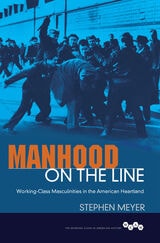
Stephen Meyer charts the complex vagaries of men reinventing manhood in twentieth century America. Their ideas of masculinity destroyed by principles of mass production, workers created a white-dominated culture that defended its turf against other racial groups and revived a crude, hypersexualized treatment of women that went far beyond the shop floor. At the same time, they recast unionization battles as manly struggles against a system killing their very selves. Drawing on a wealth of archival material, Meyer recreates a social milieu in stunning detail--the mean labor and stolen pleasures, the battles on the street and in the soul, and a masculinity that expressed itself in violence and sexism but also as a wellspring of the fortitude necessary to maintain one's dignity while doing hard work in hard world.
[more]
cover of Manhood: A Journey from Childhood into the Fierce Order of Virility

Manhood

A Journey from Childhood into the Fierce Order of Virility

Michel Leiris

University of Chicago Press, 1992

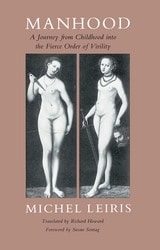
"Not only one of the frankest of autobiographies, but also a brilliantly written book, Leiris' Manhood mingles memories, philosophic reflections, sexual revelation, meditations on bullfighting, and the life-long progress of self-discovery."—Washington Post Book World

"Leiris writes to appall, and thereby to receive from his readers the gift of a strong emotion—the emotion needed to defend himself against the indignation and disgust he expects to arouse in his readers."—Susan Sontag, New York Review of Books
[more]
cover of Paper Money Men: Commerce, Manhood, and the Sensational Public Sphere in Antebellum America

Paper Money Men

Commerce, Manhood, and the Sensational Public Sphere in Antebellum America

David Anthony

The Ohio State University Press, 2009

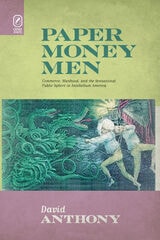
Paper Money Men: Commerce, Manhood, and the Sensational Public Sphere in Antebellum America by David Anthony outlines the emergence of a “sensational public sphere” in antebellum America. It argues that this new representational space reflected and helped shape the intricate relationship between commerce and masculine sensibility in a period of dramatic economic upheaval. Looking at a variety of sensational media—from penny press newspapers and pulpy dime novels to the work of well-known writers such as Irving, Hawthorne, and Melville—this book counters the common critical notion that the period’s sensationalism addressed a primarily working-class audience. Instead, Paper Money Men shows how a wide variety of sensational media was in fact aimed principally at an emergent class of young professional men. “Paper money men” were caught in the transition from an older and more stable mercantilist economy to a panic-prone economic system centered on credit and speculation. And, Anthony argues, they found themselves reflected in the sensational public sphere, a fantasy space in which new models of professional manhood were repeatedly staged and negotiated. Compensatory in nature, these alternative models of manhood rejected fiscal security and property as markers of a stable selfhood, looking instead toward intangible factors such as emotion and race in an effort to forge a secure sense of manhood in an age of intense uncertainty.
[more]
cover of The Fragility of Manhood: Hawthorne, Freud, and the Politics of Gender

The Fragility of Manhood

Hawthorne, Freud, and the Politics of Gender

David Greven

The Ohio State University Press, 2012
Merging psychoanalytic and queer theory perspectives, The Fragility of Manhood: Hawthorne, Freud, and the Politics of Gender reframes Nathaniel Hawthorne’s work as a critique of the normative construction of American male identity. Revising Freudian and Lacanian literary theory and establishing the concepts of narcissism and the gaze as central, David Greven argues that Hawthorne represents normative masculinity as fundamentally dependent on the image. In ways that provocatively intersect with psychoanalytic theory, Hawthorne depicts subjectivity as identification with an illusory and deceptive image of wholeness and unity. As Hawthorne limns it, male narcissism both defines and decenters male heterosexual authority. Moreover, in Greven’s view, Hawthorne critiques hegemonic manhood’s recourse to domination as a symptom of the traumatic instabilities at the core of traditional models of male identity. Hawthorne’s representation of masculinity as psychically fragile has powerful implications for his depictions of female and queer subjectivity in works such as the tales “Rappaccini’s Daughter” and “The Gentle Boy,” the novel The Blithedale Romance, and Hawthorne’s critically neglected late, unfinished writings, such as Septimius Felton. Rereading Freud from a queer theory perspective, Greven reframes Freudian theory as a radical critique of traditional models of gender subjectivity that has fascinating overlaps with Hawthorne’s work. In the chapter “Visual Identity,” Greven also discusses the agonistic relationship between Hawthorne and Herman Melville and the intersection of queer themes, Hellenism, and classical art in their travel writings, The Marble Faun, and Billy Budd.
[more]
cover of The Politics of Manhood: Profeminist Men Respond to the Mythopoetic Men's Movement (And the Mythopoetic Leaders Answer)

The Politics of Manhood

Profeminist Men Respond to the Mythopoetic Men's Movement (And the Mythopoetic Leaders Answer)

edited by Michael S. Kimmel

Temple University Press, 1995
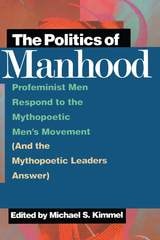
The concept and reality of revolution continue to pose some of the most challenging and important questions in the world today. What causes revolution? Why do some people participate in revolutionary events while others do not? What is the role of religion and ideology in causing and sustaining revolution? Why do some revolutions succeed and some fail? These questions have preoccupied philosophers and social scientists for centuries. In Revolution, Michael S. Kimmel examines why the study of revolution has attained such importance and he provides a systematic historical analysis of key ideas and theories. The book surveys the classical perspectives on revolution offered by nineteenth- and early twentieth-century theorists, such as Marx, Weber, Durkheim, Tocqueville, and Freud. Kimmel argues that their perspectives on revolution were affected by the reality of living through the revolutions of 1848 and 1917, a reality that raised crucial issues of class, state, bureaucracy, and motivation. The author then turns to the interpretations of revolution offered by social scientists in the post-World War II period, especially modernization theory and social psychological theories. Here, he contends that the relative quiescence of the 1950s cast revolutions in a different light, which was poorly suited to explain the revolutionary upheavals that have marked the 1960s, 1970s, and 1980s. With reference to the work of Barrington Moore, Theda Skocpol, Immanuel Wallerstein, and Charles Tilly, among others, Kimmel develops the criteria for a structural theory of revolution. This lucid, accessible account includes contemporary analyses of the Nicaraguan, Iranian, and Angolan revolutions.
[more]
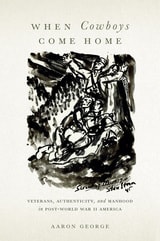
cover of When Cowboys Come Home: Veterans, Authenticity, and Manhood in Post–World War II America

When Cowboys Come Home

Veterans, Authenticity, and Manhood in Post–World War II America

Aaron George

Rutgers University Press, 2024

When Cowboys Come Home: Veterans, Authenticity, and Manhood in Post–World War II America is a cultural and intellectual history of the 1950s that argues that World War II led to a breakdown of traditional markers of manhood and opened space for veterans to reimagine what masculinity could mean. One particularly important strand of thought, which influenced later anxieties over “other-direction” and “conformity,” argued that masculinity was not defined by traits like bravery, stoicism, and competitiveness but instead by authenticity, shared camaraderie, and emotional honesty. To elucidate this challenge to traditional “frontiersman” masculinity, Aaron George presents three intellectual biographies of important veterans who became writers after the war: James Jones, the writer of the monumentally important war novel From Here to Eternity; Stewart Stern, one of the most important screenwriters of the fifties and sixties, including for Rebel without a Cause; and Edward Field, a bohemian poet who used poetry to explore his love for other men. Through their lives, George shows how wartime disabused men of the notion that war was inherently a brave or heroic enterprise and how the alienation they felt upon their return led them to value the authentic connections they made with other men during the war.
 
[more]