Results by title
7 books match the query 'Manning, Susan'
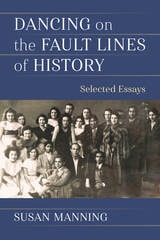
Dancing on the Fault Lines of History
Selected EssaysSusan Manning
University of Michigan Press, 2025
Dancing on the Fault Lines of History collects essential essays by Susan Manning, one of the founders of critical dance studies, recounting her career writing and rewriting the history of modern dance. Three sets of keywords—gender and sexuality, whiteness and Blackness, nationality and globalization—illuminate modern dance histories from multiple angles, coming together in varied combinations, shifting positions from foreground to background. Among the many artists discussed are Isadora Duncan, Vaslav Nijinsky, Ted Shawn, Helen Tamiris, Katherine Dunham, José Limón, Pina Bausch, Reggie Wilson, and Nelisiwe Xaba. Calling for a comparative and transnational historiography, Manning ends with an extended case study of Mary Wigman’s multidimensional exchange with artists from Indonesia, India, China, Korea, and Japan.
Like the artists at the center of her research, Manning’s writing dances on the fault lines of history. Her introduction and annotations to the essays reflect on how and why these keywords became central to her research, revealing the autobiographical resonances of her scholarship as she confronts the cultural politics of the late twentieth and early twenty-first centuries.
Like the artists at the center of her research, Manning’s writing dances on the fault lines of history. Her introduction and annotations to the essays reflect on how and why these keywords became central to her research, revealing the autobiographical resonances of her scholarship as she confronts the cultural politics of the late twentieth and early twenty-first centuries.
[more]
Dancing on the Third Coast, Volume 1
Performing ModernismsEdited by Susan Manning and Lizzie Leopold
University of Illinois Press, 2027
The 1893 World’s Columbian Exposition brought an international array of dance to Chicago. Thereafter, the city’s dance community became a meeting place for cultures where dance styles from around the world blended to emerge in bold, original forms and strike out in new directions.
Susan Manning and Lizzie Leopold offer original essays from voices at all levels of the Chicago dance scene that explore dance in the city through the rise of the 1960s Black Arts Movement. From the beginning, dance performances questioned assumptions about gender, race, and the control of culture. Immigrant groups and Indigenous performers, among others, danced to express identity and resist injustice. The Black Arts Movement used dance to build pride and community. Throughout the period, migration and segregation shaped dance scenes while dance expanded through neighborhoods, clubs, settlement houses, and schools.
The first of two volumes, Dancing on the Third Coast: Performing Modernisms shines a light on long-overlooked Chicago artists and institutions as it repositions the city as an essential part of dance history in the United States.
Contributors: Jake Austen, Bril Barrett, David R. M. Beck, Sophie Benn, Cristin Carole, Joanna Dee Das, Amira Millicent Davis, Samuel N. Dorf, Tanya Jayani Fernando, Jessica Friedman, Megan E. Geigner, Nadine George-Graves, Auna R. Hearne, Pamela Krayenbuhl, John Neumeier, Liesl Olson, Jenna Pearse-Pollack, Jessica Erin Ray, Tyler T. Schmidt, Caroline Drane Shadle, Nina S. Spiegel, Lauren Warnecke, Carolyn Watts, Dorene Wiese, Queen Meccasia Zabriskie
[more]
Dancing on the Third Coast, Volume 2
Contemporary CulturesEdited by Lizzie Leopold and Susan Manning
University of Illinois Press, 2027
Precipitated by an influx of federal and corporate granting programs, the 1960s and 1970s are often referred to as the U.S. dance boom, and Chicago was no exception. New nonprofits emerged on the South and North sides, as choreographers experimented with the fusion aesthetics innovated by their predecessors and as new immigrants and Black subcultures fashioned new forms of social dance. The second volume of Dancing on the Third Coast explores the inevitable collisions of artistic identity with cultural infrastructure, as nonprofit institutions codified aesthetic preferences and social practices from the 1960s to the present.
Contributors write from their own experiences of Chicago dance. Informed by their perspectives as performers and dancemakers, critics and dramaturges, educators and ethnographers, their essays invite readers to join the ongoing work of telling the myriad stories of Chicago dance.
Contributors: Frances R. Aparicio, Maggie Bridger, Ellen Chenoweth, Sydney Erlikh, Joanna Furnans, Wills Glasspiegel, Irvin Manuel Gonzalez, Daniel “BRAVEMONK” Haywood, J’Sun Howard, Wenke (Coco) Huang, Maggie Kast, Michael J. Kramer, Mario LaMothe, Michael Landez, Lizzie Leopold, Kelsa “K-Soul” Rieger-Haywood, Rebecca Rossen, Micah Salkind, Roell Schmidt, Elizabeth Schwall, Nora Sharp, Shayna M. Silverstein, Lauren Warnecke, Zachary Whittenburg, Tara Aisha Willis
[more]
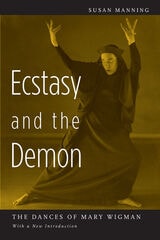
Ecstasy and the Demon
The Dances of Mary WigmanSusan Manning
University of Minnesota Press, 2006
Mary Wigman, Germany’s premier dancer between the two world wars, envisioned the performer in the thrall of ecstatic and demonic forces. Widely hailed as an innovator of dance modernism, she never acknowledged her complex relationship with National Socialism. In Ecstasy and the Demon, Susan Manning advances a sociological explanation for the collaboration between German modern dancers and National Socialism. She models methods for dance studies that contextualize choreography in relation to changing sociopolitical conditions, bringing dance scholarship into conversation with intellectual trends across the humanities.The introduction to this second edition brings Manning’s groundbreaking work to bear on dance studies today and reconsiders Wigman’s career from the perspective of queer theory and globalization, further illuminating the interplay of dance and politics in the twentieth century.Susan Manning is professor of English, theater, and performance studies at Northwestern University.
[more]
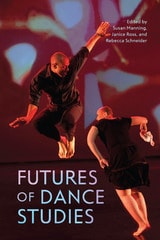
Futures of Dance Studies
Susan Manning
University of Wisconsin Press, 2020
A collaboration between well-established and rising scholars, Futures of Dance Studies suggests multiple directions for new research in the field. Essays address dance in a wider range of contexts—onstage, on screen, in the studio, and on the street—and deploy methods from diverse disciplines. Engaging African American and African diasporic studies, Latinx and Latin American studies, gender and sexuality studies, and Asian American and Asian studies, this anthology demonstrates the relevance of dance analysis to adjacent fields.
[more]
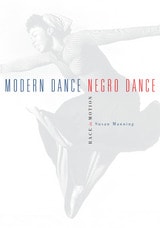
Modern Dance, Negro Dance
Race in MotionSusan Manning
University of Minnesota Press, 2006
At the New School for Social Research in 1931, the dance critic for the New York Times announced the arrival of modern dance, touting the “serious art” of such dancers as Mary Wigman, Martha Graham, and Doris Humphrey. Across town, Hemsley Winfield and Edna Guy were staging what they called “The First Negro Dance Recital in America,” which Dance Magazine proclaimed “the beginnings of great and important choreographic creations.” Yet never have the two parallel traditions converged in the annals of American dance in the twentieth century.Modern Dance, Negro Dance is the first book to bring together these two vibrant strains of American dance in the modern era. Susan Manning traces the paths of modern dance and Negro dance from their beginnings in the Depression to their ultimate transformations in the postwar years, from Helen Tamiris’s and Ted Shawn’s suites of Negro Spirituals to concerts sponsored by the Workers Dance League, from Graham’s American Document to the debuts of Katherine Dunham and Pearl Primus, from José Limón’s 1954 work The Traitor to Merce Cunningham’s 1958 dances Summerspace and Antic Meet, to Ailey’s 1960 masterpiece Revelations.Through photographs and reviews, documentary film and oral history, Manning intricately and inextricably links the two historically divided traditions. The result is a unique view of American dance history across the divisions of black and white, radical and liberal, gay and straight, performer and spectator, and into the multiple, interdependent meanings of bodies in motion. Susan Manning is associate professor of English, theater, and performance studies at Northwestern University. She is the author of Ecstasy and the Demon: Feminism and Nationalism in the Dances of Mary Wigman, winner of the 1994 de la Torre Bueno Prize for the year’s most important contribution to dance studies.
[more]
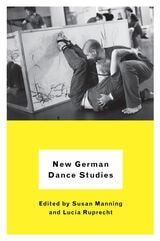
New German Dance Studies
Edited by Susan Manning and Lucia Ruprecht
University of Illinois Press, 2012
New German Dance Studies offers fresh histories and theoretical inquiries that resonate across fields of the humanities. Sixteen essays range from eighteenth-century theater dance to popular contemporary dances in global circulation. In an exquisite trans-Atlantic dialogue that demonstrates the complexity and multilayered history of German dance, American and European scholars and artists elaborate on definitive performers and choreography, focusing on three major thematic areas: Weimar culture and its afterlife, the German Democratic Republic, and recent conceptual trends in theater dance.
Contributors are Maaike Bleeker, Franz Anton Cramer, Kate Elswit, Susanne Franco, Susan Funkenstein, Jens Richard Giersdorf, Yvonne Hardt, Sabine Huschka, Claudia Jeschke, Marion Kant, Gabriele Klein, Karen Mozingo, Tresa Randall, Gerald Siegmund, and Christina Thurner.
[more]