Results by title
13 books match the query 'Marginality, Social, in literature'
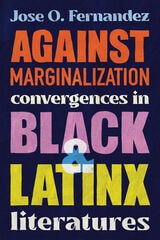
Against Marginalization
Convergences in Black and Latinx LiteraturesJose O. Fernandez
The Ohio State University Press, 2022
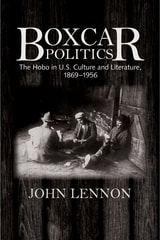
Boxcar Politics
The Hobo in U.S. Culture and Literature, 1869-1956John Lennon
University of Massachusetts Press, 2014
John Lennon maps the rise and demise of the political hobo from the nineteenth-century introduction of the transcontinental railroad to the Federal Aid Highway Act of 1956. Intertwining literary, historical, and theoretical representations of the hobo, he explores how riders and writers imagined alternative ways that working-class people could use mobility to create powerful dissenting voices outside of fixed hierarchal political organizations. Placing portrayals of hobos in the works of Jack London, Jim Tully, John Dos Passos, and Jack Kerouac alongside the lived reality of people hopping trains (including hobos of the IWW, the Scottsboro Boys, and those found in numerous long-forgotten memoirs), Lennon investigates how these marginalized individuals exerted collective political voices through subcultural practices.
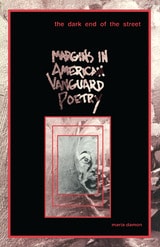
Dark End Of The Street
Margins in American Vanguard PoetryMaria Damon
University of Minnesota Press, 1993
Damon foregrounds a number of modern American poets work and lives in order to argue that the American avant-garde is located in the experimental literary works of social "outsiders." Discussed is the work of Black/Jewish surrealist street poet Bob Kaufman, Boston-Brahmin Robert Lowell and three teenaged women writing from a South Boston housing project, pre-Stonewall gay poets Jack Spicer and Robert Duncan, and Jewish lesbian-in-exile Gertrude Stein.
"An engaging and important book. Damon's sophisticated, theoretical approaches to American verse, coupled with her fresh, writerly style in The Dark End of The Street, put her on the forefront of American poetry's next generation of literary criticism." -American Literature"A work of art as well as a work of criticism. Addresses important questions about art and social life, about the margins and the center, and about oppression and suppression." -George Lipsitz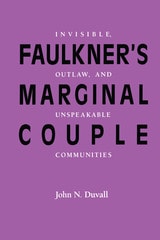
Faulkner’s Marginal Couple
Invisible, Outlaw, and Unspeakable CommunitiesBy John N. Duvall
University of Texas Press, 1990
Is William Faulkner’s fiction built on a fundamental dichotomy of outcast individual versus the healthy agrarian community? The New Critics of the 1930s advanced this view, and it has shaped much Faulkner criticism. However, in Faulkner’s Marginal Couple, John Duvall posits the existence of another possibility, alternative communities formed by “deviant” couples. These couples, who violate “normal” gender roles and behaviors, challenge the either/or view of Faulkner’s world.
The study treats in detail the novels Light in August, The Wild Palms, Sanctuary, Pylon, and Absalom, Absalom!, as well as several of Faulkner’s short stories. In discussing each work, Duvall challenges the traditional view that Faulkner created active men who follow a code of honor and passive women who are close to nature. Instead, he charts the many instances of men who are nurturing and passive and women who are strong and sexually active. These alternative couples undermine a common view of Faulkner as an upholder of Southern patriarchal values, thus countering the argument that Faulkner’s fiction is essentially misogynist.
This new approach, drawing on semiotics, feminism, and Marxism, makes Faulkner more accessible to readers interested in ideological analysis. It also stresses the intertextual connections between Faulkner’s Yoknapatawpha and non-Yoknapatawpha fiction. Perhaps most importantly, it uncovers what the New Criticism concealed, namely, that Faulkner’s fiction traces the full androgynous spectrum of the human condition.
In Science's Shadow
Literary Constructions of Late Victorian WomenPatricia Murphy
University of Missouri Press, 2006
The Victorian era was characterized by great scientific curiosity—as exemplified by the publication of Darwin’s Descent of Man—as well as by new questions regarding the place of women in society. Patricia Murphy now explores the tenuous interplay of gender and science to show how the era’s literature both challenged and reinforced a constrictive role for Victorian women. Focusing on a specific body of literature involving women intensely associated with scientific pursuits, and examining selected noncanonical writings—both fictional and nonfictional representations of scientific women—Murphy demonstrates how these works informed the “Woman Question” by reinforcing or rejecting presumed truths about gender and science.
Never Better!
The Modern Jewish PicaresqueMiriam Udel
University of Michigan Press, 2016
The characters defined by this dual consciousness constitute a new kind of protagonist: a distinctively Jewish scapegrace whom Udel denominates the polit or refugee. Cousin to the Golden Age Spanish pícaro, the polit is a socially marginal figure who narrates his own story in discrete episodes, as if stringing beads on a narrative necklace. A deeply unsettled figure, the polit is allergic to sentimentality and even routine domesticity. His sequential misadventures point the way toward the heart of the picaresque, which Jewish authors refashion as a vehicle for modernism—not only in Yiddish, but also in German, Russian, English and Hebrew. Udel draws out the contours of the new Jewish picaresque by contrasting it against the nineteenth-century genre of progress epitomized by the Bildungsroman.
While this book is grounded in modern Jewish literature, its implications stretch toward genre studies in connection with modernist fiction more generally. Udel lays out for a diverse readership concepts in the history and theory of the novel while also explicating the relevant particularities of Jewish literary culture. In addressing the literary stylistics of a “minor” modernism, this study illuminates how the adoption of a picaresque sensibility allowed minority authors to write simultaneously within and against the literary traditions of Europe.
Poetics of Visibility in the Contemporary Arab American Novel
Mazen Naous
The Ohio State University Press, 2020
Naous’s book offers analyses of Diana Abu-Jaber’s Arabian Jazz and Crescent, Rabih Alameddine’s Koolaids: The Art of War, Laila Halaby’s Once in a Promised Land, and Mohja Kahf’s The Girl in the Tangerine Scarf as ways to answer this question. Naous explores how these novels negotiate queer desire, music, Western and Middle Eastern art, gender, and relationships between other minorities. These poetics enable readers to see the nuance and richness of Arab American experience. Naous ultimately argues that fiction creates crucial spaces for reimagining and redefining intercultural relationships.
Raising the Dead
Readings of Death and (Black) SubjectivitySharon Patricia Holland
Duke University Press, 2000
Holland argues that the presence of blacks, Native Americans, women, queers, and other “minorities” in society is, like death, “almost unspeakable.” She gives voice to—or raises—the dead through her examination of works such as the movie Menace II Society, Toni Morrison’s novel Beloved, Leslie Marmon Silko’s Almanac of the Dead, Randall Kenan’s A Visitation of Spirits, and the work of the all-white, male, feminist hip-hop band Consolidated. In challenging established methods of literary investigation by putting often-disparate voices in dialogue with each other, Holland forges connections among African-American literature and culture, queer and feminist theory.
Raising the Dead will be of interest to students and scholars of American culture, African-American literature, literary theory, gender studies, queer theory, and cultural studies.
Shakespeare from the Margins
Language, Culture, ContextPatricia Parker
University of Chicago Press, 1996
Combining feminist and historical approaches with attention to the "matter" of language as well as of race and gender, Parker's brilliant "edification from the margins" illuminates much that has been overlooked, both in Shakespeare and in early modern culture. This book, a reexamination of popular and less familiar texts, will be indispensable to all students of Shakespeare and the early modern period.
Specters, Monsters, and the Damned
Fantastic Threats to the Social Order in Nineteenth-Century Spanish FictionWan Sonya Tang
Vanderbilt University Press, 2024
Tang offers innovative readings of eleven fantastic short stories and one novella as they first appeared, some serialized and others illustrated, in Spanish periodicals from the late 1800s and early 1900s. Drawing on original archival research, she demonstrates how these stories—in which the everyday is suddenly and inexplicably disrupted by the supernatural—often employ gothic imagery (specifically that of the specter, the monster, and the curse) to depict as threatening those who deviate from cultural norms in terms of class, gender, and race. Tang argues, however, that these unsettling, open‑ended narratives likewise allow readers to question how and why certain designated groups are privileged by society. She contends that the fantastic depiction of reality as unstable in these works ultimately facilitates an interrogation of those values that are accepted as natural by the reigning social order, gesturing toward the inhumanity not of the marginalized, but of the dominant group.
The Objectivist Nexus
Essays in Cultural PoeticsPeter Quartermain
University of Alabama Press, 1999
Outstanding poets and critics present cultural readings of the Objectivist poets, a group whose works have been largely unexamined.
"Objectivist" writers, conjoined through a variety of personal, ideological, and literary-historical links, have, from the late 1920s to the present, attracted emulation and suspicion. Representing a nonsymbolist, postimagist poetics and characterized by a historical, realist, antimythological worldview, Objectivists have retained their outsider status. Despite such status, however, the formal, intellectual, ideological, and ethical concerns of the Objectivist nexus have increasingly influenced poetry and poetics in the United States.
Thus, argue editors Rachel Blau DuPlessis and Peter Quartermain, the time has come for an anthology that unites essential works on Objectivist practices and presents Objectivist writing as an enlargement of the possibilities of poetry rather than as a determinable and definable literary movement. The authors' collective aim is to bring attention to this group of poets and to exemplify and specify cultural readings for poetic texts--readings alert to the material world, politics, society, and history, and readings concerned with the production, dissemination, and reception of poetic texts.
The contributors consider Basil Bunting, Lorine Niedecker, George Oppen, Carl Rakosi, Charles Reznikoff, and Louis Zukofsky within both their historical milieu and our own. The essays insist on poetry as a mode of thought; analyze and evaluate Objectivist politics; focus on the ethical, spiritual, and religious issues raised by certain Objectivist affiliations with Judaism; and explore the dissemination of poetic texts and the vagaries of Objectivist reception. Running throughout the book are two related threads: Objectivist writing as generally a practice aware of its own historical and social contingency and Objectivist writing as a site of complexity, contestation, interrogation, and disagreement.
The Politics of Privacy in Contemporary Native, Latinx, and Asian American Metafictions
Colleen G. Eils
The Ohio State University Press, 2020
Eils breaks strict disciplinary silos by putting visibility/surveillance studies, ethnic studies, and narrative studies in conversation with one another. Eils also puts texts in the Native, Latinx, and Asian American literary canon in conversation with each other. She focuses on texts by Viet Thanh Nguyen, David Treuer, Monique Truong, Rigoberto González, Nam Le, and Stephen Graham Jones that call into question our positions as readers and critics. In deliberately and self-consciously evading readers through the form of their fiction, these writers seize privacy as a political tool for claiming and wielding power in both representational and material registers.
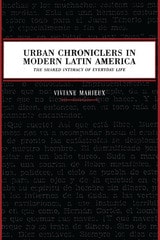
Urban Chroniclers in Modern Latin America
The Shared Intimacy of Everyday LifeBy Viviane Mahieux
University of Texas Press, 2011
An unstructured genre that blends high aesthetic standards with nonfiction commentary, the journalistic crónica, or chronicle, has played a vital role in Latin American urban life since the nineteenth century. Drawing on extensive archival research, Viviane Mahieux delivers new testimony on how chroniclers engaged with modernity in Mexico City, Buenos Aires, and São Paulo during the 1920s and 1930s, a time when avant-garde movements transformed writers' and readers' conceptions of literature. Urban Chroniclers in Modern Latin America: The Shared Intimacy of Everyday Life examines the work of extraordinary raconteurs Salvador Novo, Cube Bonifant, Roberto Arlt, Alfonsina Storni, and Mário de Andrade, restoring the original newspaper contexts in which their articles first emerged.
Each of these writers guided their readers through a constantly changing cityscape and advised them on matters of cultural taste, using their ties to journalism and their participation in urban practice to share accessible wisdom and establish their role as intellectual arbiters. The intimate ties they developed with their audience fostered a permeable concept of literature that would pave the way for overtly politically engaged chroniclers of the 1960s and 1970s. Providing comparative analysis as well as reflection on the evolution of this important genre, Urban Chroniclers in Modern Latin America is the first systematic study of the Latin American writers who forged a new reading public in the early twentieth century.