Results by title
10 books match the query 'Maritime'
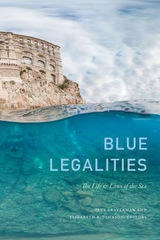
Blue Legalities
The Life and Laws of the SeaIrus Braverman and Elizabeth R. Johnson, editors
Duke University Press, 2019
Contributors. Stacy Alaimo, Amy Braun, Irus Braverman, Holly Jean Buck, Jennifer L. Gaynor, Stefan Helmreich, Elizabeth R. Johnson, Stephanie Jones, Zsofia Korosy, Berit Kristoffersen, Jessica Lehman, Astrida Neimanis, Susan Reid, Alison Rieser, Katherine G. Sammler, Astrid Schrader, Kristen L. Shake, Phil Steinberg

Ocean Yearbook, Volume 16
Edited by Elisabeth Mann Borgese, Aldo Chircop, and Moira L. McConnell
University of Chicago Press, 2002
Selected Documents and Proceedings include:
Report of the International Ocean Institute 1999 - 2000
Oceans and the Law of the Sea Report of the Secretary General, 2000
UN Convention on the Law of the Sea Report
The Hamburg Declaration on the Ocean
The Fiji Declaration on Islands in the New Millennium
The Appendix includes a Directory of Oceans-related Institutions
Since its inception in 1978, the Ocean Yearbook has proven an invaluable research tool to marine biologists, oceanographers, ocean development specialists, students of international law, as well as analysts of foreign policy and international security.
Ocean Yearbook, Volume 17
Edited by Elisabeth Mann Borgese, Aldo Chircop, and Moira L. McConnell
University of Chicago Press, 2003
Ocean Yearbook is a collaborative initiative of the International Ocean Institute and the Marine and Environmental Law Programme at Dalhousie University Law School.
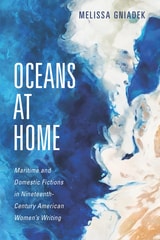
Oceans at Home
Maritime and Domestic Fictions in Nineteenth-Century American Women's WritingMelissa Gniadek
University of Massachusetts Press, 2021
Melissa Gniadek explores the role of the ocean, with particular attention to the Pacific, in a diverse range of literary texts spanning the late 1820s through the mid-1860s from Lydia Maria Child, Caroline Kirkland, Harriet Beecher Stowe, Elizabeth Stoddard, and Harriet Prescott Spofford. Oceans at Home shows that authors employed maritime plots and stories from distant locations to probe contemporary concerns facing the continental United States, ranging from issues of gender restrictions in the domestic sphere to the racial prejudices against indigenous peoples that lay at the heart of settler colonialism.
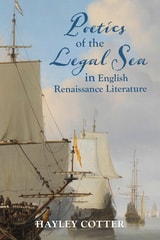
Poetics of the Legal Sea in English Renaissance Literature
Hayley Cotter
University of Alabama Press, 2026
A vivid exploration of how early modern literature transformed the law of the sea into a rich imaginative realm of maritime space and poetic possibility
Poetics of the Legal Sea in English Renaissance Literature is a richly layered study that traces how early modern writers imagined the sea as both a legal landscape and a site of narrative possibility. Through an interdisciplinary lens, the book illuminates the ways literary forms conceptualized the maritime laws that governed the early modern world. Its narrative moves fluidly between legal frameworks and poetic language, revealing a dynamic exchange between artistic expression and the systems that regulated life at sea.
Hayley Cotter’s analysis charts a metaphorical voyage, guiding readers from the calm departure of genre and jurisdiction through turbulent encounters with piracy, shipwreck, and salvage. Plays and poems become vessels that carry ideas about authority, justice, and sovereignty, while rhetorical devices such as metaphor, synecdoche, and metonymy deepen the imaginative pull of maritime experience. This journey foregrounds the cognitive effects of literary language, showing how early modern authors engaged with legal culture in ways that often moved beneath the surface of conscious thought.
As the chapters progress, literary texts become active participants in shaping understandings of law and maritime space. Shakespearean drama, Elizabethan pirate tales, sonneteering traditions, and anonymous sea poems all contribute to a vibrant conversation about how societies negotiated law and commerce on the open water. Bringing together readers interested in early modern literature, maritime history, and interdisciplinary inquiry, Poetics of the Legal Sea in English Renaissance Literature offers a compelling exploration of how the ocean’s vast, shifting expanse inspired new ways of thinking about power and the stories that give shape to legal life.
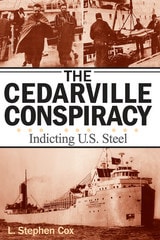
The Cedarville Conspiracy
Indicting U.S. SteelL. Stephen Cox
University of Michigan Press, 2005
The Cedarville Conspiracy is the story of that doomed ship and its crew. It is also the first Great Lakes history to expose the heroism, villainy, courage, and confusion surrounding the Cedarville disaster.
In atmospheric, cinematic style, L. Stephen Cox's gripping page-turner dramatizes the events surrounding the collision between the Norwegian and American freighters. As the mortally wounded Cedarville began to list and sink, U.S. Steel refused to allow the crew to escape to safety, while the captain secretly donned his life jacket and abandoned the sinking ship. Ten seamen died in the frigid waters that morning as the captain and survivors swam to safety.
Researching the story, author L. Stephen Cox interviewed the surviving crew and their rescuers and attorneys, examined more than 20,000 pages of Coast Guard reports, and discovered deposition transcripts and other documentary evidence that detailed the deterioration of the ship, the captain's disregard of Great Lakes navigational rules, the company's participation in the decision to confine the men aboard the sinking vessel, and the subsequent efforts by U.S. Steel to manipulate the evidence.
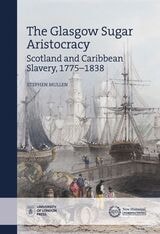
The Glasgow Sugar Aristocracy
Scotland and Caribbean Slavery, 1775–1838Stephen Mullen
University of London Press, 2020
This important book assesses the size and nature of Caribbean slavery’s economic impact on British society. The Glasgow Sugar Aristocracy, a grouping of West India merchants and planters, became active before the emancipation of chattel slavery in the British West Indies in 1834. Many acquired nationally significant fortunes, and their investments percolated into the Scottish economy and wider society. At its core, the book traces the development of merchant capital and poses several interrelated questions during an era of rapid transformation, namely, what impact the private investments of West India merchants and colonial adventurers had on metropolitan society and the economy, as well as the wider effects of such commerce on industrial and agricultural development.
The book also examines the fortunes of temporary Scottish economic migrants who traveled to some of the wealthiest of the Caribbean islands, presenting the first large-scale survey of repatriated slavery fortunes via case studies of Scots in Jamaica, Grenada, and Trinidad before emancipation in 1834. It, therefore, takes a new approach to illuminate the world of individuals who acquired West Indian fortunes and ultimately explores, in an Atlantic frame, the interconnections between the colonies and metropole in the late eighteenth and early nineteenth centuries.
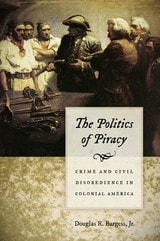
The Politics of Piracy
Crime and Civil Disobedience in Colonial AmericaDouglas R. Burgess
University Press of New England, 2014
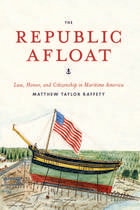
The Republic Afloat
Law, Honor, and Citizenship in Maritime AmericaMatthew Taylor Raffety
University of Chicago Press, 2013

Who Rules the Waves?
Piracy, Overfishing and Mining the OceansDenise Russell
Pluto Press, 2010
With piracy raging in the Indian Ocean, international disputes over undersea oil and gas, and chronic overfishing, the oceans have rarely been subject to such varied and environmentally damaging conflict outside a world war. In Who Rules the Waves? Denise Russell gives us a rare insight into these issues and how they could be resolved.
International law states that a coastal country has territorial rights for 12 miles into the sea beyond its coastline, and economic rights for 200 miles, but in practice many countries have virtually no control over their own waters, and there is no international agency powerful enough to settle disputes. Russell provides a thorough examination of the politics of the sea, showing that without a radical change in ocean governance, accelerating climate change and overuse of the sea's resources is likely to have catastrophic effects.