Results by title

29 books match the query 'Market'
cover of Art and the Market: Roger Fry on Commerce in Art, Selected Writings, Edited with an Interpretation

Art and the Market

Roger Fry on Commerce in Art, Selected Writings, Edited with an Interpretation

Craufurd D. Goodwin

University of Michigan Press, 1998

Roger Fry, a core member of the Bloomsbury Group, was involved with all aspects of the art market as artist, critic, curator, historian, journalist, advisor to collectors, and gallery operator. He is especially remembered as the person who introduced postimpressionist art to Britain.
Reprinted in this volume are seventeen of Fry's works on commerce in art. Although he had no formal training in economics, Fry addressed the art market as a modern economist might do. It is therefore fitting that his writings receive here an original interpretation from the perspective of a modern economist, Craufurd D. Goodwin. Goodwin explores why Fry's work is both a landmark in the history of cross-disciplinary thought and a source of fresh insights into a wide range of current policy questions.
The new writings included contain Fry's most important contributions to theory, history, and debates over policy as he explored the determinants of the supply of art, the demand for art, and the art market institutions that facilitate exchange. His ideas and speculations are as stimulating and provocative today as when they were written.
"A fascinating selection of essays by one of the twentieth century's most thoughtful and stimulating critics. Goodwin's introduction sets the stage beautifully, providing useful links to Veblen and Keynes." --D. E. Moggridge, University of Toronto
"Art and the Market uncovers new connections between aesthetics and art in the Bloomsbury Group. . . . Goodwin adds significantly to the understanding of cultural economics in the work of Fry himself as well as J. M. Keynes and even Leonard and Virginia Woolf." --S. P. Rosenbaum, University of Toronto
"All those interested in the arts and economics, and their connections, will be delighted by this collection, as will be students of Bloomsbury." --Peter Stansky, Stanford University
Craufurd D. Goodwin is James B. Duke Professor of Economics, Duke University.
[more]
cover of Between Jesus and the Market: The Emotions that Matter in Right-Wing America

Between Jesus and the Market

The Emotions that Matter in Right-Wing America

Linda Kintz

Duke University Press, 1997

Between Jesus and the Market looks at the appeal of the Christian right-wing movement in contemporary American politics and culture. In her discussions of books and videotapes that are widely distributed by the Christian right but little known by mainstream Americans, Linda Kintz makes explicit the crucial need to understand the psychological makeup of born-again Christians as well as the sociopolitical dynamics involved in their cause. She focuses on the role of religious women in right-wing Christianity and asks, for example, why so many women are attracted to what is often seen as an antiwoman philosophy. The result, a telling analysis of the complexity and appeal of the "emotions that matter" to many Americans, highlights how these emotions now determine public policy in ways that are increasingly dangerous for those outside familiarity’s circle.
With texts from such organizations as the Christian Coalition, the Heritage Foundation, and Concerned Women for America, and writings by Elizabeth Dole, Newt Gingrich, Pat Robertson, and Rush Limbaugh, Kintz traces the usefulness of this activism for the secular claim that conservative political economy is, in fact, simply an expression of the deepest and most admirable elements of human nature itself. The discussion of Limbaugh shows how he draws on the skepticism of contemporary culture to create a sense of absolute truth within his own media performance—its truth guaranteed by the market. Kintz also describes how conservative interpretations of the Holy Scriptures, the U.S. Constitution, and the Declaration of Independence have been used to challenge causes such as feminism, women’s reproductive rights, and gay and lesbian rights. In addition to critiquing the intellectual and political left for underestimating the power of right-wing grassroots organizing, corporate interests, and postmodern media sophistication, Between Jesus and the Market discusses the proliferation of militia groups, Christian entrepreneurship, and the explosive growth and "selling" of the Promise Keepers.

[more]
cover of Building a Market: The Rise of the Home Improvement Industry, 1914-1960

Building a Market

The Rise of the Home Improvement Industry, 1914-1960

Richard Harris

University of Chicago Press, 2012
Each year, North Americans spend as much money fixing up their homes as they do buying new ones. This obsession with improving our dwellings has given rise to a multibillion-dollar industry that includes countless books, consumer magazines, a cable television network, and thousands of home improvement stores.
Building a Market charts the rise of the home improvement industry in the United States and Canada from the end of World War I into the late 1950s. Drawing on the insights of business, social, and urban historians, and making use of a wide range of documentary sources, Richard Harris shows how the middle-class preference for home ownership first emerged in the 1920s—and how manufacturers, retailers, and the federal government combined to establish the massive home improvement market and a pervasive culture of Do-It-Yourself. 
Deeply insightful, Building a Market is the carefully crafted history of the emergence and evolution of a home improvement revolution that changed not just American culture but the American landscape as well.
[more]
cover of Concept and Controversy: Sixty Years of Taking Ideas to Market

Concept and Controversy

Sixty Years of Taking Ideas to Market

By W. W. Rostow

University of Texas Press, 2003

A trusted advisor to Presidents Eisenhower, Kennedy, and Johnson and one of America's leading professors of economic history, W. W. Rostow has helped shape the intellectual debate and governmental policies on major economic, political, and military issues since World War II. In this thought-provoking memoir, he takes a retrospective look at eleven key policy problems with which he has been involved to show how ideas flow into concrete action and how actions taken or not taken in the short term actually determine the long run that we call "the future."

The issues that Rostow discusses are these:

  • The use of air power in Europe in the 1940s
  • Working toward a united Europe during the Cold War
  • The death of Joseph Stalin and early attempts to end the Cold War
  • Eisenhower's Open Skies policy
  • The debate over foreign aid in the 1950s
  • The economic revival of Korea
  • Efforts to control inflation in the 1960s
  • Waiting for democracy in China
  • The Vietnam War and Southeast Asian policy
  • U.S. urban problems in disadvantaged neighborhoods
  • The challenges posed by declining population in the twenty-first century

In discussing how he and others have worked to meet these challenges, Rostow builds a compelling case for including long-term forces in the making of current policy. He concludes his memoir with provocative reflections on the twentieth and twenty-first centuries and on how individual actors shape history.
[more]
cover of Faith in the Market: Religion and the Rise of Urban Commercial Culture

Faith in the Market

Religion and the Rise of Urban Commercial Culture

Edited by John M. Giggie and Diane Winston

Rutgers University Press, 2002

Scholars have long assumed that industrialization and the growth of modern cities signaled a decline of religious practice among urban dwellers - that urban commercial culture weakened traditional religious ties by luring the faithful away from their devotional practice. Spanning many disciplines, the essays in this volume challenge this notion of the "secular city" and examine how members of metropolitan houses of worship invented fresh expressions of religiosity by incorporating consumer goods, popular entertainment, advertising techniques, and marketing into their spiritual lives. Faith in the Market explores phenomena from Salvation Army "slum angels" to the "race movies" of the mid-twentieth century, from Catholic teens' modest dress crusades to Black Muslim artists. The contributors-integrating gender, performance, and material culture studies into their analyses-reveal the many ways in which religious groups actually embraced commercial culture to establish an urban presence. Although the city streets may have proved inhospitable to some forms of religion, many others, including evangelicalism, Catholicism, and Judaism, assumed rich and complex forms as they developed in vital urban centers.
[more]
cover of From Central Planning to the Market: Transformation of the Czech Economy 1989 – 2004

From Central Planning to the Market

Transformation of the Czech Economy 1989 – 2004

Libor Zidek

Central European University Press, 2018

This book describes the process of the Czech economic transformation from the beginning of the 1990s to the country's entry into the European Union in 2004. This transformation is divided into four periods: an initial recession caused by the transformation; economic growth in the mid-1990s; a recession connected to the currency crisis of 1997; and recovery and growth from 1999 until 2004, when the analysis ends. The examination covers the main aspects of the transformation – an overall view of the process, political transition, economic policy, economic results (GDP development, inflation, unemployment), changes in outside indicators (balance of payments), privatization, transformation of the financial sector, and changes in the business sector and institutional development. The book also compares Czech development in this transformative era to those of Poland and Hungary. As in Hungary and Poland, the Czech Republic underwent an exceptional qualitative shift from a system centrally planned to one that was market-based. The book concludes that despite mistakes and hardships, the overall transformation process in Central Europe has been successful.
[more]
cover of Media, Market, and Democracy in China: Between the Party Line and the Bottom Line

Media, Market, and Democracy in China

Between the Party Line and the Bottom Line

Yuezhi Zhao

University of Illinois Press, 1998

How do market forces influence the media in China? How does the Party both introduce and try to contain the market's influence? How do commercial imperatives both accommodate and challenge Party control? 

Yuezhi Zhao interviewed a wide range of scholars, media administrators, and media professionals to answer these and other questions. Working in China in 1994 and 1995, she monitored media content, carried out extensive documentary research in Beijing, and held off-the-record meetings with Chinese media insiders. What she found informs an in-depth look at the intertwining nature of the Communist Party and the news media in China, how they affect each other, and what the future might hold for each. 

A rare on-the-ground portrait, Media, Market, and Democracy in China is must reading for scholars, media and business professionals, and policymakers who need to understand what happened to China and its mass media during a period of dynamic growth and change.
[more]
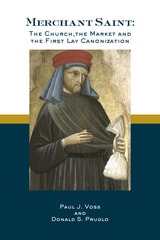
cover of Merchant Saint: The Church, the Market, and the First Lay Canonization

Merchant Saint

The Church, the Market, and the First Lay Canonization

prudlo

St. Augustine's Press, 2024

Paul Voss and Donald Prudlo trace Western attitudes to money, merchants, and the market through 3,000 years of history. They focus their attention on one person in particular, Omobono of Cremona (1117–1197), as an axial figure in the wholesale reappraisal of the value of business, entrepreneurship, and white-collar work in Christian Europe. More precisely, Voss and Prudlo examine the evolution of the mentality of wealth and economics in the Catholic Church, beginning from the Scriptural disdain for material pursuits and moving to the eventually declared sainthood of Omobono, a lay merchant living amid the hectic rhythm of a life of business. As the authors note, "His story resonates today with an unexpected poignancy for the contribution it makes to the pressing issues of economic justice, free markets, work-life balance, the 'theology of work,' and Catholic history." The reconstruction of the socio-theological perspective of wealth is a fascinating contribution to contemporary attempts to reconcile culture, capitalism, and the common good. Omobono stands as the first lay individual proposed by the Catholic Church as a model of heroic virtue, and thought him commercial life came thereby also to be 'canonized' as a possible path to sanctity. 

Voss and Prudlo provide a rich resource for readers concerned with the proper aims and boundaries of a life in the world of commerce, the nature of work, the ethics of profit, the problem of money-lending, the virtues needed for moral capitalism, and the tension between otium and negotium. Voss and Prudlo have accumulated a veritable trove of primary text materials relating to the life of Omobono, and provide translations and commentary to complete their analysis. This fascinating account crosses the threshold of pure history and stimulates inquiry in the fields of philosophy, economics, and theology. 
 
[more]
cover of Music In The Market

Music In The Market

Don Cusic

University of Wisconsin Press, 1996

Cusic examines the music business in the context of popular culture, the ways that popular music is disseminated in the American commercial market, the money flow, talent acquisition and development, artwork and promotion, and the strategies of multinational recording companies as they market music to consumers through media and retailers. He also discusses the marketing of specialty music—classical, gospel, jazz, bluegrass, rap, and folk, by small independent labels.
[more]
cover of Non-Design: Architecture, Liberalism, and the Market

Non-Design

Architecture, Liberalism, and the Market

Anthony Fontenot

University of Chicago Press, 2021
Anthony Fontenot’s staggeringly ambitious book uncovers the surprisingly libertarian heart  of the most influential British and American architectural and urbanist discourses of the postwar period, expressed as a critique of central design and a support of spontaneous order. Non-Design illuminates the unexpected philosophical common ground between enemies of state support, most prominently the economist Friedrich Hayek, and numerous notable postwar architects and urbanists like Robert Venturi, Denise Scott Brown, Reyner Banham, and Jane Jacobs. These thinkers espoused a distinctive concept of "non-design,"characterized by a rejection of conscious design and an embrace of various phenomenon that emerge without intention or deliberate human guidance. This diffuse and complex body of theories discarded many of the cultural presuppositions of the time, shunning the traditions of modern design in favor of the wisdom, freedom, and self-organizing capacity of the market. Fontenot reveals the little-known commonalities between the aesthetic deregulation sought by ostensibly liberal thinkers and Hayek’s more controversial conception of state power, detailing what this unexplored affinity means for our conceptions of political liberalism. Non-Design thoroughly recasts conventional views of postwar architecture and urbanism, as well as liberal and libertarian philosophies.
[more]
cover of Not Only the Market

Not Only the Market

Martin Potucek

Central European University Press, 1999
Successful transition for any post-communist country is reliant upon market, government and the civil sector. Potucek's pioneering study of the Czech Republic highlights the early transitional mistakes made during the Klaus era with respect to the role of these sectors. Not Only the Market examines the balance between where the sectors are or should be and makes useful comparisons with other post-communist countries. Focusing on developmental issues, the book looks at a number of public concerns including social and health care reform, privatization and the emerging patterns of corporatism and examines problems such as insufficient legislation, excessive lenience and the incompetence of public administration which has created an unreasonably large space for socio-pathological forces - corruption, Mafia activity and the siphoning of public funds into private hands. The causes and consequences of these forces are considered and Potucek provides a blueprint of reform which emphasizes the necessity of a conscious public policy to optimize both freedom and inequality.
[more]
cover of Persons of the Market: Conservatism, Corporate Personhood, and Economic Theology

Persons of the Market

Conservatism, Corporate Personhood, and Economic Theology

Kevin Musgrave

Michigan State University Press, 2022

Taking corporate personhood as a starting point, Persons of the Market observes the complex historical entanglement of Christian theology and liberal capitalism to shed new
light on their seemingly odd marriage in contemporary American politics. Author Kevin Musgrave highlights the ways that theories of corporate and human personhood have long been and remain bound together by examining four case studies: the U.S. Supreme Court’s 1886 Santa Clara decision, the role of early twentieth-century advertisers in endowing corporations with souls, Justice Lewis Powell Jr.’s eponymous memo of 1971, and the arc of the conservative movement from Ronald Reagan to Donald Trump. Tracing this rhetorical history of the extension and attribution of personhood to the corporate form illustrates how the corporation has for many increasingly become a normative model or ideal to which human persons should aspire. In closing, the book offers preliminary ideas about how we might fashion a more democratic and humane understanding of what it means to be a person.
[more]
cover of Publishing Beyond the Market: Open Access, Care, and the Commons

Publishing Beyond the Market

Open Access, Care, and the Commons

Samuel A. Moore

University of Michigan Press, 2025

Publishing Beyond the Market argues that the move to open access should focus less on the free accessibility of research outputs and more on who controls the publications and infrastructures for scholarly communication. By deploying theoretical literature on science and technology studies, care ethics, and the commons, the book critically interrogates open access and reimagines a more ethical future for researcher-led publishing. A case study of Plan S—the multifunder European policy for open access publishing—explores its tendency to rehearse all the failures of commercialisation. Through critical engagement with the open access landscape, the book reveals the shortcomings of market-centric and policy-based approaches to open access book and journal publishing, particularly their tendency to reinforce conservatism, commercialism, and private control of publishing.

Going forward, Publishing Beyond the Market explores the importance of collectivity and democratic governance within the transition to open access publishing. It suggests that developing a commons-based, scholar-led publishing landscape through a series of presses that are each managed by working academics could offer a productive counterpoint to marketised systems of open access and subscription publishing. In weaving themselves together in order to “scale small” these publishing initiatives would act as a counter-hegemonic project based on mutual reliance and care. By illustrating how these projects build toward a commons-based publishing future, and how they may complement other approaches to publishing within university presses and libraries, the book culminates in an argument for the infrastructures, policies, and forms of governance needed to nurture such a collective vision.
[more]
cover of Race, Nation, and Market: Economic Culture in Porfirian Mexico

Race, Nation, and Market

Economic Culture in Porfirian Mexico

Richard Weiner

University of Arizona Press, 2004
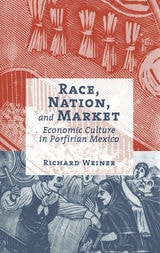
Prior to the Revolution of 1910, economic ideals were a dominant mode of political and social discourse in Mexico. Scholars have focused considerable attention on the expansion of the market economy during this period—particularly its political, economic, and social importance. Richard Weiner now enhances our understanding of the emergence of modern Mexico by exploring the market's immense symbolic significance. Race, Nation, and Market traces the intellectual strands of economic thought during the late Porfiriato. Even in the face of Díaz's political reign, the market became the dominant theme in national discourse as contemporaries of all political persuasions underscored its social and cultural effects. This work documents the ways in which liberals, radicals, and conservatives employed market rhetoric to establish their political identities and map out their courses of action, and it shows how the market became an emblem linked to the identity of each group. Weiner explains how the dominant political interests—the científicos, the Mexican Liberal Party, and the social Catholics—each conceived economic issues, and he compares how they rhetorically used their conceptions of the market to promote their political objectives. Some worshiped it as a deity that created social peace, political harmony, and material abundance, while others demonized it as a source of social destruction. Weiner delineates their approaches and reveals how distinct notions of race, gender, community, and nationality informed economic culture and contradicted a laissez-faire conception of society and economy. By focusing on these rhetorical contests, Race, Nation, and Market offers a new perspective on social mobilization in late nineteenth-century Mexico as it also explores the related field of Porfirian economic culture and thought, about which little thus far has been written. In the face of today's controversy over globalization, it offers a unique historical perspective on the market's long-standing significance to political activism.
[more]
cover of Rembrandt's Enterprise: The Studio and the Market

Rembrandt's Enterprise

The Studio and the Market

Svetlana Alpers

University of Chicago Press, 1990

"Singularly interesting and stimulating. . . . A passionate and original work of scholarship."—Richard Wollheim, Times Literary Supplement

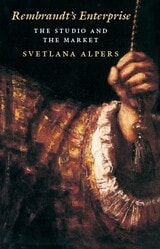
"With the publication [of Rembrandt's Enterprise], Svetlana Alpers has firmly established herself in the front ranks of art historians at work today. . . . The book is not a long one. Yet, there is more perceptive scholarship packed into its four chapters than is typically found in a whole shelf of the more common outpourings of academic writers. Rembrandt's Enterprise is less a book of archival discoveries than of fresh interpretation of the revered artist and his milieu. . . . Alpers makes us see how Rembrandt's complex and enormously popular art has embedded itself in our ways of thinking about who we are and how we live, even in the late 20th century."—Christopher Knight, Los Angeles Herald Examiner
[more]
cover of Revivalism and Cultural Change: Christianity, Nation Building, and the Market in the Nineteenth-Century United States

Revivalism and Cultural Change

Christianity, Nation Building, and the Market in the Nineteenth-Century United States

George M. Thomas

University of Chicago Press, 1989

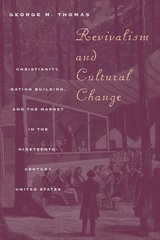
The history of Christianity in America has been marked by recurring periods of religious revivals or awakenings. In this book, George M. Thomas addresses the economic and political context of evangelical revivalism and its historical linkages with economic expansion and Republicanism in the nineteenth century. Thomas argues that large-scale change results in social movements that articulate new organizations and definitions of individual, society, authority, and cosmos. Drawing on religious newspapers, party policies and agendas, and quantitative analyses of voting patterns and census data, he claims that revivalism in this period framed the rules and identities of the expanding market economy and the national policy.

"Subtle and complex. . . . Fascinating."—Randolph Roth, Pennsylvania History

"[Revivalism and Cultural Change] should be read with interest by those interested in religious movements as well as the connections among religion, economics, and politics."—Charles L. Harper, Contemporary Sociology

"Readers old and new stand to gain much from Thomas's sophisticated study of the macrosociology of religion in the United States during the nineteenth century. . . . He has given the sociology of religion its best quantitative study of revivalism since the close of the 1970s."—Journal for the Scientific Study of Religion

[more]
cover of Shakespearean Pragmatism: Market of His Time

Shakespearean Pragmatism

Market of His Time

Lars Engle

University of Chicago Press, 1993

Just as Shakespeare's theater was an economic gamble, subject to the workings of a market, so the plays themselves submit actions, persons, and motives to an audience's judgment. Such a theatrical economy, Lars Engle suggests, provides a model for the way in which truth is determined and assessed in the world at large—a model much like that offered by contemporary pragmatism.

To Engle, the problems of worth, price, and value that appear so frequently in Shakespeare's works reveal a playwright dramatizing the negotiable nature of perception and belief—in short, the nature of his audience's purchase on reality. This innovative argument is the first to view Shakespeare in the context of contemporary pragmatism and to show that Shakespeare in many ways anticipated pragmatism as it has been developed in the thought of Richard Rorty, Barbara Herrnstein Smith, and others. With detailed reference to the sonnets and plays, Engle explores Shakespeare's tendency to treat knowledge, truth, and certainty as relatively stable goods within a theatrical economy of social interaction. He shows the playwright recasting kingship, aristocracy, and poetic immortality in pragmatic terms.

As attentive to history as it is to contemporary theory, this book mediates between current and traditional accounts of Shakespeare. In doing so, it offers a sweeping new account of Shakespeare's enterprise that will interest philosophers, literary theorists, and Shakespeare scholars alike.
[more]
cover of Sovereign of the Market: The Money Question in Early America

Sovereign of the Market

The Money Question in Early America

Jeffrey Sklansky

University of Chicago Press, 2017

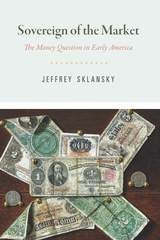
What should serve as money, who should control its creation and circulation, and according to what rules? For more than two hundred years, the “money question” shaped American social thought, becoming a central subject of political debate and class conflict.  Sovereign of the Market reveals how and why this happened.

Jeffrey Sklansky’s wide-ranging study comprises three chronological parts devoted to major episodes in the career of the money question. First, the fight over the innovation of paper money in colonial New England. Second, the battle over the development of commercial banking in the new United States. And third, the struggle over the national banking system and the international gold standard in the late nineteenth century. Each section explores a broader problem of power that framed each conflict in successive phases of capitalist development: circulation, representation, and association. The three parts also encompass intellectual biographies of opposing reformers for each period, shedding new light on the connections between economic thought and other aspects of early American culture. The result is a fascinating, insightful, and deeply considered contribution to the history of capitalism.

[more]
cover of Suq: Geertz on the Market

Suq

Geertz on the Market

Clifford Geertz

HAU, 2022

A formative ethnography of the relationship between markets and social life, back in print.
 
Originally published in 1979, Clifford Geertz’s essay on the Moroccan bazaar is a classic ethnographic account of the interplay of economic, social, and religious lives in the bustle of transaction. Drawing on years of fieldwork in the Middle Atlas town of Sefrou, Geertz explores how actors from diverse backgrounds assess the worth and meaning of other people’s wares, words, and ways of doing business. He shows how the search for market information, so central to the theorization of markets by economists, is here based on careful appraisals of social relations, embedded in understandings of the broader institutional environment of the market town and its hinterlands. With a richness of insights procured for generations of readers, Geertz’s essay on the sūq is a model of and for the craft of ethnographic theory. Long out of print, it is republished here in a stand-alone edition introduced by Lawrence Rosen.
[more]
cover of Switching to Digital Television: UK Public Policy and the Market

Switching to Digital Television

UK Public Policy and the Market

Michael Starks

Intellect Books, 2007

Sometime in the next four years, in a move that is bound to anger consumers and endanger the careers of politicians, the United Kingdom plans to turn off its analog, terrestrial television and switch fully to digital TV. Switching to Digital Television argues that, in order for the initiative to succeed, public policymakers need to carefully consider competitive market forces and collaborate with the broadcasting industry.
This authoritative study of the government policy behind the switchover also draws on the United Kingdom’s experience as a basis for comparative analysis of the United States, Japan, and western European nations, all of which will face similar questions in coming years.
 
“The book provides an interesting and ‘different’ history of Digital Television, and if you want to know why and how the decisions were made, it deserves a place on your bookshelf.”– Jim Slater, Image Technology Magazine
 
“Michael Starks brilliantly describes the complex mix of Government and industry responses to technological change which have led to the digital switchover process in the UK.”—Barry Cox, Chairman of Digital UK
 
 
[more]
cover of The Firm, the Market, and the Law

The Firm, the Market, and the Law

R. H. Coase

University of Chicago Press, 1987

A Nobel Prize winner's most important, groundbreaking work, collected in one volume

The Firm, the Market, and the Law gathers the most important and lasting works by Nobel Prize-winning economist Ronald Coase. Awarded the Nobel Prize in 1991 for his groundbreaking work on the significance of transaction costs and property rights, Coase continually urged his fellow economists to examine the real-world foundations on which their theories rest. This volume collects some of his classic articles probing those very foundations. "The Nature of the Firm" (1937) introduced the then-revolutionary concept of transaction costs into economic theory. "The Problem of Social Cost" (1960) further developed this concept, emphasizing the effect of the law on the working of the economic system. The remaining papers and new introductory essay clarify and extend Coarse's arguments and address his critics.

 

[more]
cover of The Firm, the Market, and the Law

The Firm, the Market, and the Law

R. H. Coase

University of Chicago Press, 1987

This is an auto-narrated audiobook version of this book. 

Few other economists have been read and cited as often as R.H. Coase has been, even though, as he admits, "most economists have a different way of looking at economic problems and do not share my conception of the nature of our subject." Coase's particular interest has been that part of economic theory that deals with firms, industries, and markets—what is known as price theory or microeconomics. He has always urged his fellow economists to examine the foundations on which their theory exists, and this volume collects some of his classic articles probing those very foundations. "The Nature of the Firm" (1937) introduced the then-revolutionary concept of transaction costs into economic theory. "The Problem of Social Cost" (1960) further developed this concept, emphasizing the effect of the law on the working of the economic system. The remaining papers and new introductory essay clarify and extend Coarse's arguments and address his critics.

"These essays bear rereading. Coase's careful attention to actual institutions not only offers deep insight into economics but also provides the best argument for Coase's methodological position. The clarity of the exposition and the elegance of the style also make them a pleasure to read and a model worthy of emulation."—Lewis A. Kornhauser, Journal of Economic Literature

Ronald H. Coase was awarded the Nobel Prize in Economic Science in 1991.

[more]
cover of The Gospel of Sustainability: Media, Market and LOHAS

The Gospel of Sustainability

Media, Market and LOHAS

Monica M. Emerich

University of Illinois Press, 2014
From organic produce and clothing to socially conscious investing and eco-tourism, the lifestyles of health and sustainability, or LOHAS, movement encompasses diverse products and practices intended to contribute to a more sustainable lifestyle for people and the planet. In The Gospel of Sustainability, Monica M. Emerich explores the contemporary spiritual expression of this green cultural shift at the confluence of the media and the market.
 
This is the first book to qualitatively study the LOHAS marketplace and the development of a discourse of sustainability of the self and the social and natural worlds. Emerich draws on myriad sources related to the notions of mindful consumption found throughout the LOHAS marketplace, including not just products and services but marketing materials, events, lectures, regulatory policies, and conversations with leaders and consumers. These disparate texts, she argues, universally project a spiritual message about personal and planetary health that is in turn reforming capitalism by making consumers more conscious.
[more]
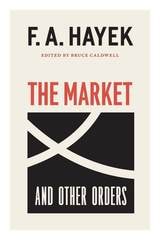
cover of The Market and Other Orders

The Market and Other Orders

F. A. Hayek

University of Chicago Press, 2013

In addition to his groundbreaking contributions to pure economic theory, F. A. Hayek also closely examined the ways in which the knowledge of many individual market participants could culminate in an overall order of economic activity. His attempts to come to terms with the “knowledge problem” thread through his career and comprise the writings collected in the fifteenth volume of the University of Chicago Press’s Collected Works of F. A. Hayek series.

The Market and Other Orders brings together more than twenty works spanning almost forty years that consider this question. Consisting of speeches, essays, and lectures, including Hayek’s 1974 Nobel lecture, “The Pretense of Knowledge,” the works in this volume draw on a broad range of perspectives, including the philosophy of science, the physiology of the brain, legal theory, and political philosophy. Taking readers from Hayek’s early development of the idea of spontaneous order in economics through his integration of this insight into political theory and other disciplines, the book culminates with Hayek’s integration of his work on these topics into an overarching social theory that accounts for spontaneous order in the variety of complex systems that Hayek studied throughout his career.

Edited by renowned Hayek scholar Bruce Caldwell, who also contributes a masterly introduction that provides biographical and historical context, The Market and Other Orders forms the definitive compilation of Hayek’s work on spontaneous order.
[more]
cover of The Market and Other Orders

The Market and Other Orders

F. A. Hayek

University of Chicago Press, 2013

This is an auto-narrated audiobook version of this book.

In addition to his groundbreaking contributions to pure economic theory, F. A. Hayek also closely examined the ways in which the knowledge of many individual market participants could culminate in an overall order of economic activity. His attempts to come to terms with the “knowledge problem” thread through his career and comprise the writings collected in the fifteenth volume of the University of Chicago Press’s Collected Works of F. A. Hayek series.

The Market and Other Orders brings together more than twenty works spanning almost forty years that consider this question. Consisting of speeches, essays, and lectures, including Hayek’s 1974 Nobel lecture, “The Pretense of Knowledge,” the works in this volume draw on a broad range of perspectives, including the philosophy of science, the physiology of the brain, legal theory, and political philosophy. Taking readers from Hayek’s early development of the idea of spontaneous order in economics through his integration of this insight into political theory and other disciplines, the book culminates with Hayek’s integration of his work on these topics into an overarching social theory that accounts for spontaneous order in the variety of complex systems that Hayek studied throughout his career.

Edited by renowned Hayek scholar Bruce Caldwell, who also contributes a masterly introduction that provides biographical and historical context, The Market and Other Orders forms the definitive compilation of Hayek’s work on spontaneous order.
[more]
cover of This Little Kiddy Went to Market: The Corporate Capture of Childhood

This Little Kiddy Went to Market

The Corporate Capture of Childhood

Sharon Beder, Wendy Varney, and Richard Gosden

Pluto Press, 2009

This book investigates the way that corporations are strategically shaping children to be under-aged hyperconsumers as well as the submissive employees and uncritical citizens of the future.

Sharon Beder shows how marketers and advertisers are targeting ever younger children in a relentless campaign, transforming children's play into a commercial opportunity and taking advantage of childish anxieties. 

Beder investigates the corporate relations and ideals that infiltrate every aspect of our lives. She presents an alarming picture of how a child's social development -- through education, health care and nutrition -- has become an ordered conveyor belt of consumerist conditioning. Focusing on education in particular, Beder explains how businesses are taking control of more and more aspects of schooling, not only for profit but to erode state schooling and promote business values. Similarly, she shows how 'difficult' children are taught from an early age that pharmaceuticals can be used to discipline them or to make them 'happy'.
[more]
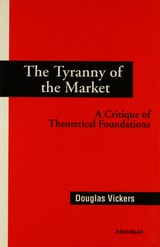
cover of Tyranny of the Market: A Critique of Theoretical Foundations

Tyranny of the Market

A Critique of Theoretical Foundations

Douglas Vickers

University of Michigan Press, 1995

This book critically reviews and evaluates a number of central theoretical concepts that have shaped economists' analysis of markets. In a rigorous discussion of the demand and supply sides of the market, Douglas Vickers questions the cogency of many of the established ideas and tools of economic analysis. The critique relies considerably on the significance of real historical time and the epistemic uniqueness of individuals in decision making. The author identifies deficiencies in the concepts of utility and its cognate -- preference orderings on the demand side of the market, and in marginal productivity and the related theory of income distribution on the supply side. Setting the critique of received traditions in historical perspective, The Tyranny of the Market reviews the bequests to contemporary theory of classical and neoclassical economics. The analytical problem of the place and significance of money in economic argument is addressed and the nonneutrality and substantial endogeneity of money are clarified. The book's analysis of macromarket failure, or the failure of the market system to provide automatically for the full employment of economic resources, incorporates a monetary-flow model of the macroeconomy. Economic theorists and scholars in related disciplines will appreciate the originality of the book's critique of the neoclassical and competing systems of thought.
[more]
cover of Tyson: From Farm to Market

Tyson

From Farm to Market

Marvin Schwartz

University of Arkansas Press, 1991
Marvin Schwartz chronicles the story of Tyson Foods and its impact on both the business community and the poultry market in America in an entertaining and enlightening tribute to the Tyson vision and success.
[more]
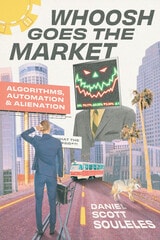
cover of Whoosh Goes the Market: Algorithms, Automation, and Alienation

Whoosh Goes the Market

Algorithms, Automation, and Alienation

Daniel Scott Souleles

University of Chicago Press, 2024

A vivid, fast-paced inside look at financial markets, the people who work on them, and how technology is changing their world (and ours).
 
Markets are messy, and no one knows this better than traders who work tirelessly to predict what they will do next. In Whoosh Goes the Market, Daniel Scott Souleles takes us into the day-to-day experiences of a team at a large trading firm, revealing what it’s actually like to make and lose money on contemporary capital markets.
 
The traders Souleles shadows have mostly moved out of the pits and now work with automated, glitch-prone computer systems. They remember the days of trading manually, and they are suspicious of algorithmically driven machine-learning systems. Openly musing about their own potential extinction, they spend their time expressing fear and frustration in profanity-laced language. With Souleles as our guide, we learn about everything from betting strategies to inflated valuations, trading swings, and market manipulation. This crash course in contemporary finance vividly reveals the existential anxiety at the evolving front lines of American capitalism.
[more]