Results by title

5 books match the query 'Marriage law'
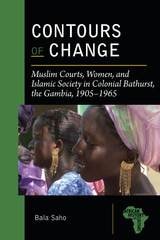
cover of Contours of Change: Muslim Courts, Women, and Islamic Society in Colonial Bathurst, the Gambia, 1905-1965

Contours of Change

Muslim Courts, Women, and Islamic Society in Colonial Bathurst, the Gambia, 1905-1965

Bala Saho

Michigan State University Press, 2018
Based on a previously unexamined body of qadi court records as well as two hundred oral interviews in Wolof and Mandinka, Contours of Change: Muslim Courts, Women, and Islamic Society in Colonial Bathurst, the Gambia, 1905–1965, offers a new perspective on the impact of British rule in West Africa. It focuses on the formation of present-day Banjul and the role of law, religion, and gender relations. Specifically, this volume explores how colonization affected the evolution of women’s understanding of the importance of law in securing their rights, and how urban women used the new qadi court system to fight for greater rights in the domestic sphere. The fascinating cases discussed in the text show that male Muslim judges often were sympathetic to women’s claims, and that, as a result, the qadi court created opportunities for women to acquire property rights and negotiate patriarchal relationships. Contours of Change sheds light on African subjectivities and the broader social, economic, and political changes taking place in colonial Gambian society during the first half of the twentieth century. This text breaks new ground in Senegambian history and makes a significant contribution to British colonial studies, African legal studies, Islam in Africa studies, and women’s history studies.
[more]
cover of Courting Desire: Litigating for Love in North India

Courting Desire

Litigating for Love in North India

Rama Srinivasan

Rutgers University Press, 2020
Inquiries into marital patterns can serve as an effective lens to analyze social structures and material cultures not only on the question of sexuality, but also on the nature of a private citizen’s engagement with state and law. Through ethnographic research in courtrooms, community,and kinship spaces, the author outlines the transformations in material culture and political economy that have led to renewed negotiations on the institution of marriage in North India, especially in legal spaces. Tracing organically evolving notions of sexual consent and legal subjectivity, Courting Desire underlines how non-normative decisions regarding marriage become possible in a region otherwise known for high instances of honor killings and rigid kinship structures. Aspirations for consensual relationships have led to a tentative attempt to forge relationships that are non-normative but grudgingly approved after state intervention. The book traces this nascent and under-explored trend in the North Indian landscape.  
 
[more]
cover of Covenant Marriage: The Movement to Reclaim Tradition in America

Covenant Marriage

The Movement to Reclaim Tradition in America

Nock, Steven

Rutgers University Press, 2008

Regardless how you interpret the statistics, the divorce rate in the United States is staggering. But, what if the government could change this? Would families be better off if new public policies made it more difficult for couples to separate?


This book explores a movement that emerged over the past fifteen years, which aims to do just that. Guided by certain politicians and religious leaders who herald marriage as a solution to a range of longstanding social problems, a handful of state governments enacted "covenant marriage" laws, which require couples to choose between a conventional and a covenant marriage. While the familiar type of union requires little effort to enter and can be terminated by either party unilaterally, covenant marriage requires premarital counseling, an agreement bound by fault-based rules or lengthy waiting periods to exit, and a legal stipulation that divorce can be granted only after the couple has received counseling.


Drawing on interviews with over 700 couples-half of whom have chosen covenant unions-this book not only evaluates the viability of public policy in the intimate affairs of marriage, it also explores how growing public discourse is causing men and women to rethink the meaning of marriage.
[more]
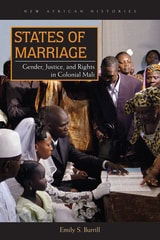
cover of States of Marriage: Gender, Justice, and Rights in Colonial Mali

States of Marriage

Gender, Justice, and Rights in Colonial Mali

Emily S. Burrill

Ohio University Press, 2015
States of Marriage shows how throughout the colonial period in French Sudan (present-day Mali) the institution of marriage played a central role in how the empire defined its colonial subjects as gendered persons with certain attendant rights and privileges. The book is a modern history of the ideological debates surrounding the meaning of marriage, as well as the associated legal and sociopolitical practices in colonial and postcolonial Mali. It is also the first to use declassified court records regarding colonialist attempts to classify and categorize traditional marriage conventions in the southern region of the country. In French Sudan, as elsewhere in colonial Africa, the first stage of marriage reform consisted of efforts to codify African marriages, bridewealth transfers, and divorce proceedings in public records, rendering these social arrangements “legible” to the colonial administration. Once this essential legibility was achieved, other, more forceful interventions to control and reframe marriage became possible. This second stage of marriage reform can be traced through transformations in and by the colonial court system, African engagements with state-making processes, and formations of “gender justice.” The latter refers to gender-based notions of justice and legal rights, typically as defined by governing and administrative bodies as well as by socioxadpolitical communities. Gender justice went through a period of favoring the rights of women, to a period of favoring patriarchs, to a period of emphasizing the power of the individual—but all within the context of a paternalistic and restrictive colonial state.
[more]
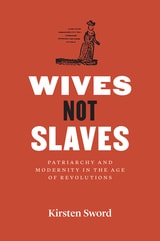
cover of Wives Not Slaves: Patriarchy and Modernity in the Age of Revolutions

Wives Not Slaves

Patriarchy and Modernity in the Age of Revolutions

Kirsten Sword

University of Chicago Press, 2021

Wives not Slaves begins with the story of John and Eunice Davis, a colonial American couple who, in 1762, advertised their marital difficulties in the New Hampshire Gazette—a more common practice for the time and place than contemporary readers might think. John Davis began the exchange after Eunice left him, with a notice resembling the ads about runaway slaves and servants that were a common feature of eighteenth-century newspapers. John warned neighbors against “entertaining her or harbouring her. . . or giving her credit.” Eunice defiantly replied, “If I am your wife, I am not your slave.” With this pointed but problematic analogy, Eunice connected her individual challenge to her husband’s authority with the broader critiques of patriarchal power found in the politics, religion, and literature of the British Atlantic world.

Kirsten Sword’s richly researched history reconstructs the stories of wives who fled their husbands between the mid-seventeenth and early nineteenth centuries, comparing their plight with that of other runaway dependents.  Wives not Slaves explores the links between local justice, the emerging press, and transatlantic political debates about marriage, slavery and imperial power. Sword traces the relationship between the distress of ordinary households, domestic unrest, and political unrest, shedding new light on the social changes imagined by eighteenth-century revolutionaries, and on the politics that determined which patriarchal forms and customs the new American nation would—and would not—abolish.
[more]