Results by title
2 books match the query 'Marshall'

Marshall and Taney
Statesmen of the LawBen W. Palmer
University of Minnesota Press, 1939
Marshall and Taney was first published in 1939. Minnesota Archive Editions uses digital technology to make long-unavailable books once again accessible, and are published unaltered from the original University of Minnesota Press editions.
The tides of social, political, and economic conflict will surge more violently about the Supreme Court in the future than they have in the past. Constantly larger numbers of the people are becoming aware of the tremendous power of the court as final interpreter of the constitution as a check upon Congress and the executive, and as guardian of individuals and minorities against governmental power. As a president of the American Bar Association has said, "Producers of potatoes in Maine, peanuts in Virginia, cotton in South Carolina, cane sugar in Louisiana, wheat in Kansas, corn in Iowa, peaches in Georgia, oranges in California, and thousands of small local enterprises everywhere are coming more and more to realize that their own bread and butter is seriously affected by the personnel of the Supreme Court.
Since public opinion rules in America, the place that the court will occupy in the scheme of things will be determined by the thought and emotions of the people. Thought and emotion alike will, in turn, depend largely upon popular conceptions of the part played by the court. Those conceptions cannot be accurate without a knowledge of the functioning of the individual judge.
We can better comprehend present and future judges if we understand why past ones acted officially as they did. This study contributes materially to that understanding.
In the light of history and the law, Ben W. Palmer has made a clear and thought provoking analysis of the judicial function, indicated revolutionary changes in the law. In the sharply etched portraits of the two chief justices who molded American constitutional law in its formative stages, he has shown how and why these two men affect lawyer and laymen today.
"Law," says historian-lawyer Palmer, "like religion, government, art, science, receives its meaning and value, not because of what it has been or is, but because of what it accomplishes as an instrument for the benefit of humanity."
"The judge's most essential and unavoidable function," thinks Dr. Palmer, "is the attempt to reconcile the contending principles of liberty and order. He stands between rule and discretion, the strict law and one tempered by time, circumstance, abstract justice, popular feeling—all crying out for relaxation of the rule. He must stand between Shylock, with his shining knife of legal right, and the victim who calls to his compassion."
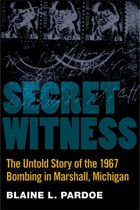
Secret Witness
The Untold Story of the 1967 Bombing in Marshall, MichiganBlaine Pardoe
University of Michigan Press, 2012
Every small town has a moment when the real world abruptly intrudes, shattering the town's notions of itself and its people. For citizens of Marshall, Michigan, that moment came August 18, 1967. Nola Puyear was working downtown at the Tasty Cafe that morning when she received a package. She opened it and was instantly killed in a fiery explosion.
In the months that followed, law enforcement and prosecutors wrestled with a crime that to all appearances was senseless. Evidence recovered from the blown-up restaurant, including a bottle of pills that had been tainted with lye, suggested a concerted plot to murder Mrs. Puyear. But why had someone wanted to kill the well-liked woman, by all accounts a pillar of her close-knit community? For that matter, was Marshall really the quaint paradise it seemed to be?
Secret Witness brings to light startling new evidence and freshly uncovered facts to address these and other questions that, to this day, surround one of Michigan's most brutal murders. Based on extensive interviews with surviving prosecutors, police, and witnesses, Blaine Pardoe re-creates the investigation that pried into Marshall's dark underbelly and uncovered the seamy private lives led by some of the town's citizenry but led to only tenuous theories about the bombing. The book also examines the pivotal role played by the Secret Witness program, an initiative by the Detroit News that offered rewards for anonymous tips related to violent crimes. What's ultimately revealed is the true depth of evil that occurred in Marshall that day. Every small town has dirty little secrets. This time, they were deadly.