Results by title
6 books match the query 'Martial Arts'
A Beautiful Fight
The Racial Politics of Capoeira in Backland BahiaEsther Viola Kurtz
University of Michigan Press, 2025
2026 Dance Studies Association de la Torre Bueno First Book Award Shortlist Finalist
A Beautiful Fight examines the potentials and limits of capoeira Angola to cohere a multiracial community committed to antiracist struggle. Capoeira, a musical fight-game that originated among enslaved Africans in Brazil, holds special significance for Black Brazilian activists as a spiritual and political practice that affirms the value of Black lives, thus countering anti-Black violence sanctioned by the Brazilian state. However, many capoeira groups count more white practitioners than Black, especially groups of the politicized, Afrocentric style capoeira Angola, raising debates about appropriation of Black culture that resonate across the Americas. A Beautiful Fight addresses these tensions. Drawing on ethnographic research with a multiracial capoeira Angola group in Brazil’s Bahian sertão or backlands, Esther Viola Kurtz explores diverse group members’ understandings of capoeira’s spiritual and political meanings and considers how white participation impacts capoeira’s antiracist politics. A Beautiful Fight argues that white practitioners occupying space in capoeira divert attention from Black members’ concerns and reproduce racist and colonialist ideologies, albeit unintentionally. In this way, the book complicates claims that shared music and dance bridge differences and facilitate cross-racial unity, yet Kurtz proposes that capoeira still transmits knowledge and tools that, when used with intention, commitment, and care, can be wielded to collaboratively contest racism and imagine a more just world.
Black Dragon
Afro Asian Performance and the Martial Arts ImaginationZachary F. Price
The Ohio State University Press, 2022

Fighting Visibility
Sports Media and Female Athletes in the UFCJennifer McClearen
University of Illinois Press, 2021
Mixed martial arts stars like Amanda Nunes, Zhang Weili, and Ronda Rousey have made female athletes top draws in the Ultimate Fighting Championship (UFC). Jennifer McClearen charts how the promotion incorporates women into its far-flung media ventures and investigates the complexities surrounding female inclusion. On the one hand, the undeniable popularity of cards headlined by women add much-needed diversity to the sporting landscape. On the other, the UFC leverages an illusion of promoting difference—whether gender, racial, ethnic, or sexual—to grow its empire with an inexpensive and expendable pool of female fighters. McClearen illuminates how the UFC's half-hearted efforts at representation generate profit and cultural cachet while covering up the fact it exploits women of color, lesbians, gender non-conforming women, and others.
Thought provoking and timely, Fighting Visibility tells the story of how a sports entertainment phenomenon made difference a part of its brand—and the ways women paid the price for success.
Graceful Resistance
How Capoeiristas Use Their Art for Activism and Community EngagementLauren Miller Griffith
University of Illinois Press, 2023
Capoeira began as a martial art developed by enslaved Afro-Brazilians. Today, the practice incorporates song, dance, acrobatics, and theatrical improvisation—and leads many participants into activism.
Lauren Miller Griffith’s extensive participant observation with multiple capoeira groups informs her ethnography of capoeiristas--both individuals and groups--in the United States. Griffith follows practitioners beyond their physical training into social justice activities that illuminate capoeira’s strong connection to resistance and subversion. As both individuals and communities of capoeiristas, participants march against racial discrimination, celebrate Martin Luther King Jr. Day and Juneteenth, organize professional clothing drives for job seekers, and pursue economic and environmental justice in their neighborhoods. For these people, capoeira becomes a type of serious leisure that contributes to personal growth, a sense of belonging, and an overall sense of self, while also imposing duties and obligations.
An innovative look at capoeira in America, Graceful Resistance reveals how the practicing of an art can catalyze action and transform communities.
The Hidden History of Capoeira
A Collision of Cultures in the Brazilian Battle DanceBy Maya Talmon-Chvaicer
University of Texas Press, 2007
Capoeira, a Brazilian battle dance and national sport, has become popular all over the world. First brought to Brazil by African slaves and first documented in the late eighteenth century, capoeira has undergone many transformations as it has diffused throughout Brazilian society and beyond, taking on a multiplicity of meanings for those who participate in it and for the societies in which it is practiced. In this book, Maya Talmon-Chvaicer combines cultural history with anthropological research to offer an in-depth study of the development and meaning of capoeira, starting with the African cultures in which it originated and continuing up to the present day.
Using a wealth of primary sources, Talmon-Chvaicer analyzes the outlooks on life, symbols, and rituals of the three major cultures that inspired capoeira—the Congolese (the historic area known today as Congo-Angola), the Yoruban, and the Catholic Portuguese cultures. As she traces the evolution of capoeira through successive historical eras, Talmon-Chvaicer maintains a dual perspective, depicting capoeira as it was experienced, observed, and understood by both Europeans and Africans, as well as by their descendants. This dual perspective uncovers many covert aspects of capoeira that have been repressed by the dominant Brazilian culture.
This rich study reclaims the African origins and meanings of capoeira, while also acknowledging the many ways in which Catholic-Christian culture has contributed to it. The book will be fascinating reading not only for scholars but also for capoeira participants who may not know the deeper spiritual meanings of the customs, amulets, and rituals of this jogo da vida, "game of life."
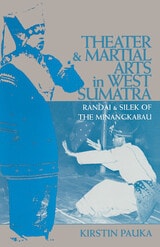
Theater and Martial Arts in West Sumatra
Randai and Silek of the MinangkabauKirstin Pauka
Ohio University Press, 1998
Randai, the popular folk theater tradition of the Minangkabau ethnic group in West Sumatra, has evolved to include influences of martial arts, storytelling, and folk songs. Theater and Martial Arts in West Sumatra describes the origin, development, and cultural background of randai and highlights two recent developments: the emergence of female performers and modern staging techniques.
This book also explores the indigenous martial arts form silek, a vital part of randai today. The strong presence of silek is illustrated in the martial focus of the stories that are told through randai, in its movement repertoire, and even in its costumes and musical accompaniment. As Kirstin Pauka shows, randai, firmly rooted in silek and Minangkabau tradition, is an intriguing mirror of the Minangkabau culture.