Results by title

13 books match the query 'Martyrdom'
cover of Between Resistance and Martyrdom: Jehovah's Witnesses in the Third Reich

Between Resistance and Martyrdom

Jehovah's Witnesses in the Third Reich

Detlef Garbe

University of Wisconsin Press, 2008

Between Resistance and Martyrdom is the first comprehensive historical study of the persecution of Jehovah’s Witnesses during the Holocaust era. Refusing to perform military service under Germany’s Third Reich due to their fundamental belief in nonviolence, Jehovah’s Witnesses caught the attention of the highest authorities in the justice system, the police, and the SS.
            Although persecuted and banned from practicing their beliefs by the Nazi regime in 1933, the Jehovah’s Witnesses’ unified resistance has been largely forgotten. Basing his work on a wide range of sources, including documents and archives previously unconsidered as well as critical analyses of Jehovah’s Witness literature and survivor interviews, Detlef Garbe chronicles the Nazi’s relentless persecution of this religious group before and during World War II.
    The English translation of this important work features a series of original photographs not published in the German edition. These striking images bring a sense of individual humanity to this story and help readers comprehend the reality of the events documented. Between Resistance and Martyrdom is an indispensable work that will introduce an English-speaking audience to this important but lesser-known part of Holocaust history.
[more]
cover of Fools, Martyrs, Traitors: The Story of Martyrdom in the Western World

Fools, Martyrs, Traitors

The Story of Martyrdom in the Western World

Lacey Baldwin Smith

Northwestern University Press, 1999
Lacey Baldwin Smith takes us on a riveting journey through history as he examines one of the most baffling characteristics of the human experience: the willingness to die to sanctify a deity, defend a cause, or simply to prove a point. By delving into the psyches, politics, and personalities of martyrs like Thomas Becket, John Brown, and Gandhi, he illuminates the complex and elusive subject of martyrdom as it has evolved over 2,500 years.
[more]
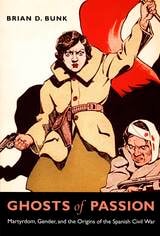
cover of Ghosts of Passion: Martyrdom, Gender, and the Origins of the Spanish Civil War

Ghosts of Passion

Martyrdom, Gender, and the Origins of the Spanish Civil War

Brian D. Bunk

Duke University Press, 2007

The question of what caused the Spanish Civil War (1936–39) is the central focus of modern Spanish historiography. In Ghosts of Passion, Brian D. Bunk argues that propaganda related to the revolution of October 1934 triggered the broader conflict by accentuating existing social tensions surrounding religion and gender. Through careful analysis of the images produced in books, newspapers, posters, rallies, and meetings, Bunk contends that Spain’s civil war was not inevitable. Commemorative imagery produced after October 1934 bridged the gap between rhetoric and action by dehumanizing opponents and encouraging violent action against them.

In commemorating the uprising, revolutionaries and conservatives used the same methods to promote radically different political agendas: they deployed religious imagery to characterize the political situation as a battle between good and evil, with the fate of the nation hanging in the balance, and exploited traditional gender stereotypes to portray themselves as the defenders of social order against chaos. The resulting atmosphere of polarization combined with increasing political violence to plunge the country into civil war.
[more]
cover of Isaac, Iphigeneia, and Ignatius: Martyrdom and Human Sacrifice

Isaac, Iphigeneia, and Ignatius

Martyrdom and Human Sacrifice

Monika Pesthy-Simon

Central European University Press, 2017
What is the meaning of the martyr’s sacrifice? Is it true that the martyr imitates Christ? After the “one and eternal” sacrifice of Jesus why are from time to time new (and often quite numerous) sacrifices necessary? What is the underlying concept concerning the divinity? How do these ideas survive in present times? These are the kind of questions behind the inquiries in this monograph. The author investigates martyrdom as a (voluntary) human sacrifice and wishes to demonstrate how human sacrifice has been turned into martyrdom. The two emblematic figures of this transformation are Iphigeneia and Isaac. Pesthy argues that all the peoples in the environment in which Christianity came into being are characterized by a very ambiguous and hypocritical attitude toward human sacrifice: while in theory they condemn it as barbarian and belonging to bygone times, in concrete cases they accept, admire and practice it. The same attitude survives in Christianity in which martyrs replace the human sacrifice of olden days: they are real sacrifices, not symbolical ones. Our feelings about martyrs can be very different: we may admire their unbending courage and heroism or be irritated by their stubbornness, or even feel disgusted at the fanaticism with which they strove for death. But whatever our feelings may be, we must admit that a very strong motivation is needed to accept voluntarily or even seek death (and, in the majority of cases, a very painful death at that).
[more]
cover of Patience and Salvation in Third Century North Africa: A Christian Latin Reader

Patience and Salvation in Third Century North Africa

A Christian Latin Reader

Sarah Wear

Catholic University of America Press, 2022

Patience and Salvation in Third Century North Africa: A Christian Latin Reader features the entirety of Tertullian’s To Martyrs and The Passion of Perpetua and Felicity, with selections from Cyprian’s On the Good of Patience and a short appendix on Augustine’s Commentary on Psalm 121.6. The Latin text has facing vocabulary and theological, historical, philosophical, and grammatical notes. In the first three centuries, Roman Carthage produced some of the earliest literature composed originally in Latin by Christians. Tertullian’s Ad Martyras (197); Passio Perpetuae et Felicitatis (203), and Cyprian’s De Bono Patientiae (256) all embody the force of this new genre of Latin literature. With this literature, we see a variant of Latin often denoted “Christian Latin.” Christian Latin featured linguistic elements marked by characteristics of biblical Latin, later Latin, as well as vulgarisms. In addition to converging philologically, Tertullian, the author of the Passio, and Cyprian align themselves in topos: they all ask the question of how one can endure torment and anxiety in this world. Patience (patientia), derived from the verb for “to suffer” (patior), is a virtue that allows one to endure troubles, anxieties, and physical pains with the hope of eternal happiness and salvation in heaven. In this Reader, the student will find three different literary perspectives on this theme. The book also draws parallels to the works of Seneca and Cicero on patience and suffering.
[more]
cover of Suicide Bombers: Allah's New Martyrs

Suicide Bombers

Allah's New Martyrs

Farhad Khosrokhavar

Pluto Press, 2005

[more]
cover of The Ancient Martyrdom Accounts of Peter and Paul

The Ancient Martyrdom Accounts of Peter and Paul

David L. Eastman

SBL Press, 2015

New English translations based upon the most up-to-date critical editions

This book for the first time collects the various ancient accounts of the martydoms of Peter and Paul, which number more than a dozen, along with more than forty references to the martyrdoms from early Christian literature. At last a more complete picture of the traditions about the deaths of Peter and Paul is able to emerge.

Features:

  • Greek, Latin, and Syriac accounts from antiquity translated into English
  • Introductions and notes for each text
  • Original texts are produced on facing pages for specialists
[more]
cover of The Day They Hanged Old Brown: The Making of Celebrity and Martyrdom in the Civil War Era

The Day They Hanged Old Brown

The Making of Celebrity and Martyrdom in the Civil War Era

John R. Van Atta

University of Missouri Press, 2025

Abolitionist, fanatic, terrorist, freedom fighter, alleged murderer—all of those labels fit John Brown. Yet he also qualified as a mid-nineteenth-century celebrity. Reserved only for a few, celebrity in Brown’s time was, in historian Carolyn Eastman’s words, a quality “of being well known, an attribute, a degree of popularity and fame—the state of being celebrated by others,” as Brown certainly was.
 
Brown’s lifespan covered most of the period between the Revolution and the Civil War, a time of the still-early beginnings of the United States. Only then had his kind of “celebrity” started to matter. From different economic and moral perspectives, politically aware Americans clashed over different visions for the future of the country. At that time, any disruptive figure might be taken as a barometer of the progress or the decline of the republic. A function of the widely varying newspapers and magazines of that day, celebrity offered Americans an angle of vision, happily or not, as to who they were or were becoming or believed themselves to be—as if by a mirror reflection.
 
In The Day They Hanged Old Brown, John Van Atta examines the creation of celebrity in John Brown’s time and how it differed from modern day perceptions. Yet, as applicable as the concept of celebrity is in this case, the story of Brown’s notoriety represents far more. To his admirers, Brown was not merely a celebrity; he was a hero and, after his sacrificial death, a martyr. Not all celebrities rise to such levels. This book traces the meaning of heroism and martyrdom—as well as the opposite side of that coin, villainy—and suggests that John Brown’s story and legacy helped to redefine these concepts for many Americans during the era of the Civil War, before modern historians began to deliberate him.
 
[more]
cover of The Martyrdom of Maev and Other Irish Stories

The Martyrdom of Maev and Other Irish Stories

Harold Frederic

Catholic University of America Press, 2015
The Martyrdom of Maev and Other Irish Stories gathers for the first time all of the Irish work Harold Frederic completed in his lifetime. He planned more, but died of a stroke in his early forties, in England, where he was employed as The New York Times London Correspondent. He had earlier written his publisher that he had been "toiling for years" on the archeology of the Iveagha (present Mizen) Peninsula in Cork, and that the projected book of historical fiction underway would be unique. The Martyrdom of Maev and Other Irish Stories brings together the four sixteenth-century stories that Frederic finished and published in magazines in 1895-96, and two of his stories set in the west of Ireland of the second-half of the nineteenth century.
[more]
cover of The Power of Sacrifice: Roman and Christian Discourses in Conflict

The Power of Sacrifice

Roman and Christian Discourses in Conflict

George Heyman

Catholic University of America Press, 2007
In this work, George Heyman offers a fresh perspective on the similarities between pagan Roman and Christian thinking about the public role of sacrifice in the first two and a half centuries of the Christian era.
[more]
cover of The Spiritualiity of Martyrdom

The Spiritualiity of Martyrdom

Servais Pinckaers

Catholic University of America Press, 2016
Originally published in French in 2000, The Spirituality of Martyrdom is a brief and accessible yet sweeping study of the spiritual significance attached to martyrdom in the early centuries of the Christian Church. Although studies of early Christian martyrdom have proliferated in recent decades, this book stands out by conveying to a wider audience the essence of this spirituality in its relevance to both theology and the life of every astute Christian today.
[more]
cover of Warring Souls: Youth, Media, and Martyrdom in Post-Revolution Iran

Warring Souls

Youth, Media, and Martyrdom in Post-Revolution Iran

Roxanne Varzi

Duke University Press, 2006

With the first Fulbright grant for research in Iran to be awarded since the Iranian revolution in 1979, Roxanne Varzi returned to the country her family left before the Iran-Iraq war. Drawing on ethnographic research she conducted in Tehran between 1991 and 2000, she provides an eloquent account of the beliefs and experiences of young, middle-class, urban Iranians. As the first generation to have come of age entirely in the period since the founding of the Islamic Republic of Iran, twenty-something Iranians comprise a vital index of the success of the nation’s Islamic Revolution. Varzi describes how, since 1979, the Iranian state has attempted to produce and enforce an Islamic public sphere by governing behavior and by manipulating images—particularly images related to religious martyrdom and the bloody war with Iraq during the 1980s—through films, murals, and television shows. Yet many of the young Iranians Varzi studied quietly resist the government’s conflation of religious faith and political identity.

Highlighting trends that belie the government’s claim that Islamic values have taken hold—including rising rates of suicide, drug use, and sex outside of marriage—Varzi argues that by concentrating on images and the performance of proper behavior, the government’s campaign to produce model Islamic citizens has affected only the appearance of religious orthodoxy, and that the strictly religious public sphere is partly a mirage masking a profound crisis of faith among many Iranians. Warring Souls is a powerful account of contemporary Iran made more vivid by Varzi’s inclusion of excerpts from the diaries she maintained during her research and from journal entries written by Iranian university students with whom she formed a study group.
[more]
cover of Witnesses to Beatitude: Seven Romanian Greek Catholic Bishops Under Communism

Witnesses to Beatitude

Seven Romanian Greek Catholic Bishops Under Communism

Francisca Băltăceanu

Catholic University of America Press, 2026

Veteran authors Francisca Băltăceanu and Monica Broşteanu render extensive archival research into a readable, stand-alone volume about seven key figures in the outlawed Romanian Greek Catholic Church. Prefaced by the Greek Catholic bishop of Bucharest, the book synthesizes indispensable background information for reading the story of these twentieth-century church leaders from Transylvania where in 1700 an agreement of union was reached between the Romanian Orthodox leadership and the Catholic Church in Rome, forming the Romanian Church United to Rome, Greek Catholic. In 1948 the Soviet-imposed government in Romania determined that the Romanian Greek Catholic Church no longer existed and detained its bishops: Vasile Aftenie, Valeriu Traian Frenţiu, Ioan Suciu, Ioan Bălan, Alexandru Rusu, and Iuliu Hossu. At the same time, it detained numerous priests including Tit Liviu Chinezu who was secretly consecrated bishop at the request of the papal nuncio. I>Witnesses to Beatitude traces the bishops’ various origins and the extensive pressures put on them to cut their ties with the Vatican. For creatively resisting these pressures the seven men were put in the infamous Sighet prison and under house arrest where in 1969 Iuliu Hossu, the last to survive, was made a cardinal in pectore by Pope Paul VI. The book garnered a large bipartisan Catholic and Orthodox readership in Romania where it was a bestseller at the 2019 Bookfest. Drawing from the casefile submitted to the Holy See to recognize the martyrdom of the seven bishops who were beatified in June 2019, the book documents how the Communist government conducted a fierce campaign to ban the Greek Catholic Church and made the Orthodox leadership look responsible. The book includes oral testimonies suggesting the life force and humor that brought the bishops through the storm. It also contains the full bibliography of the casefile and an introduction and updated bibliography for English-language readers.
[more]