Results by title
20 books match the query 'Marx'

Capitalism, Democracy, and Ecology
Departing from MarxTimothy W. Luke
University of Illinois Press, 1999
Using Marx as a touchstone, Timothy W. Luke warns that if communities are not to be overwhelmed by new class economic and political agendas, then the practice of democracy must be reconstituted on a more populist basis. However, the galvanizing force for this new, more community-centered populism will not be the proletariat, as Marx predicted, nor contemporary militant patriotic groups. Rather, Luke argues that many groups unified by a concern for ecological justice present the strongest potential opposition to capitalism.
Wide-ranging and lucid, Capitalism, Democracy, and Ecology is essential reading in the age of information.

Economics Transformed
Discovering the Brilliance of MarxRobert Albritton
Pluto Press, 2007

Egocracy
Marx, Freud and LacanSonia Arribas and Howard Rouse
Diaphanes, 2011
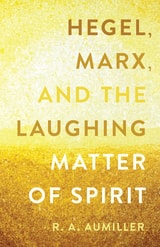
Hegel, Marx, and the Laughing Matter of Spirit
R. A. Aumiller
Northwestern University Press, 2026
What happens when those who have been denied political subjectivity fully play out their negative role in a historical drama that damned them from the beginning? Hegel, Marx, and the Laughing Matter of Spirit locates the eruption of revolutionary laughter in historical cracks across nineteenth- and twentieth-century Europe, where exiled philosophers, partisan fighters, and artists framed their political resistance as a historical comedy. Hegelian comedy fuels the Young Hegelian critique of Prussian censorship, Walter Benjamin’s staging of the anti-fascist resistance, and the Yugoslavian partisan attempt to begin again in fascism’s aftermath. Revolution erupts from a historical stage that can no longer look on its own contradictions with a straight face. Drawing on the defiant spirit of comedy, this Hegelian feminist manifesto defies political despair, overturning the perception that history tragically repeats itself. Invoking the phrase “Nothing changes” as a mantra, R. A. Aumiller turns a concession of defeat into a battle cry for political resistance.
Heidegger and Marx
A Productive Dialogue over the Language of HumanismLaurence Paul Hemming
Northwestern University Press, 2013
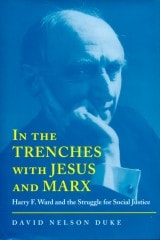
In the Trenches with Jesus and Marx
Harry F. Ward and the Struggle for Social JusticeDavid Duke
University of Alabama Press, 2006
The story of a Social Gospel leader who brought faith, activism, and social justice into the heart of modern American politics.
Radical religious and political leader Harry F. Ward started life quietly enough in a family of Methodist shopkeepers and butchers in London. But his relentless pursuit of social justice would lead him to the United States and a long career of religious activism. Ward served as professor of Christian ethics at the Union Theological Seminary and chairman of the board of the American Civil Liberties Union for two decades. He also became a leader in labor groups, Protestant activist organizations, and New York intellectual circles.
David Duke builds his comprehensive story of this fiery leader from extensive archival sources, including FBI files and private correspondence, sermons, class notes, and other unpublished material. Duke skillfully charts Ward's rise from an idealistic Methodist minister in a Chicago stockyard parish to a prominent national religious leader and influential political figure. Ultimately, Ward's lifelong attempt to synthesize the beliefs of Jesus and Marx and his role as an admirer of the Soviet Union put him on a collision course with McCarthyism in Cold War America. Viewed by some as a prophet and by others as a heretic, traitor, and communist, Ward became increasingly marginalized as he stubbornly maintained his radical positions. Even in his own circle, he went from being a figure of unquestioned integrity who eloquently spoke his convictions to a tragically short-sighted idealogue whose unwavering pro-Soviet agenda blinded him to the horrors of Stalinist oppression.
Harry Ward's long, colorful career intersected nearly every intellectual current in American culture for more than a half century. This biography will be important for scholars of American religious history, students of liberalism and politics, social Christians, and general readers who enjoy a compelling tour into the private and public lives of notable figures of history.
Machiavelli to Marx
Modern Western Political ThoughtDante Germino
University of Chicago Press, 1979
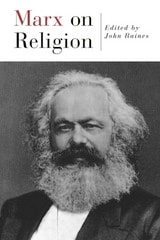
Marx On Religion
John Raines
Temple University Press, 2002
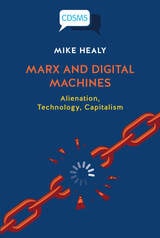
Marx and Digital Machines
Alienation, Technology, CapitalismMike Healy
University of Westminster Press, 2020
“Healy closes his marvellous book by saying that ‘alienation is a constant feature and is experienced as a norm rather than as an aberration’.” - https://marxandphilosophy.org.uk/reviews/19718_marx-and-digital-machines-alienation-technology-capitalism-by-mike-healy-reviewed-by-thomas-klikauer/
This book explores the fundamental contradiction at the heart of the digital environment: technology offers all manner of promises, yet habitually fails to deliver. This failure often arises from numerous problems: the proficiency of the technology or end-user, policy failure at various levels, or a combination of these. Solutions such as better technology and more effective end-user education are often put into place to solve these failures.
Mike Healy argues that such approaches are inherently faulty drawing upon qualitative research informed by Marx’s theory of alienation. Using Marx’s theory, he considers participants in three distinct settings: the workplace of information and communications technology (ICT) professionals; university scholars researching the ethical and societal implications of our digital environment; and a group of pensioners living in South London, UK, undertaking ICT training. By delving beneath the surface of how digital technologies are created, researched and experienced, this study illustrates the contradictory nature of our digital lives, as they directly arise from the needs of capitalism.
The book also places Marx’s theory in contrast to the mainstream approaches derived from Seaman and Blauner. In researching and comprehending ICT, this book reaffirms the superior explanatory power of Marx’s theory of alienation.
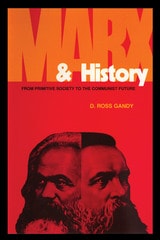
Marx and History
From Primitive Society to the Communist FutureBy D. Ross Gandy
University of Texas Press, 1979
In this book Marx's observations on history, which are found scattered throughout his voluminous writings, are brought together and subjected to searching analysis.
D. Ross Gandy writes in refreshingly direct language, without resorting to jargon. For the first time we have a thoughtful assessment of Marx's views on all the epochs that cross his historical vision. Gandy treats Marx's ideas on primitive societies, on ancient Roman and Asiatic civilization, on the structure of feudalism, on strategies for overthrowing capitalism, and on the hypothetical communist future. Among the author's departures from traditional readings of Marx are his interpretations of class struggle, his conception of social strata, and his cogent analysis of the "new Marxism."
Since many aspects of Marxist historical theory have been neglected or distorted, Gandy's remarkably clear commentary, based on extensive research—including an exhaustive study of the forty-volume Marx-Engels Werke—will doubtless stimulate debate among sociologists and other students of social change, political scientists, and historians.
Marx and other Four-Letter Words
Edited by Georgina Blakeley and Valerie Bryson
Pluto Press, 2005
Yet these concepts, within a specifically Marxist framework, are not always easy to understand. This book is an ideal student introduction that explains, in clear and concise chapters, the precise meaning and implications of each of Marx's key concepts. Furthermore, the contributors show how these ideas continue to be relevant, and how they relate to modern society.
The contributors include leading academics in the field of politicial science. Outlining clearly what each concept means, they move on to situate it within cutting-edge contemporary political theory.
Concepts include historical materialism, capitalism, class, the state, imperialism, the division of labour, oppression, production and reproduction, revolution, working class internationalism, equality and democracy.
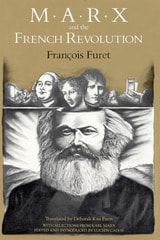
Marx and the French Revolution
François Furet
University of Chicago Press, 1988
With his early critique of Hegel, Marx started moving toward his fundamental thesis: that the state is a product of civil society and that the French Revolution was the triumph of bourgeois society. Furet's interpretation follows the evolution of this idea and examines the dilemmas it created for Marx as he considered all the faces the new state assumed over the course of the Revolution: the Jacobin Terror following the constitutional monarchy, Bonaparte's dictatorship following the parliamentary republic.
The problem of reconciling his theory with the reality of the Revolution's various manifestations is one of the major difficulties Marx contended with throughout his work. The hesitation, the remorse, and the contradictions of the resulting analyses offer a glimpse of a great thinker struggling with the constraints of his own system. Marx never did elaborate a theory of an autonomous state, but he never stopped wrestling with the challenge to his doctrine posed by late eighteenth-century France, whose changing conditions and successive regimes prompted some of his most intriguing and, until now, unexplored thought.
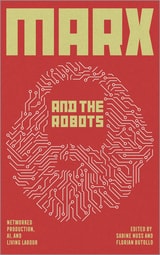
Marx and the Robots
Networked Production, AI, and Human LabourFlorian Butollo
Pluto Press, 2022
It covers a broad range of digital aspects now proliferating across our work and lives, including chapters on the digitalization of agriculture, robotics in the factory and the labor process on crowdworking platforms. It looks to how 20th century Marxist predictions of the 'workerless factory' are, or are not, coming true, and how 'Platform Capitalism' should be understood and critiqued.
Through rich empirical, theoretical and historical material, this book is necessary reading for those wanting a clear overview of our digital world.

Marx on Suicide
Karl Marx
Northwestern University Press, 1999
Marx
The Alternative to CapitalismKieran Allen
Pluto Press, 2017
If we are serious about finding a different way to run the post-credit crunch society, we must start by introducing alternatives to undergraduates. Kieran Allen begins the task with an accessible and comprehensive look at the ideas of Karl Marx.
Dispensing with the dryness of traditional explanations of Marx, Allen shows how Marx's ideas apply to modern society. The first section briefly outlines Marx's life and the development of his work, then goes on to clearly explain his key theories, including historical materialism and surplus value. The second section examines alternatives to capitalism, the concept of 'anti-capitalism' and provides concrete, contemporary examples of Marx’s theories being put into practice in today's world.
Sewn in the Sweatshops of Marx
Beuys, Warhol, Klein, DuchampThierry de Duve
University of Chicago Press, 2012
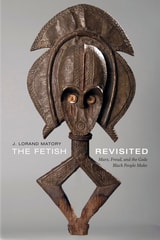
The Fetish Revisited
Marx, Freud, and the Gods Black People MakeJ. Lorand Matory
Duke University Press, 2018
The Theological Metaphors of Marx
Enrique Dussel
Duke University Press, 2024
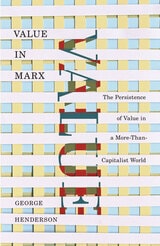
Value in Marx
The Persistence of Value in a More-Than-Capitalist WorldGeorge Henderson
University of Minnesota Press, 2013
Long prone to dogmatic disagreement, the question of value in Marx’s thought—what value is, the purpose it serves, its application to real-world capitalism—requires renewal if Marx’s work is to remain vibrant. In Value in Marx, George Henderson offers a lucid rereading of Marx that strips value of its turgid theoretical reduction and reframes it as an investigation into the tensions between social relations and forms as they are rather than as what they could otherwise become.
Drawing on Marx’s Capital and Grundrisse, Henderson shows how these volumes do not harbor a single theory of value that equates value to capital. Instead, these books experimentally compose and recompose value for a world that is more than capitalist. At stake is how Marx conceives of human freedom, of balanced social arrangements, and of control over the things people produce. Henderson finds that the limits on social becoming, including the tendency toward alienated existence, haunt Marx even as he looks beyond the critique of capital to an emancipated society to come.
Can these limits be confronted in a creative, even joyful, way? Can they become aspects of what we desire, rather than being silenced and denied? As long as we persist in interpreting value broadly, following it as an active and not a shut-down, predetermined feature of Marx’s texts, Henderson ultimately views Marx as responding positively to these challenges and employing value as a powerful tool of the political imaginary.