Results by title
25 books match the query 'Marxian economics'

Capitalism and the Dialectic
The Uno-Sekine Approach to Marxian Political EconomyJohn R. Bell
Pluto Press, 2009
From the 1960s to the 1990s the ground-breaking Japanese economists Kozo Uno and Thomas Sekine developed a masterful reconfiguration of Marxist economics. The most well-known aspect of which is the levels of analysis approach to the study of capitalism.
Written in Japanese, the Uno-Sekine approach to Marx's work is little understood in West. John Bell seeks to correct this, explaining how problematic elements of Marxian Political Economy such as the law of value and the law of relative surplus population can be solved by using a more rigorous dialectical analysis.
Bell's clear and accessible synthesis provides economists with the tools to interrogate capitalism in a more powerful way than ever before.

Capitalism, Democracy, and Ecology
Departing from MarxTimothy W. Luke
University of Illinois Press, 1999
Using Marx as a touchstone, Timothy W. Luke warns that if communities are not to be overwhelmed by new class economic and political agendas, then the practice of democracy must be reconstituted on a more populist basis. However, the galvanizing force for this new, more community-centered populism will not be the proletariat, as Marx predicted, nor contemporary militant patriotic groups. Rather, Luke argues that many groups unified by a concern for ecological justice present the strongest potential opposition to capitalism.
Wide-ranging and lucid, Capitalism, Democracy, and Ecology is essential reading in the age of information.
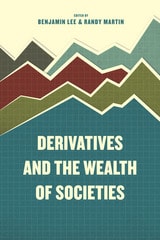
Derivatives and the Wealth of Societies
Edited by Benjamin Lee and Randy Martin
University of Chicago Press, 2016
To answer that question, the contributors to this book draw upon their deep backgrounds in finance, social science, art, and the humanities to create a new way of understanding derivative finance that does justice to its social and cultural dimensions. They offer a two-pronged analysis. First, they develop a social understanding of the derivative that casts it in the light of anthropological concepts such as the gift, ritual, play, dividuality, and performativity. Second, they develop a derivative understanding of the social, using financial concepts such as risk, hedging, optionality, and arbitrage to uncover new dimensions of contemporary social reality. In doing so, they construct a necessary, renewed vision of derivative finance as a deeply embedded aspect not just of our economics but our culture.
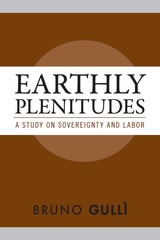
Earthly Plenitudes
A Study on Sovereignty and LaborBruno Gullì
Temple University Press, 2016
Gullì first reviews approaches to sovereignty by philosophers as varied as Gottfried Leibniz and Georges Bataille, and then looks at concrete examples where the alliance of sovereignty and capital cracks under the potency of living labor. He examines contingent academic labor as an example of the super-exploitation of labor, which has become a global phenomenon, and as such, a clear threat to the sovereign logic of capital. Gullì also looks at disability to assert that a new measure of humanity can only be found outside the schemes of sovereignty, productivity, efficiency, and independence, through care and caring for others, in solidarity and interdependence.
Economics Transformed
Discovering the Brilliance of MarxRobert Albritton
Pluto Press, 2007
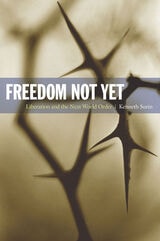
Freedom Not Yet
Liberation and the Next World OrderKenneth Surin
Duke University Press, 2009
Surin begins by examining the current regime of accumulation—the global domination of financial markets over traditional industrial economies—which is used as an instrument for the subordination and dependency of poorer nations. He then moves to the constitution of subjectivity, or the way humans are produced as social beings, which he casts as the key arena in which struggles against dispossession occur. Surin critically engages with the major philosophical positions that have been posed as models of liberation, including Derrida’s notion of reciprocity between a subject and its other, a reinvigorated militancy in political reorientation based on the thinking of Badiou and Zizek, the nomad politics of Deleuze and Guattari, and the politics of the multitude suggested by Hardt and Negri. Finally, Surin specifies the material conditions needed for liberation from the economic, political, and social failures of our current system. Seeking to illuminate a route to a better life for the world’s poorer populations, Surin investigates the philosophical possibilities for a Marxist or neo-Marxist concept of liberation from capitalist exploitation and the regimes of power that support it.
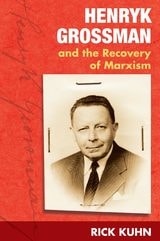
Henryk Grossman and the Recovery of Marxism
Rick Kuhn
University of Illinois Press, 2006
Rick Kuhn’s Henryk Grossman and the Recovery of Marxism is the definitive study of the life and work of this renowned economist, activist, and intellectual. As a young man, Grossman joined the socialist movement and participated in Jewish workers' strikes and demonstrations, as well as in boycotts against employers and the Austro-Hungarian state. He moved to Vienna, but was driven back to Poland by the Austrian state's racist citizenship policies. A member of the illegal Polish Communist Party, Grossman was frequently arrested and jailed, finally leaving Poland for a post at the Institute for Social Research in Frankfurt am Main, which gave rise to the famous 'Frankfurt School'.
Grossman published his best known work in Frankfurt, including studies of Marx's method in Capital and theories of economic crisis that remain influential today. In tracing Grossman's experiences, from Kraków to New York, and offering a detailed account of his ideas, the biography provides an intimate account of key events in twentieth century history, including the politicization of east European Jewry, the World Wars, the rise of Stalinism and Nazism, and the cold war.
How to Read Marx's Capital
Stephen Shapiro
Pluto Press, 2008
Students are urged to think for themselves and engage with Marx's powerful methods of argument and explanation. Shapiro shows that Capital is key to understanding critical theory and cultural production.
This highly focused book will prove invaluable to students of politics, cultural studies, and literary theory.
Justice Is an Option
A Democratic Theory of Finance for the Twenty-First CenturyRobert Meister
University of Chicago Press, 2021
Justice Is an Option uses those problems—and the framework of finance that created them—to reimagine historical justice. Robert Meister returns to the spirit of Marx to diagnose our current age of finance. Instead of closing our eyes to the political and economic realities of our era, we need to grapple with them head-on. Meister does just that, asking whether the very tools of finance that have created our vastly unequal world could instead be made to serve justice and equality. Meister here formulates nothing less than a democratic financial theory for the twenty-first century—one that is equally conversant in political philosophy, Marxism, and contemporary politics. Justice Is an Option is a radical, invigorating first page of a new—and sorely needed—leftist playbook.
Knowledge and Class
A Marxian Critique of Political EconomyStephen A. Resnick and Richard D. Wolff
University of Chicago Press, 1987
Labor of Fire
The Ontology of Labor between Economy and CultureBruno Gullì
Temple University Press, 2005
Gullì lays the groundwork for his book by offering a critique of productive labor, and then maps out his productive/living labor distinction in detail, reviewing the work of Marx and others.
Law of Accumulation and Breakdown of the Capitalist System
Henryk Grossmann
Pluto Press, 1992
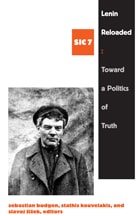
Lenin Reloaded
Toward a Politics of Truth, sic viiSebastian Budgen, Stathis Kouvelakis, and Slavoj Žižek, eds.
Duke University Press, 2007
These essays, some of which are appearing in English for the first time, bring Lenin face-to-face with the problems of today, including war, imperialism, the imperative to build an intelligentsia of wage earners, the need to embrace the achievements of bourgeois society and modernity, and the widespread failure of social democracy. Lenin Reloaded demonstrates that truth and partisanship are not mutually exclusive as is often suggested. Quite the opposite—in the present, truth can be articulated only from a thoroughly partisan position.
Contributors. Kevin B. Anderson, Alain Badiou, Etienne Balibar, Daniel Bensaïd, Sebastian Budgen, Alex Callinicos, Terry Eagleton, Fredric Jameson, Stathis Kouvelakis, Georges Labica, Sylvain Lazarus, Jean-Jacques Lecercle, Lars T. Lih, Domenico Losurdo, Savas Michael-Matsas, Antonio Negri, Alan Shandro, Slavoj Žižek
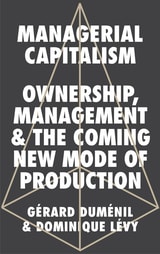
Managerial Capitalism
Ownership, Management, and the Coming New Mode of ProductionGérard Duménil and Dominique Lévy
Pluto Press, 2018
Drawing examples from the United States and Europe, the authors offer a historically rooted interpretation of major current economic and political trends. Without eschewing Marx’s theory of history and political economy, they update it to take account of the changes underway in class patterns and relationships to production. The result is a robust new Marxism for the present and the future.
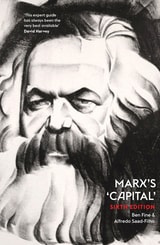
Marx's 'Capital'
Ben Fine and Alfredo Saad-Filho
Pluto Press, 2016
Marxism and Media Studies
Key Concepts and Contemporary TrendsMike Wayne
Pluto Press, 2003
Polarizing Development
Alternatives to Neoliberalism and the CrisisEdited by Lucia Pradella and Thomas Marois
Pluto Press, 2015
The global economic crisis has exposed the limits of neoliberalism and dramatically deepened social polarization. Yet, despite increasing social resistance and opposition, neoliberalism prevails globally.
Radical alternatives, moreover, are only rarely debated. And if they are, such alternatives are reduced to new Keynesian and new developmental agendas, which fail to address existing class divisions and imperialist relations of domination.
This collection of essays polarizes the debate between radical and reformist alternatives by exploring head-on the antagonistic structure of capitalist development. The contributors ground their proposals in an international, non-Eurocentric and Marxian inspired analysis of capitalism and its crises. From Latin America to Asia, Africa to the Middle East and Europe to the US, social and labour movements have emerged as the protagonists behind creating alternatives.
This book’s new generation of scholars has written accessible yet theoretically informed and empirically rich chapters elaborating radical worldwide strategies for moving beyond neoliberalism, and beyond capitalism. The intent is to provoke critical reflection and positive action towards substantive change.
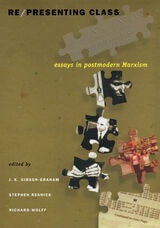
Re/presenting Class
Essays in Postmodern MarxismJ . K. Gibson-Graham, Stephen Resnick, and Richard Wolff, eds.
Duke University Press, 2001
Investigating a wide range of cases, the essays illuminate, for instance, the organizational and cultural means by which unmeasured surpluses—labor that occurs outside the formal workplace‚ such as domestic work—are distributed and put to use. Editors Resnick and Wolff, along with J. K. Gibson-Graham, bring theoretical essays together with those that apply their vision to topics ranging from the Iranian Revolution to sharecropping in the Mississippi Delta to the struggle over the ownership of teaching materials at a liberal arts college. Rather than understanding class as an element of an overarching capitalist social structure, the contributors—from radical and cultural economists to social scientists—define class in terms of diverse and ongoing processes of producing, appropriating, and distributing surplus labor and view class identities as multiple, changing, and interacting with other aspects of identity in contingent and unpredictable ways.
Re/presenting Class will appeal primarily to scholars of Marxism and political economy.
Contributors. Carole Biewener, Anjan Chakrabarti, Stephen Cullenberg, Fred Curtis, Satyananda Gabriel, J. K. Gibson-Graham, Serap Kayatekin, Bruce Norton, Phillip O’Neill, Stephen Resnick, David Ruccio, Dean Saitta, Andriana Vlachou, Richard Wolff
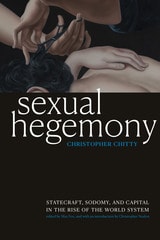
Sexual Hegemony
Statecraft, Sodomy, and Capital in the Rise of the World SystemChristopher Chitty
Duke University Press, 2020
The Cancer Stage of Capitalism
From Crisis to CureJohn McMurtry
Pluto Press, 2013
The Cancer Stage of Capitalism is a modern classic of critical philosophy and political economy, renowned for its depth and comprehensive research. It provides a step by step diagnosis of the continuing economic collapse in the US and Europe and has had an enormous influence on new visions of economic alternatives.
John McMurtry argues that our world disorder of unending crises is the predictable result of a cancerous economic system multiplying out of all control and destroying ecological, social and organic life - a process he describes as 'global ecogenocide'. In this updated edition he explains the ‘social immune response’ required to fight the ‘macro cancer’, something which has already been shown in developments such as the Occupy movement and the democratic social transformation of Latin America.
In an official global culture increasingly destructive of life, this book shows the necessity and possibility of building a sustainable society based on a universal commitment to life and nature.
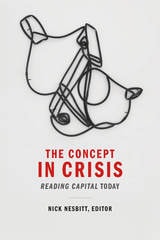
The Concept in Crisis
Reading Capital TodayNick Nesbitt, editor
Duke University Press, 2017
Contributors. Emily Apter, Alain Badiou, Étienne Balibar, Bruno Bosteels, Adrian Johnston, Warren Montag, Fernanda Navarro, Nick Nesbitt, Knox Peden, Nina Power, Robert J. C. Young
The End Of Capitalism (As We Knew It)
A Feminist Critique of Political EconomyJ. K. Gibson-Graham
University of Minnesota Press, 2006
“Paralyzing problems are banished by this dazzlingly lucid, creative, and practical rethinking of class and economic transformation.” —Meaghan Morris, Lingnan University, Hong Kong
“Profoundly imaginative.” —Eve Kosofsky Sedgwick, City University of New York “Filled with insights, it is clearly written and well supported with good examples of actual, deconstructive practices.” —International Journal of Urban and Regional Research
J. K. Gibson-Graham is the pen name of Katherine Gibson and Julie Graham, feminist economic geographers who work, respectively, at the Australian National University in Canberra and the University of Massachusetts Amherst.
The Social Production of Urban Space
By M. Gottdiener
University of Texas Press, 1994
From reviews of the first edition:
"This is perhaps the best theoretically oriented book by a United States urban sociologist since the work of Firey, Hawley, and Sjoberg in the 1940s and 1950s.... Gottdiener is on the cutting edge of urban theoretical work today." —Joe R. Feagin, Contemporary Sociology
Since its first publication in 1985, The Social Production of Urban Space has become a landmark work in urban studies. In this second edition, M. Gottdiener assesses important new theoretical models of urban space—and their shortcomings—including the global perspective, the flexible accumulation school, postmodernism, the new international division of labor, and the "growth machine" perspective.
Going beyond the limitations of these and older theories, Gottdiener proposes a model of urban growth that accounts for the deconcentration away from the central city that began in the United States in the 1920s and continues today. Sociologists, political scientists, economists, geographers, and urban planners will find his interdisciplinary approach to urban science invaluable, as it is currently the most comprehensive treatment of European and American work in these related fields.
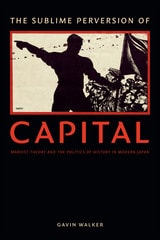
The Sublime Perversion of Capital
Marxist Theory and the Politics of History in Modern JapanGavin Walker
Duke University Press, 2016
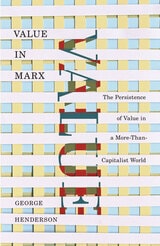
Value in Marx
The Persistence of Value in a More-Than-Capitalist WorldGeorge Henderson
University of Minnesota Press, 2013
Long prone to dogmatic disagreement, the question of value in Marx’s thought—what value is, the purpose it serves, its application to real-world capitalism—requires renewal if Marx’s work is to remain vibrant. In Value in Marx, George Henderson offers a lucid rereading of Marx that strips value of its turgid theoretical reduction and reframes it as an investigation into the tensions between social relations and forms as they are rather than as what they could otherwise become.
Drawing on Marx’s Capital and Grundrisse, Henderson shows how these volumes do not harbor a single theory of value that equates value to capital. Instead, these books experimentally compose and recompose value for a world that is more than capitalist. At stake is how Marx conceives of human freedom, of balanced social arrangements, and of control over the things people produce. Henderson finds that the limits on social becoming, including the tendency toward alienated existence, haunt Marx even as he looks beyond the critique of capital to an emancipated society to come.
Can these limits be confronted in a creative, even joyful, way? Can they become aspects of what we desire, rather than being silenced and denied? As long as we persist in interpreting value broadly, following it as an active and not a shut-down, predetermined feature of Marx’s texts, Henderson ultimately views Marx as responding positively to these challenges and employing value as a powerful tool of the political imaginary.