Results by title

22 books match the query 'Mary, Blessed Virgin, Saint'
cover of A Short Treatise on the Virgin Mary

A Short Treatise on the Virgin Mary

Rene Laurentin

Catholic University of America Press, 2022
As a peritus at Vatican II and by the end of his life arguably the world’s leading Mariologist, René Laurentin has earned the privilege of republication of a work of considerable value for any theologian who aims for comprehensiveness of Catholic theological perspective, historically and systematically. Laurentin’s orthodox, yet highly original treatment displays his command of all of the relevant biblical, patristic, medieval and modern texts up to and including the entire proceedings of the Second Vatican Council, as well as the whole range of related historical and theological scholarship. His proposal to pursue Mariological speculation along two tracks – first, “from above,” following the course of doctrinal development from biblical revelation to the VCII era, and second, “from below,” considering Mary’s own life (walking in her footsteps, as it were), from before the Annunciation to the Parousia – provides a clear, accessible structure for the work, yielding rich theological and spiritual fruit. Not only are all the major Marian doctrines and their developments handled with the greatest sensitivity, from the Virgin birth to the modern promulgations of Immaculate Conception and Assumption, but Laurentin’s approach in his second part opens the way to a human-psychological treatment of motherhood, still solidly bolstered by traditional Christian anthropology. Regarding Mary’s status as Mother of God, Laurentin’s discussion of the Theotokos exhibits his deep ecumenical commitments, as much as his specific attention to Mary’s soteriological role as a sticking point for Protestantism. One of the most striking qualities of the work is Laurentin’s deft integration of his evident scholastic formation into an overarching vision thoroughly at ease with the phenomenological (“personalist”) and existential currents in which he also inevitably swam throughout his education and professional scholarly occupation. As a result, the work can be read and appreciated instinctively, as it were, as much by the eclectic contemporary theologian, influenced by the likes of Heidegger, et al, as by the Thomist.
[more]
cover of Approaching the Assumption, 1863-1950: Revelation, Scripture, and the Laity in the Development of a Marian Dogma

Approaching the Assumption, 1863-1950

Revelation, Scripture, and the Laity in the Development of a Marian Dogma

Eric Lafferty

Catholic University of America Press, 2026
The Assumption of Mary refers to the ancient Christian belief that the Mother of God was taken up into Heaven, body and soul, at the end of her earthly life. For centuries, Catholics and other Christians celebrated the Assumption as a liturgical feast and meditated on the miraculous event in the Rosary. Nevertheless, its relationship to Revelation remained undefined. This changed in 1950 when Pope Pius XII declared the Assumption of Mary a dogma of the Catholic Church. In this rare exercise of papal authority, Pius XII infallibly and irrevocably taught that the Assumption was a truth revealed by God. This book explores how the definition of this Marian dogma came to fruition. After a brief history of the prior three Marian dogmas — Mother of God, Ever-Virgin, and the Immaculate Conception — this book narrates the major moments in the effort to obtain a dogmatic definition of the Assumption. The beginning of this “Assumptionist movement” can be dated to 1863 when Queen Isabel II of Spain petitioned the pope to declare the Assumption a dogma. Subsequently, petitionary efforts and scholarly inquiry increased and spread throughout the world. In addition to the narrative of this movement, this book gives special consideration to three vital aspects: debate over the Assumption’s definability as a dogma, if and how Scripture reveals the Assumption, and the contribution of the laity on a matter of doctrine. Collectively, the Assumptionist movement emerges as a critical event in the nineteenth- and twentieth-century Catholic Church. Culminating in a dogmatic definition shortly before the opening of Vatican II, it also serves as a key point of inquiry for continuity and development of doctrine. A final chapter argues that the operative beliefs pertaining to Revelation, Scripture, and the laity during the Assumptionist movement stand in continuity with the teachings of Vatican II.
[more]
cover of Bernardo and the Virgin: A Novel

Bernardo and the Virgin

A Novel

Silvio Sirias

Northwestern University Press, 2007

In 1980, with the Sandinistas newly in power, tailor and pig farmer Bernardo Martinez witnesses an extraordinary thing: an otherworldly glow about the statue of the Virgin Mary in the church where he works as sacristán. Soon the Holy Virgin appears. She tells Bernardo to forget his money problems and fear of ridicule and spread her message of peace and faith to his neighbors. Though a work of fiction, Bernardo and the Virgin is based on actual events in Bernardo Martinez's life. The visitation of the Virgin Mary at Cuapa, Nicaragua, remains one of the few such events accepted by the Roman Catholic Church in the last sixty years.

Silvio Sirias' sweeping novel tells many stories: that of a humble man touched by the transcendent; that same man as a devout boy denied the priesthood because of poverty; and those in his orbit, past and present. It is also the stormy epic of Nicaragua through the long Somoza years to the Sandinista revolution. Sirias' beautiful language mixes English with Spanish and details of dusty village life with wondrous images of Catholic mysticism. His portrayal of the rich recent past of Central America resonates with the experiences of both the natives and the thriving communities of Nicaraguans, Salvadorans, and others putting down roots in the United States.
[more]
cover of Blessed Mary and the Monks of England, 1000-1215

Blessed Mary and the Monks of England, 1000-1215

Matthew J. Mills

Catholic University of America Press, 2024
In the study of historical Mariology, the monastic communities of England before and after the Norman conquest receive too little attention. Classic surveys, such as Hilda Graef’s, Mary: A History of Doctrine and Devotion (2 vols, orig. 1963, 1965), highlight key figures and developments; and a fine book by Mary Clayton, The Cult of the Virgin Mary in Anglo-Saxon England (1990), takes scholarship as far as the early-eleventh century. The present volume, building upon such works, delves more deeply into the prayerful, intellectual and artistic contemplation of Mary during the age of monasticism, roughly the two hundred years prior to the advent of the mendicant orders in the thirteenth century. In the history of England, this was a time of high drama: conquest, power struggle, martyrdom; for English monasticism, it was marked by suppression, reform and renewal, patronage, and new currents of prayer and thought. Against this backdrop, Matthew Mills uncovers many vibrant contributions to Marian doctrine and devotion by theologians and communities living according to the sixth-century Rule of St Benedict: the Benedictines and their successors, the Cistercians, who arrived in England in 1128. In a thematic unfolding of Mary’s life and identity, from conception to assumption and intercession, a picture emerges of a Mariology shaped by the constant of monastic liturgy, anchored in deep biblical and patristic wisdom, cherished and transmitted by the Englishman, St Bede (d. 735), and animated by profound love. Towering figures, St Anselm (d. 1109) and St Ælred (d. 1167), are placed within a wider landscape, alongside lesser-known but still significant individuals, including the Cistercian abbot, John of Forde (d. 1214), royal confessor and pioneer of Marian exegesis of the Song of Songs. England’s monastic Mariology was colored by Greek as well as Latin influences and touched by key experiences of the contemporary church at large: apocalyptic disappointment, eleventh-century reform (sometimes called, ‘Gregorian’), sacramentalism, intense yearning for salvation. This book also sheds light upon the significance of Mary for medieval monks’ understanding of their own profession; their mother and their lady, she was, in addition, their icon and exemplar of life in St Benedict’s ‘school for the Lord’s service’ (Rule, Prol. 45).
[more]
cover of Cachita's Streets: The Virgin of Charity, Race, and Revolution in Cuba

Cachita's Streets

The Virgin of Charity, Race, and Revolution in Cuba

Jalane D. Schmidt

Duke University Press, 2015
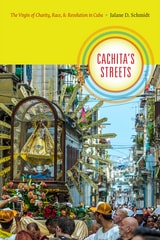
Cuba’s patron saint, the Virgin of Charity of El Cobre, also called Cachita, is a potent symbol of Cuban national identity. Jalane D. Schmidt shows how groups as diverse as Indians and African slaves, Spanish colonial officials, Cuban independence soldiers, Catholic authorities and laypeople, intellectuals, journalists and artists, practitioners of spiritism and Santería, activists, politicians, and revolutionaries each have constructed and disputed the meanings of the Virgin. Schmidt examines the occasions from 1936 to 2012 when the Virgin's beloved, original brown-skinned effigy was removed from her national shrine in the majority black- and mixed-race mountaintop village of El Cobre and brought into Cuba's cities. There, devotees venerated and followed Cachita's image through urban streets, amassing at large-scale public ceremonies in her honor that promoted competing claims about Cuban religion, race, and political ideology. Schmidt compares these religious rituals to other contemporaneous Cuban street events, including carnival, protests, and revolutionary rallies, where organizers stage performances of contested definitions of Cubanness. Schmidt provides a comprehensive treatment of Cuban religions, history, and culture, interpreted through the prism of Cachita.
[more]
cover of Chekhov and Russian Religious Culture: Poetics of the Marian Paradigm

Chekhov and Russian Religious Culture

Poetics of the Marian Paradigm

Julie de Sherbinin

Northwestern University Press, 1997
Chekhov and Russian Religious Culture is an innovative study of the Virgin Mary and the "saintly harlots"–Mary of Egypt and Mary Magdalene–as a cultural paradigm encoded in Chekhov's prose. De Sherbinin establishes the authority of the Marian paradigm in nineteenth-century Russian culture with a comprehensive overview of salient religious and literary texts, then offers critical readings of more than fifteen Chekhov stories, including key works such as "Peasants," "Peasant Women," and "My Life." De Sherbinin argues that Chekhov inverts and displaces the Christian meanings of Marian texts in order to reveal a vast array of problematized relationships to the canonized figures. This illuminating semiotic reading of Chekhov explores questions of female identity as it probes the mindset of Russian Orthodox popular culture.
[more]
cover of Emotion and Devotion: The Meaning of Mary in Medieval Religious Cultures

Emotion and Devotion

The Meaning of Mary in Medieval Religious Cultures

Miri Rubin

Central European University Press, 2009
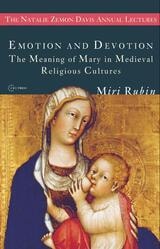
In Emotion and Devotion Miri Rubin explores the craft of the historian through a series of studies of medieval religious cultures. In three original chapters she approaches the medieval figure of the Virgin Mary with the aim of unravelling meaning and experience. Hymns and miracle tales, altarpieces and sermons – a wide range of sources from many European regions – are made to reveal the creativity and richness which they elicited in medieval people, women and men, clergy and laity, people of status and riches as well as those of modest means.
[more]
cover of From Viracocha to the Virgin of Copacabana: Representation of the Sacred at Lake Titicaca

From Viracocha to the Virgin of Copacabana

Representation of the Sacred at Lake Titicaca

By Verónica Salles-Reese

University of Texas Press, 1997

Surrounded by the peaks of the Andean cordillera, the deep blue waters of Lake Titicaca have long provided refreshment and nourishment to the people who live along its shores. From prehistoric times, the Andean peoples have held Titicaca to be a sacred place, the source from which all life originated and the site where the divine manifests its presence.

In this interdisciplinary study, Verónica Salles-Reese explores how Andean myths of cosmic and ethnic origins centered on Lake Titicaca evolved from pre-Inca times to the enthronement of the Virgin of Copacabana in 1583. She begins by describing the myths of the Kolla (pre-Inca) people and shows how their Inca conquerors attempted to establish legitimacy by reconciling their myths of cosmic and ethnic origin with the Kolla myths. She also shows how a similar pattern occurred when the Inca were conquered in turn by the Spanish.

This research explains why Lake Titicaca continues to occupy a central place in Andean thought despite the major cultural disruptions that have characterized the region's history. This book will be a touchstone in the field of Colonial literature and an important reference for Andean religious and intellectual history.
[more]
cover of Introducation to Mariology

Introducation to Mariology

Manfred Hauke

Catholic University of America Press, 2020
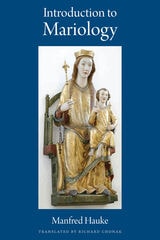
In Introduction to Mariology, Fr. Manfred Hauke provides a synthesis of Mariology and the biblical fundaments and development of Marian doctrine. While it works as a comprehensive introduction suitable for courses on the subject, it is in reality a panoramic view on the entire Marian doctrine, and as such will be essential for the theological formation of seminarians, priests, theologians, and all kinds of educated Catholics. With an unparalleled bibliographic citation of Marian literature across a dozen languages, it is also a perfect gateway to further research on the subject. It begins with Biblical doctrine, which is important especially for the dialogue with Protestant denominations: Catholic Mariology can be traced in its “embryonic” state already in Holy Scripture. From there Hauke presents a historical overview of the whole development of Marian doctrine, before developing further historical details in the subsequent chapters dedicated to systematic issues. The first systematic step approaches the figure of Mary through her role in the mystery of the Covenant between God and redeemed humanity; her being “Mother of God” and companion of the Redeemer is the “fundamental principle.” Then the four established Marian dogmas are presented: divine maternity, virginity, Immaculate Conception (in a chapter on Mary’s holiness more broadly), and bodily Assumption. A close look is given to maternal mediation which includes a part dedicated to the “Mater Unitatis”. A stand alone chapter is dedicated to Marian apparitions; authentic apparitions are presented as a part of prophetic charisma. The last chapter presents the basics on Marian devotion which culminates in the consecration to Mary (as a response to her maternal mediation). Already available in Spanish, Italian, Portugese, and Korean, this landmark work is published here for the first time in English.
[more]
cover of Jesus and Mary Reimagined in Early Christian Literature

Jesus and Mary Reimagined in Early Christian Literature

Vernon K. Robbins

SBL Press, 2015

Explore the diverse character of emerging Christian narratives

This book presents essays that show how prophetic and priestly emphases in Luke and Acts, and emphasis on Jesus’s existence prior to creation in the Gospel of John, are reworked in some second- and third-century Christian literature. Early Christians interpreted and expressed the storylines of Jesus, Mary, and other important figures in ways that created new images and stories. Contributors show the effect of including rhetography, the rhetoric of a text that prompts images and pictures in the mind of a hearer or reader, in interpretation of texts.

Features:

  • Readings that attempt to account for the development of richly creative and complicated early Christian traditions
  • Essays bridging New Testament studies and interpretation of Early Christian literature
  • Interpretations that integrate social and rhetorical interpretations
[more]
cover of Mary in the Qur'an: Friend of God, Virgin, Mother

Mary in the Qur'an

Friend of God, Virgin, Mother

Muna Tatari and Klaus von Stosch

Gingko, 2025

A sensitive consideration of Mary, mother of Jesus, in the Qur’an.

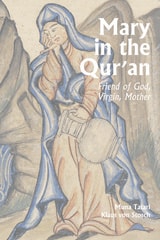
An entire chapter (surah) is dedicated to her, and she is the only woman mentioned by name in the Qur’an—indeed, her name appears more frequently than that of either Muhammad or Jesus. From the earliest times to the present day, Mary, the mother of Jesus, continues to be held in high regard by Christians and Muslims alike, yet she has also been the cause of much tension between these two religions.
 
In this groundbreaking study, Muna Tatari and Klaus von Stosch painstakingly reconstruct the picture of Mary that is presented in the Qur’an and show how veneration of the Blessed Virgin Mary in the Roman Catholic Church intersects and interacts with the testimony of the Qur’an. This sensitive and scholarly treatise offers a significant contribution to contemporary interfaith dialogue.
 
[more]
cover of Mary, Mother and Warrior: The Virgin in Spain and the Americas

Mary, Mother and Warrior

The Virgin in Spain and the Americas

By Linda B. Hall

University of Texas Press, 2004

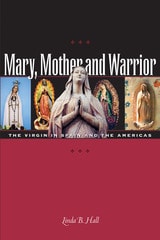
A Mother who nurtures, empathizes, and heals... a Warrior who defends, empowers, and resists oppression... the Virgin Mary plays many roles for the peoples of Spain and Spanish-speaking America. Devotion to the Virgin inspired and sustained medieval and Renaissance Spaniards as they liberated Spain from the Moors and set about the conquest of the New World. Devotion to the Virgin still inspires and sustains millions of believers today throughout the Americas.

This wide-ranging and highly readable book explores the veneration of the Virgin Mary in Spain and the Americas from the colonial period to the present. Linda Hall begins the story in Spain and follows it through the conquest and colonization of the New World, with a special focus on Mexico and the Andean highlands in Peru and Bolivia, where Marian devotion became combined with indigenous beliefs and rituals. Moving into the nineteenth century, Hall looks at national cults of the Virgin in Mexico, Bolivia, and Argentina, which were tied to independence movements. In the twentieth century, she examines how Eva Perón linked herself with Mary in the popular imagination; visits contemporary festivals with significant Marian content in Spain, Peru, and Mexico; and considers how Latinos/as in the United States draw on Marian devotion to maintain familial and cultural ties.
[more]
cover of Mary, Mother of God's Word Made Flesh

Mary, Mother of God's Word Made Flesh

Dylan Schrader

Catholic University of America Press, 2025
Mary, Mother of God’s Word Made Flesh overviews Catholic teaching on Mary, with a special focus on the “four Marian dogmas” and other major doctrines, such as Mary’s cooperation in the work of salvation and the distribution of graces. The book takes the relationship of Mary to Jesus as its starting point, while also drawing on insights from ecclesio typical and Christotypical ap­proaches to Mariology. This book emphasizes that Marian doctrine must be grounded in the revealed Word of God. Thus, it does not rely on private revelations but instead draws on scriptural, magisterial, patristic, and liturgical sources. At the same time, Mary, Mother of God’s Word Made Flesh is systematic and not merely historical. It strives to show how Catholic teachings on Mary fit together and explores precisely what they mean. In this task, Mary, Mother of God’s Word Made Flesh draws in a special way on St. Thomas Aquinas and the Thomistic school, while also incorporating insights from other approaches. Thus, it also engages with some speculative questions that have not received as much attention in other recent works of Mariology but that remain important for the correct understanding and elaboration of magisterial teachings. For example, it deals with the issue of the debitum peccati (“debt of sin”), which touches on how to connect the Im­maculate Conception with the notion of redemption, and the question of precisely how Mary is involved in the conferral of graces. The most important parts of this book are the chapters on the dogmas of the divine maternity, the immaculate conception, the perpetual virginity of Mary, and her assumption into heaven. There are also chapters on Mary’s holiness of life, her participation in Christ’s saving work, and Marian devotion in the life of the Church. The first appendix overviews the problem of what St. Thomas Aquinas taught about the Immaculate Conception, while the second discusses the magisterium’s current approach to private revelations and extraordinary phenomena.
[more]
cover of Mother Figured: Marian Apparitions and the Making of a Filipino Universal

Mother Figured

Marian Apparitions and the Making of a Filipino Universal

Deirdre de la Cruz

University of Chicago Press, 2015

There is no female religious figure so widely known and revered as the Virgin Mary. Mary has inspired in cultures around the world a deep devotion, a desire to emulate her virtue, and a strong belief in her power. Perhaps no population has been so deeply affected by this maternal figure as Filipino Catholics, whose apparitions of Mary have increased in response to recent events, drawing from a broad repertoire of the Catholic supernatural and pulling attention to new articulations of Christianity in the Global South.
 
In Mother Figured, historical anthropologist Deirdre de la Cruz offers a detailed examination of several appearances and miracles of the Virgin Mary in the Philippines from materials and sites ranging from the mid-nineteenth century to the present. By analyzing the effects of the mass media on the perception and proliferation of apparition phenomena, de la Cruz charts the intriguing emergence of new voices in the Philippines that are broadcasting Marian discourse globally. Based on two years of ethnographic fieldwork and hitherto unexplored archives in the Philippines, the United States, and Spain, Mother Figured documents the conditions of Marian devotion’s modern development and tracks how it has transformed Filipinos’ social and political role within the greater Catholic world.
[more]
cover of Negotiating Marian Apparitions: The Politics of Religion in Transcarpathian Ukraine

Negotiating Marian Apparitions

The Politics of Religion in Transcarpathian Ukraine

Agnieszka Halemba

Central European University Press, 2015
This book concerns the politics of religion as expressed through apparitions of the Virgin Mary in Dzhublyk in Transcarpathian Ukraine. On the one hand, the analysis provides insights into the present position of Transcarpathia in regional, Ukraine-wide, and European struggles for identity and political belonging. The way in which the apparitions site has been conceived and managed raises questions concerning the fate of religious communities during and after socialism, the significance of national projects for religious organizations, and the politics of religious management in a situation in which local religious commitments are relatively strong and religious organizations are relatively weak. The analysis contributes to the ethnography and history of this particular region and of the post-socialist world in general. On the other hand, the changing status of the apparition site over the years allows investigation of the questions concerning authority, legitimacy, and power in religious organizations, especially in relation to management of religious experiences. The analysis aims at clarification of such concepts as religious institutions, organizations but also religious experiences and is relevant to anthropology, sociology and religious studies. It is argued that the important question in analyses of religious apparitions should not be how an individual experience becomes institutionalized and instrumentalized, but how experience becomes a tool for negotiation and transformation in the religious field. Key word: 1. Mary, Blessed Virgin, Saint-–Apparitions and miracles–Ukraine–Zakarpats'kaoblast'. 2. Zakarpats'ka oblast' (Ukraine)–Church history.
[more]
cover of Our Lady Of Victorian Feminism: The Madonna in the Work of Anna Jameson, Margaret Fuller, and George Eliot

Our Lady Of Victorian Feminism

The Madonna in the Work of Anna Jameson, Margaret Fuller, and George Eliot

Kimberly VanEsveld Adams

Ohio University Press, 2000

Our Lady of Victorian Feminism is about three nineteenth-century women, Protestants by background and feminists by conviction, who are curiously and crucially linked by their extensive use of the Madonna in arguments designed to empower women.

In the field of Victorian studies, few scholars have looked beyond the customary identification of the Christian Madonna with the Victorian feminine ideal—the domestic Madonna or the Angel in the House. Kimberly VanEsveld Adams shows, however, that these three Victorian writers made extensive use of the Madonna in feminist arguments. They were able to see this figure in new ways, freely appropriating the images of independent, powerful, and wise Virgin Mothers.

In addition to contributions in the fields of literary criticism, art history, and religious studies, Our Lady of Victorian Feminism places a needed emphasis on the connections between the intellectuals and the activists of the nineteenth-century women's movement. It also draws attention to an often neglected strain of feminist thought, essentialist feminism, which proclaimed sexual equality as well as difference, enabling the three writers to make one of their most radical arguments, that women and men are made in the image of the Virgin Mother and the Son, the two faces of the divine.
[more]
cover of Scribit Mater: Marey and the Language Arts in the Literature of Medieval England

Scribit Mater

Marey and the Language Arts in the Literature of Medieval England

Georgiana Donavin

Catholic University of America Press, 2012
While Scribit Mater highlights different medieval English understandings of the Virgin's sapient eloquence according to class, education, and gender, it demonstrates long-standing and widespread traditions acknowledging and celebrating the Mother's verbal prowess.
[more]
cover of The Internet and the Madonna: Religious Visionary Experience on the Web

The Internet and the Madonna

Religious Visionary Experience on the Web

Paolo Apolito

University of Chicago Press, 2005

In 1994, a devout Catholic woman from Vermont began having religious visions and hearing the voice of the Virgin Mary. To spread word about her mystical experiences, she turned to the Internet. As Paolo Apolito records here, she is only one of many people who use the Web as a tool of religious devotion. Every day, thousands of Catholics—from Italy and Latin America to the United States and Bosnia—use the Internet to describe and celebrate apparitions of Mary, to exchange relics and advice in chat rooms, to make pilgrimages to religious Web sites, and to practice the rites of their faith online.

But how has this potent new mix of technology and religiosity changed the way Catholics view their faith? And what challenges do the autonomous qualities of the Internet pose to the broader authority of Catholicism? Does the democratic nature of access to digital technologies constitute a return to a more archaic and mystical form of Catholicism that predates the modernizing reforms of the Second Vatican Council?

In working through these questions, Apolito considers visions of Mary on the Web over the past two decades, revealing a great deal about religion as it is now experienced through new information technologies. The Internet, he explains, has made possible a decentralized community of the devoted, even as it has absorbed God into the shifts and complexities of electronic circuitry. And this profound development in religious life will only accelerate as use of the Internet spreads around the world.

An indispensable guide to the future of Catholicism, The Internet and the Madonna offers a compelling glimpse into the spiritual life of the connected soul.
[more]
cover of The Lady and the Virgin: Image, Attitude, and Experience in Twelfth-Century France

The Lady and the Virgin

Image, Attitude, and Experience in Twelfth-Century France

Penny Schine Gold

University of Chicago Press, 1985

Penny Schine Gold provides a bold analysis of key literary and artistic images of women in the Middle Ages and the relationship between these images and the actual experience of women. She argues that the complex interactions between men and women as expressed in both image and experience reflect a common pattern of ambivalence and contradiction. Thus, women are seen as both helpful and harmful, powerful and submissive, and the actuality of women's experience encompasses women in control and controlled, autonomous and dependent.

Vividly recreating the rich texture of medieval life, Gold effectively and eloquently goes beyond a simple equation of social context and representation. In the process. she challenges equally simple judgments of historical periods as being either "good" or "bad" for women.

"[The Lady and the Virgin] presents its findings in a form that should attract students as well as their instructors. The careful and controlled use of so many different kinds of sources . . . offers us a valuable medieval case study in the inner-relationship between the segments of society and its ethos or value system."—Joel T. Rosenthal, The History Teacher

"Something of a tour de force in an interdisciplinary approach to history."—Jo Ann McNamara, Speculum

"[A] well-written, extremely well-researched book. . . . The Lady and the Virgin is useful, readable, and well informed."—R. Howard Bloch, Modern Philology
[more]
cover of The Splendor of the Church in Mary: Henri de Lubac, Vatican II, and Marian Ressourcement

The Splendor of the Church in Mary

Henri de Lubac, Vatican II, and Marian Ressourcement

Theresa Marie Chau Nguyen

Catholic University of America Press, 2023
Henri de Lubac, SJ, (1896-1991) is one of the most renowned theologians of the twentieth century. Numerous studies have been undertaken to examine his many contributions to theology, but little attention has been paid to the specific topic of the relationship of the Blessed Virgin Mary and the Church in his writings. This was a topic that gave rise to contentious discussion at the Second Vatican Council, and although the Council fathers approved the integration of Marian doctrine into the Dogmatic Constitution on the Church, this synthesis of Mariology and ecclesiology has been largely neglected in theology today. The Splendor of the Church in Mary retrieves de Lubac’s Marian ecclesiology and revives an understanding and appreciation of its enduring influence at the Vatican Council and beyond. The first part examines de Lubac’s pre-conciliar works which evince a steady biblical and patristic ressourcement of Marian themes. It also explores his writings on Teilhard de Chardin’s Eternal Feminine, Christian mysticism, and Amida Buddhism and discovers in them the essential building blocks of his Marian thought. The second part turns to the Second Vatican Council and post-conciliar developments. Rereading the debates and texts of Lumen Gentium through a Marian lens brings to light the extent of de Lubac’s influence: Méditation sur l’Eglise (1953), his principal work on Mary and the Church, anticipated the structure and content of Lumen Gentium a decade before the Council. De Lubac’s writings provided a theological compass for the Council fathers, and they continue to provide direction and orientation for ecclesiological discourse today. The Splendor of the Church in Mary culminates in a constructive analysis of one of the most pressing pastoral and ecclesiological questions of our times: the question of the relationship of the universal and particular churches. Directly engaging the crucial debate between then-Cardinal Ratzinger and Cardinal Kasper, it proposes that de Lubac’s Mariology effectively offers a new perspective and a refreshing path forward. Attentive to the mystical identification of Mary and the Church, de Lubac’s ressourcement has the potential to re-enchant and advance contemporary theology in new and significant ways.
[more]
cover of Who Is Mary?: Three Early Modern Women on the Idea of the Virgin Mary

Who Is Mary?

Three Early Modern Women on the Idea of the Virgin Mary

Vittoria Colonna, Chiara Matraini, and Lucrezia Marinella

University of Chicago Press, 2009

For women of the Italian Renaissance, the Virgin Mary was one of the most important role models. Who Is Mary? presents devotional works written by three women better known for their secular writings: Vittoria Colonna, famed for her Petrarchan lyric verse; Chiara Matraini, one of the most original poets of her generation; and the wide-ranging, intellectually ambitious polemicist Lucrezia Marinella. At a time when the cult of the Virgin was undergoing a substantial process of redefinition, these texts cast fascinating light on the beliefs  of Catholic women in the Renaissance, and also, in the cases of Matraini and Marinella, on contemporaneous women’s social behavior, prescribed for them by male writers in books on female decorum.  
            Who Is Mary? testifies to the emotional and spiritual relationships that women had with the figure of Mary, whom they were required to emulate as the epitome of femininity. Now available for the first time in English-language translation, these writings suggest new possibilities for women in both religious and civil culture and provide a window to women’s spirituality, concerning the most important icon set before them, as wives, mothers, and Christians.
 
 
[more]
cover of Writings on the Sisters of San Luca and Their Miraculous Madonna

Writings on the Sisters of San Luca and Their Miraculous Madonna

Diodata Malvasia

Iter Press, 2015

The Bolognese nun Diodata Malvasia was presumed to have authored only one work, The Arrival and the Miraculous Workings of the Glorious Image of the Virgin (1617). In her recently discovered second manuscript chronicle, A Brief Discourse on What Occurred to the Most Reverend Sisters of the Joined Convents of San Mattia and San Luca (1575), her writing demonstrates active resistance to Tridentine convent reform. Together, Malvasia’s works read as the bookends to a lifelong crusade on behalf of her convent.

[more]