Results by title
22 books match the query 'Massacres'
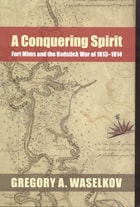
A Conquering Spirit
Fort Mims and the Redstick War of 1813–1814Gregory A. Waselkov
University of Alabama Press, 2009
WINNER, ADULT NONFICTION BOOK OF THE YEAR AWARD BY THE ALABAMA LIBRARY ASSOCIATION
WINNER, CLINTON JACKSON COLEY AWARD FROM THE ALABAMA HISTORICAL ASSOCIATION
Uncovering the Forgotten Battle That Changed a Nation.
The Fort Mims massacre changed the course of American history in many ways, not the least of which was the ensuing rise of one Andrew Jackson to the national stage. The unprecedented Indian victory over the encroaching Americans who were bent on taking their lands and destroying their culture horrified many and injured the young nation's pride. Tragedies such as this one have always rallied Americans to a common cause: a single-minded determination to destroy the enemy and avenge the fallen. The August 30, 1813 massacre at Fort Mims, involving hundreds of dead men, women, and children, was just such a spark.
Gregory Waselkov tells compellingly the story of this fierce battle at the fortified plantation home of Samuel Mims in the Tensaw District of the Mississippi Territory. With valuable maps, tables, and artifact illustrations, Waselkov looks closely at the battle to cut through the legends and misinformation that have grown around the event almost from the moment the last flames died at the smoldering ruins. At least as important as the details of the battle, though, is his elucidation of how social forces remarkably converged to spark the conflict and how reverberations of the battle echo still today, nearly two hundred years later.
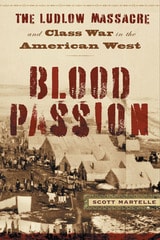
Blood Passion
The Ludlow Massacre and Class War in the American West, First Paperback EditionScott Martelle
Rutgers University Press, 2008
By early April 1914, Colorado Governor Elias Ammons thought the violence in his state’s strike-bound southern coal district had eased enough that he could begin withdrawing the Colorado National Guard, deployed six months earlier as military occupiers. But Ammons misread the signals, and on April 20, 1914, a full-scale battle erupted between the remaining militiamen and armed strikers living in a tent colony at the small railroad town of Ludlow. Eight men were killed in the fighting, which culminated in the burning of the colony. The next day, the bodies of two women and eleven children were found suffocated in a below-ground shelter. The “Ludlow Massacre,” as it quickly became known, launched a national call-to-arms for union supporters to join a ten-day guerrilla war along more than two hundred miles of the eastern Rockies. The convulsion of arson and violence killed more than thirty people and didn’t end until President Woodrow Wilson sent in the U.S. Army. Overall at least seventy-five men, women, and children were killed in seven months, likely the nation’s deadliest labor struggle.
In Blood Passion, journalist Scott Martelle explores this little-noted tale of political corruption and repression and immigrants’ struggles against dominant social codes of race, ethnicity, and class. More than a simple labor dispute, the events surrounding Ludlow embraced some of the most volatile social movements of the early twentieth century, pitting labor activists, socialists, and anarchists against the era’s powerful business class, including John D. Rockefeller, Jr., and helped give rise to the modern twins of corporate public relations and political “spin.” But at its heart, Blood Passion is the dramatic story of small lives merging into a movement for change and of the human struggle for freedom and dignity.
Blood in Their Eyes
The Elaine Massacre of 1919Grif Stockley
University of Arkansas Press, 2020
The first edition of Grif Stockley’s Blood in Their Eyes, published in 2001, brought renewed attention to the Elaine Massacre and sparked valuable new studies on racial violence and exploitation in Arkansas and beyond. With contributions from fellow historians Brian K. Mitchell and Guy Lancaster, this revised edition draws from recently uncovered source material and explores in greater detail the actions of the mob, the lives of those who survived the massacre, and the regime of fear and terror that prevailed under Jim Crow.
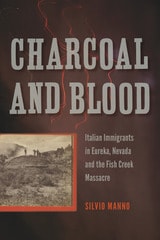
Charcoal and Blood
Italian Immigrants in Eureka, Nevada, and the Fish Creek MassacreSilvio Manno
University of Nevada Press, 2016
Through meticulous research on the event, relying on such primary sources as newspaper articles, author Silvio Manno provides the only comprehensive account of Eureka’s charcoal crisis and what came to be known as the Fish Creek Massacre. This is a well-documented narrative history of an important instance of class and ethnic conflict in the West. Readers interested in Nevada history, Italian American history, frontier trade unionism, and mining in the West will find this book a unique examination of an incident that occurred almost a century and a half ago and that has, until now, been largely overlooked.
Democracy, Dialogue, and Community Action
Truth and Reconciliation in GreensboroSpoma Jovanovic
University of Arkansas Press, 2012
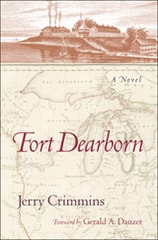
Fort Dearborn
A NovelJerry Crimmins
Northwestern University Press, 2008
In a story that brings to life the founding of one of the world's great cities, Fort Dearborn takes us back to Chicago's early struggle of fire and blood. Through the eyes of two young boys and their fathers—one father a sergeant with the United States First Infantry, the other a Potawatomi warrior—we see the events that lead up to the Fort Dearborn Massacre. Using scores of letters, historical documents and maps, and long-forgotten Native American speeches, Jerry Crimmins breathes life into the little known drama that took place in the vicinity of the fort that once occupied what is now downtown Chicago. A suspenseful narrative, Fort Dearborn is also a remarkable historical account, minutely observed and meticulously documented, preserving a key moment in American history.
Framing the Holocaust
Edited by Valerie Hébert
University of Wisconsin Press, 2023
While photographs are central to our memory of modern historical events, they often inhabit an ambivalent intellectual space. What separates the sincere desire to understand from voyeuristic curiosity? Comprehending atrocity photographs requires viewers to place themselves in the very positions of the perpetrators who took the images. When we engage with these photographs, do we risk replicating the original violence? In this tightly organized book, scholars of history, photography, language, gender, photojournalism, and pedagogy examine the images of the Šķēde atrocity along with other difficult images, giving historical, political, and ethical depth to the acts of looking and interpreting.
With a foreword by Edward Anders, who narrowly escaped the December 1941 shooting, Framing the Holocaust represents an original approach to an iconic series of Holocaust photographs. This book will contribute to compelling debates in the emerging field of visual history, including the challenges and responsibilities of using photographs to teach about atrocity.
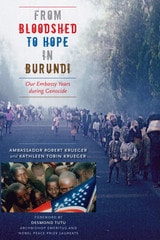
From Bloodshed to Hope in Burundi
Our Embassy Years during GenocideBy Ambassador Robert Krueger and Kathleen Tobin Krueger
University of Texas Press, 2007
In 1994, while nations everywhere stood idly by, 800,000 people were slaughtered in eight weeks in Rwanda. Arriving as U.S. Ambassador to neighboring Burundi a few weeks later, Bob Krueger began drawing international attention to the genocide also proceeding in Burundi, where he sought to minimize the killing and to preserve its fledgling democratic government from destruction by its own army. From Bloodshed to Hope in Burundi is a compelling eyewitness account of both a horrific and persistent genocide and of the ongoing efforts of many courageous individuals to build a more just society.
Krueger and his wife Kathleen graphically document the slaughter occurring all around them, as well as their repeated efforts to get the U.S. government and the international community to take notice and take action. Bob Krueger reconstructs the events of the military coup that precipitated the Burundi genocide and describes his efforts to uncover the truth by digging up graves and interviewing survivors. In straightforward and powerful language, Kathleen Krueger recounts her family's experience living amid civil war, including when she faced down a dozen AK-47-wielding African soldiers to save the life of a household worker.
From Bloodshed to Hope in Burundi shines a piercing light on a genocide that has gone largely unreported, and identifies those responsible for it. It also offers hope that as the truth emerges and the perpetrators are brought to account, the people of Burundi will at last achieve peace and reconciliation.
From a Taller Tower
The Rise of the American Mass ShooterBy Seamus McGraw
University of Texas Press, 2021
We, as a nation, have become desensitized to the shock and pain in the wake of mass shootings. In the bottomless silence between gunshots, as political stalemate ensures inaction, the killing continues; the dying continues. From a Taller Tower attends to the silence that has left us empty in the aftermath of these atrocities. Veteran journalist Seamus McGraw chronicles the rise of the mass shooter to dismantle the myths we have constructed around the murderers and ourselves.
In 1966, America’s first mass shooter, from atop the University of Texas tower, unleashed a new reality: the fear that any of us may be targeted by a killer, and the complicity we bear in granting these murderers the fame or infamy they crave. Addressing individual cases in the epidemic that began in Austin, From a Taller Tower bluntly confronts our obsession with the shooters—and explores the isolation, narcissism, and sense of victimhood that fan their obsessions. Drawing on the experiences of survivors and first responders as well as the knowledge of mental health experts, McGraw challenges the notion of the “good guy with a gun,” the idolization of guns (including his own), and the reliability of traumatized memory. Yet in this terrible history, McGraw reminds us of the humanity that can stop the killing and the dying.
Massacre at Camp Grant
Forgetting and Remembering Apache HistoryChip Colwell-Chanthaphonh
University of Arizona Press, 2007
On April 30, 1871, an unlikely group of Anglo-Americans, Mexican Americans, and Tohono O’odham Indians massacred more than a hundred Apache men, women, and children who had surrendered to the U.S. Army at Camp Grant, near Tucson, Arizona. Thirty or more Apache children were stolen and either kept in Tucson homes or sold into slavery in Mexico. Planned and perpetrated by some of the most prominent men in Arizona’s territorial era, this organized slaughter has become a kind of “phantom history” lurking beneath the Southwest’s official history, strangely present and absent at the same time.
Seeking to uncover the mislaid past, this powerful book begins by listening to those voices in the historical record that have long been silenced and disregarded. Massacre at Camp Grant fashions a multivocal narrative, interweaving the documentary record, Apache narratives, historical texts, and ethnographic research to provide new insights into the atrocity. Thus drawing from a range of sources, it demonstrates the ways in which painful histories continue to live on in the collective memories of the communities in which they occurred.
Chip Colwell-Chanthaphonh begins with the premise that every account of the past is suffused with cultural, historical, and political characteristics. By paying attention to all of these aspects of a contested event, he provides a nuanced interpretation of the cultural forces behind the massacre, illuminates how history becomes an instrument of politics, and contemplates why we must study events we might prefer to forget.
Massacre at the Yuma Crossing
Spanish Relations with the Quechans, 1779-1782Mark Santiago
University of Arizona Press, 1998
The route from the Spanish presidial settlements in upper Sonora to the Colorado River was called the Camino del Diablo, the "Road of the Devil." Running through the harshest of deserts, this route was the only way for the Spanish to transport goods overland to their settlements in California. At the end of the route lay the only passable part of the lower Colorado, and the people who lived around the river, the Yumas or Quechans, initially joined into a peaceful union with the Spanish. When the relationship soured and the Yumas revolted in 1781, it essentially ended Spanish settlement in the area, dashed the dreams of the mission builders, and limited Spanish expansion into California and beyond.
In Massacre at the Yuma Crossing, Mark Santiago introduces us to the important and colorful actors involved in the dramatic revolt of 1781: Padre Francisco Garcés, who discovered a path from Sonora to California, made contact with the Yumas and eventually became their priest; Salvador Palma, the informal leader of the Yuman people, whose decision to negotiate with the Spanish earned him a reputation as a peacebuilder in the region, which eventually caused his downfall; and Teodoro de Croix, the Spanish commandant-general, who, breaking with traditional settlement practice, established two pueblos among the Quechans without an adequate garrison or mission, thereby leaving the settlers without any sort of defense when the revolt finally took place.
Massacre at the Yuma Crossing not only tells the story of the Yuma Massacre with new details but also gives the reader an understanding of the pressing questions debated in the Spanish Empire at the time: What was the efficacy of the presidios? How extensive should the power of the Catholic mission priests be? And what would be the future of Spain in North America?
Massacred for Gold
The Chinese in Hells CanyonR. Gregory Nokes
Oregon State University Press, 2009
In 1887, more than 30 Chinese gold miners were massacred on the Oregon side of Hells Canyon, the deepest canyon in North America. Massacred for Gold, the first authoritative account of the unsolved crime—one of the worst of the many crimes committed by whites against Chinese laborers in the American West—unearths the evidence that points to an improbable gang of rustlers and schoolboys, one only 15, as the killers.
The crime was discovered weeks after it happened, but no charges were brought for nearly a year, when gang member Frank Vaughan, son of a well-known settler family, confessed and turned state’s evidence. Six men and boys, all from northeastern Oregon’s remote Wallowa country, were charged—but three fled, and the others were found innocent by a jury that a witness admitted had little interest in convicting anyone. A cover-up followed, and the crime was all but forgotten for the next 100 years, until a county clerk found hidden records in an unused safe.
In bringing this story out of the shadows, Nokes examines the once-substantial presence of Chinese laborers in the interior Pacific Northwest, describing why they came, how their efforts contributed to the region’s development, and how too often mistreatment and abuse were their only reward.
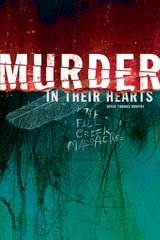
Murder in Their Hearts
The Fall Creek MassacreDavid Thomas Murphy
Indiana Historical Society Press, 2010
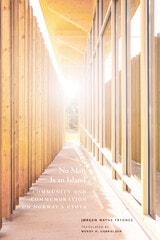
No Man Is An Island
Community and Commemoration on Norway's UtøyaJørgen Watne Frydnes, translated by Wendy H. Gabrielsen
University of Massachusetts Press, 2025
On July 22, 2011, a white supremacist killed eight people at Oslo’s Government Center in Norway and then terrorized the idyllic island of Utøya, where he executed sixty-nine more people, mostly teenagers. The country had never suffered such a massacre, and in the aftermath, the entire population was reeling.
Utøya, the Norwegian Labor Party’s summer camp for youth, a beloved place where many Norwegians learned about democratic values and processes, made lifelong friendships, and developed a vision for a just society, became mired in grief and discord. When Jørgen Watne Frydnes took on the daunting task of rebuilding the island and charting its future, he had to figure out a compassionate and just way forward. He made a radical decision: he set out to talk with each family of a murdered person, seeking to understand their needs and their hopes so that the future of the island could include their wishes and concerns. This emotionally grueling work, which was never considered in the scholarly literature on commemoration, led to a true renewal of Utøya, resulting in a meaningful memorial to those who were lost as well as beautiful surroundings for campers who come there to study democracy and peace.
Frydnes’s narrative, originally published in Norwegian, is structured around the seasons of the year and the landscape of the island, and tracks one person’s account of learning how to remember, commemorate, and honor the dead, and acknowledge a mass tragedy, and yet also create a nurturing, aspirational space for hope.
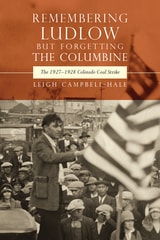
Remembering Ludlow but Forgetting the Columbine
The 1927-1928 Colorado Coal Strikeby Leigh Campbell-Hale
University Press of Colorado, 2025
Remembering Ludlow but Forgetting the Columbine examines the causes, context, and legacies of the 1927 Columbine Massacre in relation to the history of labor organizing and coal mining in both Colorado and the United States. While historians have written prolifically about the 1914 Ludlow Massacre, there has been a lack of attention to the violent event remembered now as the Columbine Massacre in which police shot and killed six striking coal miners and wounded sixty more protestors during the 1927–1928 Colorado Coal Strike, even though its aftermath exerted far more influence upon subsequent national labor policies.
This volume is a comparative biography of three key participants before, during, and after the strike: A. S. Embree, the IWW strike leader; Josephine Roche, the owner of the coal mine property where the Columbine Massacre took place; and Powers Hapgood, who came to work for Roche four months after she signed the 1928 United Mine Worker’s contract. The author demonstrates the significance of this event to national debates about labor during the period, as well as changes and continuities in labor history starting in the progressive era and continuing with 1930s New Deal labor policies and through the 1980s.
This examination of the 1927–1928 Colorado Coal Strike reorients understandings of labor history from the 1920s through the 1960s and the construction of public memory—and forgetting—surrounding those events. Remembering Ludlow but Forgetting the Columbine appeals to academic and general readers interested in Colorado history, labor history, mining history, gender studies, memory, and historiography.

Sabra and Shatila
September 1982Bayan Nuwayhed Al-Hout
Pluto Press, 2004
The book covers the history of the Sabra and Shatila massacre, which took place over three bloody days in the Lebanese capital Beirut. It was committed against Palestinian refugees by Lebanese militias, aided and supervised by the Israeli Army, which had encircled the district.
Now available for the first time in English, this classic book is the most comprehensive, authoritative account of what happened and who was responsible. The author, Bayan Nuwayhed al-Hout, was a Professor at the Lebanese University at the time. Driven by the horror of what occurred, she interviewed survivors and set up an oral history project immediately after the massacre to preserve testimonies. This book is the result.
Following a general introduction, the first part contains interviews mainly with victims' families. The second part analyses statistical data and attempts to determine the number of victims. The conclusion, 'Who Was Responsible?', sheds light on the various parties responsible.
Over five-hundred pages long, illustrated with photographs and maps, unrivalled in detail and scope, this book is a courageous attempt to make sense of what happened and an important political document in its own right.

The Convict and the Colonel
A Story of Colonialism and Resistance in the CaribbeanRichard Price
Duke University Press, 2006
In a stunning combination of scholarship and storytelling, the award-winning anthropologist Richard Price draws on long-term ethnography, archival documents, cinema and street theater, and Caribbean fiction and poetry to explore how one generation’s powerful historical metaphors could so quickly become the next generation’s trivial pursuit, how memories of oppression, inequality, and struggle could so easily become replaced by nostalgia, complicity, and celebration.
“A superb callaloo of a book. . . . Richard Price has a remarkable grasp of the literatures of the Caribbean, and draws on this resource to explore the underlying insanity of the colonial experience, as well as the bewildering complexities of the postcolonial world where memory is erased or invented according to the demands of a market modernity.”—George Lamming, author of The Pleasures of Exile
“By beautifully crafting elements as disparate as biographical data, sociological studies, literary sources, and archival documents, Richard Price’s research is more fascinating than a piece of fiction.”—Maryse Condé, author of I, Tituba, Black Witch of Salem
“Price does it again. Mixing eras, genres, and voices, he carries the reader through the contradictory streams of historical consciousness in the Caribbean island of Martinique. The result is as complex and as enticing as the sea it evokes.”—Michel-Rolph Trouillot, author of Silencing the Past
“Filled with insights that are at once theoretical, methodological, and ethnographic, The Convict and the Colonel is required reading for anyone interested in colonialism, memory, and contemporary Caribbean societies.”—Jennifer Cole, American Ethnologist

The El Mozote Massacre
Anthropology and Human RightsLeigh Binford
University of Arizona Press, 1996
Such reportage, argues anthropologist Leigh Binford, sustains the perception that the lives of Third World people are only newsworthy when some great tragedy strikes. He critiques the practices of journalists and human rights organizations for their dehumanizing studies of "subjects" and "victims." Binford suggests that such accounts objectify the people involved through statistical analyses and bureaucratic body counts while the news media sensationalize the motives and personalities of the perpetrators.
In relating the story of this tragic event, Binford restores a sense of history and social identity to the fallen people of this Salvadoran village. Drawing on interviews he conducted with El Mozote-area residents, he offers a rich ethnographic and personal account of their lives prior to the tragedy. He provides an overview of the history and culture of the area and tells how such a massacre could have happened, why it was covered up, and why it could happen again.
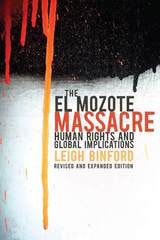
The El Mozote Massacre
Human Rights and Global Implications Revised and Expanded EditionLeigh Binford
University of Arizona Press, 2016
Almost two decades later, the consequences of the massacre continue to reverberate through the country’s legal and socioeconomic systems. The El Mozote Massacre, 2nd Edition brings together new evidence to address reconstruction, historical memory, and human rights issues resulting from what may be the largest massacre in modern Latin American history.
With a multitude of additions, including three new chapters, an extended chronology, discussion of the hearing and ruling of the Inter-American Court of Human Rights in 2012, and evidence gathered throughout half a dozen field trips made by the author, Binford presents a current perspective on the effects of this tragic moment in history. Thanks to geographically expanded fieldwork, Binford offers critical discussion of postwar social, economic, religious, and social justice in El Mozote, and adds important new regional, national, and global contexts.
The El Mozote Massacre, 2nd Edition maintains the crucial presence of the massacre in human rights discussions for El Salvador, Latin America, and the world.
The Last Colonial Massacre
Latin America in the Cold WarGreg Grandin
University of Chicago Press, 2004
Using Guatemala as a case study, Greg Grandin argues that the Cold War in Latin America was a struggle not between American liberalism and Soviet Communism but between two visions of democracy. The main effect of United States intervention in Latin America, Grandin shows, was not the containment of Communism but the elimination of home-grown concepts of social democracy.
Through unprecedented archival research and gripping personal testimonies, Grandin uncovers the hidden history of the Latin American Cold War: of hidebound reactionaries intent on holding on to their own power and privilege; of Mayan Marxists, blending indigenous notions of justice with universal ideas of freedom and equality; and of a United States supporting new styles of state terror throughout the continent. Drawing from declassified U.S. documents, Grandin exposes Washington's involvement in the 1966 secret execution of more than thirty Guatemalan leftists, which, he argues, prefigured the later wave of disappearances in Chile and Argentina.
Impassioned but judicious, The Last Colonial Massacre is history of the highest order—a work that will dramatically recast our understanding of Latin American politics and the triumphal role of the United States in the Cold War and beyond.
Through Survivors' Eyes
From the Sixties to the Greensboro MassacreSally Avery Bermanzohn
Vanderbilt University Press, 2003
In passionate first-person accounts, Through Survivors' Eyes tells the story of six remarkable people who set out to change the world. The survivors came of age as the "protest generation," joining the social movements of the 1960s and 1970s. They marched for civil rights, against war, for textile and healthcare workers, and for black power and women's liberation. As the mass mobilizations waned in the mid-1970s, they searched for a way to continue their activism, studied Marxism, and became communists.
Nelson Johnson, who grew up on a farm in eastern North Carolina in a family proud of its African American heritage, settled in Greensboro in the 1960s and became a leader of the Black Liberation Movement and a decade later the founder of the Faith Community Church. Willena Cannon, the daughter of black sharecroppers, witnessed a KKK murder as a child and was spurred to a life of activism. Her son, Kwame Cannon, was only ten when he saw the Greensboro killings. Marty Nathan, who grew up the daughter of a Midwestern union organizer and came to the South to attend medical school, lost her husband to the Klan/Nazi gunfire. Paul Bermanzohn, the son of Jewish Holocaust survivors, was permanently injured during the shootings. Sally Avery Bermanzohn, a child of the New York suburbs who came south to join the Civil Rights Movement, watched in horror as her friends were killed and her husband was wounded.
Through Survivors' Eyes is the story of people who abandoned conventional lives to become civil rights activists and then revolutionaries. It is about blacks and whites who united against Klan/Nazi terror, and then had to overcome unbearable hardship, and persist in seeking justice. It is also a story of one divided southern community, from the protests of black college students of the late 1960s to the convening this January of a Truth and Community Reconciliation Project (on the South African model) intended to reassess the Massacre.
To Rise in Darkness
Revolution, Repression, and Memory in El Salvador, 1920–1932Jeffrey L. Gould, Aldo A. Lauria-Santiago
Duke University Press, 2008
Gould conducted more than two hundred interviews with survivors of la Matanza and their descendants. He and Lauria-Santiago combine individual accounts with documentary sources from archives in El Salvador, Guatemala, Washington, London, and Moscow. They describe the political, economic, and cultural landscape of El Salvador during the 1920s and early 1930s, and offer a detailed narrative of the uprising and massacre. The authors challenge the prevailing idea that the Communist organizers of the uprising and the rural Indians who participated in it were two distinct groups. Gould and Lauria-Santiago demonstrate that many Communist militants were themselves rural Indians, some of whom had been union activists on the coffee plantations for several years prior to the rebellion. Moreover, by meticulously documenting local variations in class relations, ethnic identity, and political commitment, the authors show that those groups considered “Indian” in western El Salvador were far from homogeneous. The united revolutionary movement of January 1932 emerged out of significant cultural difference and conflict.