Results by title

11 books match the query 'Master'
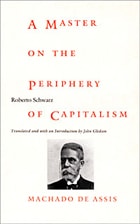
cover of A Master on the Periphery of Capitalism: Machado de Assis

A Master on the Periphery of Capitalism

Machado de Assis

Roberto Schwarz

Duke University Press, 2001

A Master on the Periphery of Capitalism is a translation (from the original Portuguese) of Roberto Schwarz’s renowned study of the work of Brazilian novelist Machado de Assis (1839–1908). A leading Brazilian theorist and author of the highly influential notion of “misplaced ideas,” Schwarz focuses his literary and cultural analysis on Machado’s The Posthumous Memoirs of Brás Cubas, which was published in 1880. Writing in the Marxist tradition, Schwarz investigates in particular how social structure gets internalized as literary form, arguing that Machado’s style replicates and reveals the deeply embedded class divisions of nineteenth-century Brazil.
Widely acknowledged as the most important novelist to have written in Latin America before 1940, Machado had a surprisingly modern style. Schwarz notes that the unprecedented wit, sarcasm, structural inventiveness, and mercurial changes of tone and subject matter found in The Posthumous Memoirs of Brás Cubas marked a crucial moment in the history of Latin American literature. He argues that Machado’s vanguard narrative reflects the Brazilian owner class and its peculiar status in both national and international contexts, and shows why this novel’s success was no accident. The author was able to confront some of the most prestigious ideologies of the nineteenth century with some uncomfortable truths, not the least of which was that slavery remained the basis of the Brazilian economy.
A Master on the Periphery of Capitalism will appeal to those with interests in Latin American literature, nineteenth century history, and Marxist literary theory.

[more]
cover of Hammer with No Master: Poems of René Char  (French and English Edition)

Hammer with No Master

Poems of René Char (French and English Edition)

René Char

Tupelo Press, 2016

In his foreword to Stone Lyre, Nancy Naomi Carlson’s previous collection of René Char translations, Ilya Kaminsky praised “the intensity, the dream-like language, the gravity of tone, and the constant impression that one is reading not words in the language, but sparks of flames.”

Stone Lyre was a selection of poems from Char’s numerous volumes of poems; Carlson’s new Hammer with No Master is a discrete and continuous work, the first English translation of Char’s Le marteau sans maître, first published in 1934 — a time of rumbling menace that our time resembles.
[more]
cover of Master and Disciple: The Cultural Foundations of Moroccan Authoritarianism

Master and Disciple

The Cultural Foundations of Moroccan Authoritarianism

Abdellah Hammoudi

University of Chicago Press, 1997

In the postcolonial era, Arab societies have been ruled by a variety of authoritarian regimes. Focusing on his native Morocco, Abdellah Hammoudi explores the ideological and cultural foundations of this persistent authoritarianism.

Building on the work of Foucault, Hammoudi argues that at the heart of Moroccan culture lies a paradigm of authority that juxtaposes absolute authority against absolute submission. Rooted in Islamic mysticism, this paradigm can be observed in the drama of mystic initiation, with its fundamental dialectic between Master and Disciple; in conflict with other cultural forms, and reelaborated in colonial and postcolonial circumstances, it informs all major aspects of Moroccan personal, political, and gender relations. Its influence is so pervasive and so firmly embedded that it ultimately legitimizes the authoritarian structure of power. Hammoudi contends that as long as the Master-Disciple dialectic remains the dominant paradigm of power relations, male authoritarianism will prevail as the dominant political form.

"Connecting political domination to gift exchange, ritual initiation, social loyalty, and gender reversals, Master and Disciple is nothing less than a thoroughgoing revision of our understanding of authoritarian rule in Morocco and in the Arab world in general."—Clifford Geertz, Institute for Advanced Study
[more]
cover of Master and Margarita: A Critical Companion

Master and Margarita

A Critical Companion

Laura Weeks

Northwestern University Press, 1996
An edited collection, part of the acclaimed AATSEEL Critical Companions series, that guides readers through Mikhail Bulgakov's satirical masterpiece. The introduction places The Master and Margarita and Bulgakov within Russian history and literature, and essays by prominent scholars offer opinion and analysis of the novel's structure, its place in current criticism, its connection to Goethe, and its symbolism and motifs. There is also an abundance of primary source material, including an excerpt from an earlier version of the novel, and related correspondence and diary entries.
[more]
cover of Master of Penance

Master of Penance

Arrai A. Larson

Catholic University of America Press, 2014

This book presents the first full-scale study of the Tractatus de penitentia (C.33 q.3) in Gratian's Decretum, which became the textbook for canon law and served as the basis of the church's developing jurisprudence, in theory and in practice
[more]
cover of Master of the Air: William Tunner and the Success of Military Airlift

Master of the Air

William Tunner and the Success of Military Airlift

Robert A. Slayton

University of Alabama Press, 2010

 
In 1948, just as the Cold War was settling into the form it would maintain for nearly half a century, major antagonists the US and the USSR began maneuvering into a series of dangerously hostile encounters. Trouble had broken out in Poland and Czechoslovakia, but it was in Germany, which had been at the heart of World Wars One and Two, that the first potentially explosive confrontation developed. The USSR, which had suffered more at Germany’s hands than the rest of the Allies combined, may have viewed developments there with heightened fear and irritability. When the western Allies moved to consolidate their areas of control in occupied Germany, the USSR responded by cutting off land access to West Berlin, holding over two million residents of that city hostage in an aggressive act of brinkmanship.

Into this difficult situation the US placed General William Henry Tunner. He was given a task that seemed doomed to failure—to supply a major city by air with everything it needed to survive from food to a winter’s supply of coal—and made it a brilliant success, astonishing the world in a major public relations defeat for the Soviets, and demonstrating the unexpected capacity of air fleets in a postwar world.

[more]
cover of The Master

The Master

Patrick Rambaud

Seagull Books, 2023

The extraordinary life of Zhuang Zhou sits halfway between fable and philosophy.

“It was twenty-five centuries ago in the land of Song, between the Yellow River and the River Huai: Zhuang Zhou was born without a cry with his eyes wide open.”
 
Welcome to China in the fifth century BCE, a colorful, violent, unstable world into which Zhuang is born. Here royals raise huge armies, constantly waging wars against one another. They have slaves, concubines. Gold is everywhere. And so is hunger. Born rich and entitled, Zhuang learns to refuse any official function. His travels bring him closer to ordinary people, from whom he learns how to live a simple and useful life. This is how he will become one of the greatest Chinese philosophers who gave his name to his legendary book, the Zhuangzi, one of the two foundational texts of Taoism—a magnificent procession of lively stories in which we meet dwarfs, virtuous bandits, butchers, powerful lords in their castles, turtles, charming concubines, and false sages. In this remarkable bildungsroman, award-winning French novelist Patrick Rambaud spins out the extraordinary life of Zhuang Zhou—a poetic, cruel, and often humorous tale, halfway between fable and philosophy.
[more]
cover of The Master Of Monterey: A Novel

The Master Of Monterey

A Novel

Lawrence Coates

University of Nevada Press, 2003
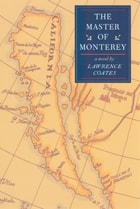
This comic novel, by the author of The Blossom Festival, is set in Mexican California in 1842 and is based on a true story of mistaken conquest. When Commodore Jones and the crew of the National Intention land in Monterey believing themselves to be bringing freedom and democracy to the benighted Californios, they discover that history has preceded them, that cruelty, betrayal, greed, and lust are already well established there, and that far from existing outside of history, California is a battleground for several contending versions of the past. They also find that their own limitations and illusions are far more powerful than the message of hope that they intend to deliver. 
[more]
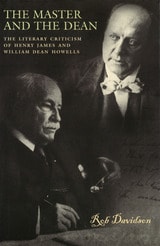
cover of The Master and the Dean: The Literary Criticism of Henry James and William Dean Howells

The Master and the Dean

The Literary Criticism of Henry James and William Dean Howells

Rob Davidson

University of Missouri Press, 2005
Henry James (1843–1916) and William Dean Howells (1837–1920) are best known for the central roles they played as nineteenth-century American novelists, penning such classics as James’s Portrait of a Lady and Howells’s The Rise of Silas Lapham. Their importance as literary critics, however, has been underplayed for decades. Although certain aspects of James’s and Howells’s criticism have been carefully considered—James’s “Prefaces” and Howells’s Criticism and Fiction, for example—no scholar has previously undertaken a comprehensive comparative study of their respective critical oeuvres. In The Master and the Dean, Rob Davidson presents the first book-length study of James’s literary criticism to be published since the early 1980s and the first-ever book-length study of Howells’s criticism. Considering Howells’s commonly accepted position among scholars as the most influential American literary critic of the period, such a study is long overdue.
            Beginning with a detailed examination of the European and domestic sources that led James and Howells toward realism, Davidson examines the interrelationships between the two writers, with special emphasis on their diverging aesthetic concerns and attitudes toward the market and audience, their beliefs concerning the moral value of fiction and the United States as a literary subject, and their various writings about each other. A rigorous, intertextual reading of their work as critics reveals both deeper rifts and more intimate similarities between the two writers than have been recognized previously. Of special note is Davidson’s careful attention to the frequently overlooked final two decades of Howells’s career.
            This close look at the lesser-known critical work of James and Howells will appeal both to scholars of the period and to anyone seeking an exceptional introduction to a crucially important era of American literary criticism.
[more]
cover of The Thinking of the Master: Bataille between Hegel and Surrealism

The Thinking of the Master

Bataille between Hegel and Surrealism

Peter Burger

Northwestern University Press, 2002
Mastery of many sorts emerges in new configurations in Peter Bürger's The Thinking of the Master as an idea developed by Hegel in the master/slave dialectic in his Phenomenology of Spirit as a quality embodied in the work of certain twentieth-century maître-penseurs, or "master thinkers"; and, not least, in the expertise of Bürger himself as he negotiates and clarified a critical intersection of contemporary French and German thought. The author of the classic Theory of the Avant-Garde, Bürger here considers what several seminal thinkers—among them Bataille, Barthes, Foucault, and Derrida—owe to Hegel's dialectic and measures their accomplishments against the avant-garde project. Succinct, witty, and instructive, each of his essays stands alone as a valuable exposition of a significant strain of postmodern thought.
[more]
cover of Uncle Abner: Master of Mysteries

Uncle Abner

Master of Mysteries

Melville Davisson Post

West Virginia University Press, 2015

First published in 1918, Uncle Abner: Master of Mysteries is an anthology of detective stories written by Melville Davisson Post. The popular stories within this collection were serialized in national magazines such as the Saturday Evening Post in the early 20th century.

Uncle Abner is an amateur detective in present-day Harrison County, West Virginia. Throughout his journeys around this antebellum wilderness, long before the nation had a proper police system, the honest Uncle Abner is confronted by murders and mysteries that cannot be ignored. With uncanny intuition, impressive logic, and keen observation of human actions, Uncle Abner is Melville Davisson Post’s most celebrated literary creation and is considered to be one of the most important texts in American detective and crime fiction.

This new edition contains an introduction by Craig Johnson, author of the Walt Longmire novels. 

[more]