Results by title
7 books match the query 'Mastery'
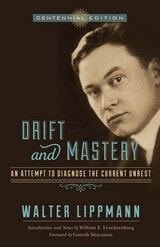
Drift and Mastery
An Attempt to Diagnose the Current UnrestWalter Lippmann, Introduction and notes by William E. Leuchtenburg, Foreword by Ganesh Sitaraman
University of Wisconsin Press, 2015
Lippman’s Drift and Mastery became one of the most important and influential documents of the Progressive Movement. It remains a valuable text for understanding the political thought of early twentieth-century America and a lucid exploration of timeless themes in American government and politics. Distinguished historian Walter Leuchtenberg’s 1986 introduction and notes are retained in this edition.
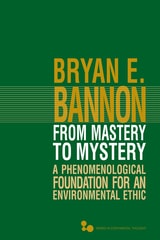
From Mastery to Mystery
A Phenomenological Foundation for an Environmental EthicBryan E. Bannon
Ohio University Press, 2014
From Mastery to Mystery is an original and provocative contribution to the burgeoningfield of ecophenomenology. Informed by current debates in environmental philosophy, Bannon critiques the conception of nature as u200a“substance” that he finds tacitly assumed by the major environmental theorists. Instead, this book reconsiders the basic goals of an environmental ethic by questioning the most basic presupposition that most environmentalists accept: that nature is in need of preservation.
Beginning with Bruno Latour’s idea that continuing to speak of nature in the way we popularly conceive of it is ethically and politically disastrous, this book describes a way in which the concept of nature can retain its importance in our discussion of the contemporary state of the environment. Based upon insights from the phenomenological tradition, specifically the work of Martin Heidegger and Maurice Merleau-Ponty, the concept of nature developed in the book preserves the best antihumanistic intuitions of environmentalists without relying on either a reductionistic understanding of nature and the sciences or dualistic metaphysical constructions.
Mastery and Drift
Professional-Class Liberals since the 1960sEdited by Brent Cebul and Lily Geismer
University of Chicago Press, 2025
Since the 1960s, American liberalism and the Democratic Party have been remade along professional class lines, widening liberalism’s impact but narrowing its social and political vision. In Mastery and Drift, historians Brent Cebul and Lily Geismer have assembled a group of scholars to address the formation of “professional-class liberalism” and its central role in remaking electoral politics and the practice of governance. Across subjects as varied as philanthropy, consulting, health care, welfare, race, immigration, economics, and foreign conflicts, the authors examine not only the gaps between liberals’ egalitarian aspirations and their approaches to policymaking but also how the intricacies of contemporary governance have tended to bolster professional-class liberals’ power.
The contributors to Mastery and Drift all came of age amid the development of professional-class liberalism, giving them distinctive and important perspectives in understanding its internal limitations and its relationship to neoliberalism and the Right. With never-ending disputes over the meaning of liberalism, the content of its governance, and its relationship to a resurgent Left, now is the time to consider modern liberalism’s place in contemporary American life.
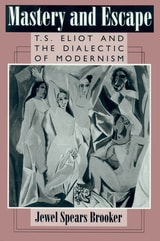
Mastery and Escape
T. S. Eliot and the Dialectic of ModernismJewel Spears Brooker
University of Massachusetts Press, 1994
This seminal scholarly work examines T. S. Eliot's literary development and philosophical outlook through the lens of modernist dialectics, exploring the tension between mastery and escape as central to understanding both his poetry and critical thought. Edited and written by acclaimed Eliot scholar Jewel Spears Brooker, this volume presents expert studies of key intellectual influences on Eliot's modernism—particularly Stéphane Mallarmé, Sir James George Frazer, F. H. Bradley, and T. E. Hulme—yielding fresh and original insights into how these thinkers shaped the poet's artistic vision.
Through careful textual analysis and intellectual history, Brooker investigates how Eliot grappled with fundamental modernist anxieties: the desire for artistic mastery and transcendence alongside the simultaneous impulse toward escape from the constraints of tradition, rationality, and conventional form. She demonstrates how Eliot's poetry and prose reflect a dialectical movement, a constant interplay between opposing forces, that defines both his modernist aesthetics and his philosophical positions.
An essential resource for scholars seeking comprehensive understanding of modernism's philosophical foundations and poetic achievements, Brooker is devoted to tracing both dialectical movements and biographical developments in Eliot's career.
Mastery of Non-Mastery in the Age of Meltdown
Michael Taussig
University of Chicago Press, 2020
Taussig seeks to move us away from the manipulation of nature and reorient us to different metaphors and sources of inspiration to develop a new ethical stance toward the world. His ultimate goal is to undo his readers’ sense of control and engender what he calls “mastery of non-mastery.” This unique book developed out of Taussig’s work with peasant agriculture and his artistic practice, which brings performance art together with aspects of ritual. Through immersive meditations on Walter Benjamin, D. H. Lawrence, Emerson, Bataille, and Proust, Taussig grapples with the possibility of collapse and with the responsibility we bear for it.
Not-Forgetting
Contemporary Art and the Interrogation of MasteryRosalyn Deutsche
University of Chicago Press, 2022
Amid times of emboldened cruelty and perpetual war, Rosalyn Deutsche links contemporary art to three practices that counter the prevailing destructiveness: psychoanalytic feminism, radical democracy, and war resistance. Deutsche considers how art joins these radical practices to challenge desires for mastery and dominion, which are encapsulated in the Eurocentric conception of the human that goes under the name “Man” and is driven by deadly inclinations that Deutsche calls masculinist. The masculinist subject—as an individual or a group—universalizes itself, claims to speak on behalf of humanity, and meets differences with conquest.
Analyzing artworks by Christopher D’Arcangelo, Robert Filliou, Hans Haacke, Mary Kelly, Silvia Kolbowski, Barbara Kruger, Louise Lawler, Martha Rosler, James Welling, and Krzysztof Wodiczko, Deutsche illuminates the diverse ways in which they expose, question, and trouble the visual fantasies that express masculinist desire. Undermining the mastering subject, these artworks invite viewers to question the positions they assume in relation to others. Together, the essays in Not-Forgetting, written between 1999 and 2020, argue that this art offers a unique contribution to building a less cruel and violent society.
The Imperial Map
Cartography and the Mastery of EmpireEdited by James R. Akerman
University of Chicago Press, 2009
Critically reflecting on elements of mapping and imperialism from the late seventeenth century to the early twentieth century, the essays discuss the nature of the imperial map through a series of case studies of empires, from the Qing dynasty of China, to the Portuguese empire in South America, to American imperial pretensions in the Pacific Ocean, among others. Collectively, the essays reveal that the relationship between mapping and imperialism, as well as the practice of political and economic domination of weak polities by stronger ones, is a rich and complex historical theme that continues to resonate in our modern day.