Results by title

15 books match the query 'Mathematical & Computational'

cover of An Equation That Changed the World: Newton, Einstein, and the Theory of Relativity

An Equation That Changed the World

Newton, Einstein, and the Theory of Relativity

Harald Fritzsch

University of Chicago Press, 1994

Fritzsch offers readers the opportunity to listen in on a meeting of Isaac Newton, Albert Einstein, and a present-day physicist. While he introduces the theory of relativity, Fritzsch teaches its sources, its workings, and the ways it has revolutionized our view of the physical world. An Equation That Changed the World dramatizes the importance of relativity, for the human race, and the survival of our planet.

"Fritzsch could not give the modern reader a more memorable introduction to the personalities and science of Isaac Newton and Albert Einstein unless somehow he could find the keys to H. G. Wells' time machine. . . . Many readers will applaud Fritzsch for this lively but profoundly insightful book." —Booklist, starred review

"[Fritzsch] has dreamed up a dialogue between the two great physicists, helped along by a fictional modern physicist. . . . The conversation builds up to an explanation of E=mc2, and on the way illuminates the important points where Newtonian and Einsteinian theory diverge." —David Lindley, New York Times Book Review
[more]
cover of Computational Electromagnetics for Metamaterial Modelling

Computational Electromagnetics for Metamaterial Modelling

Toru Uno

The Institution of Engineering and Technology, 2027
Electromagnetic metamaterials are a class of artificial media that exhibit electromagnetic properties not found in naturally occurring materials. The field of metamaterials has advanced rapidly, driven by theoretical and experimental investigations conducted predominantly in the optical field. Subsequent progress in microwave and terahertz component design has further accelerated this development, and numerous applications have since emerged in antenna engineering and electromagnetic compatibility. As a result, there is a strong demand for accurate and computationally efficient numerical techniques that support the design of electromagnetic devices incorporating metamaterials while ensuring satisfactory performance and reliability.
[more]
cover of Electrodynamics

Electrodynamics

Fulvio Melia

University of Chicago Press, 2001

Practically all of modern physics deals with fields—functions of space (or spacetime) that give the value of a certain quantity, such as the temperature, in terms of its location within a prescribed volume. Electrodynamics is a comprehensive study of the field produced by (and interacting with) charged particles, which in practice means almost all matter.

Fulvio Melia's Electrodynamics offers a concise, compact, yet complete treatment of this important branch of physics. Unlike most of the standard texts, Electrodynamics neither assumes familiarity with basic concepts nor ends before reaching advanced theoretical principles. Instead this book takes a continuous approach, leading the reader from fundamental physical principles through to a relativistic Lagrangian formalism that overlaps with the field theoretic techniques used in other branches of advanced physics. Avoiding unnecessary technical details and calculations, Electrodynamics will serve both as a useful supplemental text for graduate and advanced undergraduate students and as a helpful overview for physicists who specialize in other fields.
[more]
cover of Electromagnetic Mixing Formulas and Applications

Electromagnetic Mixing Formulas and Applications

Ari Sihvola

The Institution of Engineering and Technology, 1999
The book discusses homogenisation principles and mixing rules for the determination of the macroscopic dielectric and magnetic properties of different types of media. The effects of structure and anisotropy are discussed in detail, as well as mixtures involving chiral and nonlinear materials. High frequency scattering phenomena and dispersive properties are also discussed.
[more]
cover of From Science to Computational Sciences: Studies in the History of Computing and its Influence on Today‘s Sciences

From Science to Computational Sciences

Studies in the History of Computing and its Influence on Today‘s Sciences

Edited by Gabriele Gramelsberger

Diaphanes, 2011

In 1946 John von Neumann stated that science is stagnant along the entire front of complex problems, proposing the use of largescale computing machines to overcome this stagnation. In other words, Neumann advocated replacing analytical methods with numerical ones. The invention of the computer in the 1940s allowed scientists to realise numerical simulations of increasingly complex problems like weather forecasting, and climate and molecular modelling. Today, computers are widely used as computational laboratories, shifting science toward the computational sciences. By replacing analytical methods with numerical ones, they have expanded theory and experimentation by simulation.

During the last decades hundreds of computational departments have been established all over the world and countless computer-based simulations have been conducted. This volume explores the epoch-making influence of automatic computing machines on science, in particular as simulation tools.
[more]
cover of Geometrical Vectors

Geometrical Vectors

Gabriel Weinreich

University of Chicago Press, 1998

Every advanced undergraduate and graduate student of physics must master the concepts of vectors and vector analysis. Yet most books cover this topic by merely repeating the introductory-level treatment based on a limited algebraic or analytic view of the subject.

Geometrical Vectors introduces a more sophisticated approach, which not only brings together many loose ends of the traditional treatment, but also leads directly into the practical use of vectors in general curvilinear coordinates by carefully separating those relationships which are topologically invariant from those which are not. Based on the essentially geometric nature of the subject, this approach builds consistently on students' prior knowledge and geometrical intuition.

Written in an informal and personal style, Geometrical Vectors provides a handy guide for any student of vector analysis. Clear, carefully constructed line drawings illustrate key points in the text, and problem sets as well as physical examples are provided.
[more]
cover of Masters of Theory: Cambridge and the Rise of Mathematical Physics

Masters of Theory

Cambridge and the Rise of Mathematical Physics

Andrew Warwick

University of Chicago Press, 2003

Winner of the the Susan Elizabeth Abrams Prize in History of Science.

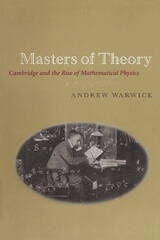
When Isaac Newton published the Principia three centuries ago, only a few scholars were capable of understanding his conceptually demanding work. Yet this esoteric knowledge quickly became accessible in the nineteenth and early twentieth centuries when Britain produced many leading mathematical physicists. In this book, Andrew Warwick shows how the education of these "masters of theory" led them to transform our understanding of everything from the flight of a boomerang to the structure of the universe.

Warwick focuses on Cambridge University, where many of the best physicists trained. He begins by tracing the dramatic changes in undergraduate education there since the eighteenth century, especially the gradual emergence of the private tutor as the most important teacher of mathematics. Next he explores the material culture of mathematics instruction, showing how the humble pen and paper so crucial to this study transformed everything from classroom teaching to final examinations. Balancing their intense intellectual work with strenuous physical exercise, the students themselves—known as the "Wranglers"—helped foster the competitive spirit that drove them in the classroom and informed the Victorian ideal of a manly student. Finally, by investigating several historical "cases," such as the reception of Albert Einstein's special and general theories of relativity, Warwick shows how the production, transmission, and reception of new knowledge was profoundly shaped by the skills taught to Cambridge undergraduates.

Drawing on a wealth of new archival evidence and illustrations, Masters of Theory examines the origins of a cultural tradition within which the complex world of theoretical physics was made commonplace.


[more]
cover of Mathematical Physics

Mathematical Physics

Robert Geroch

University of Chicago Press, 1984
Mathematical Physics is an introduction to such basic mathematical structures as groups, vector spaces, topological spaces, measure spaces, and Hilbert space. Geroch uses category theory to emphasize both the interrelationships among different structures and the unity of mathematics. Perhaps the most valuable feature of the book is the illuminating intuitive discussion of the "whys" of proofs and of axioms and definitions. This book, based on Geroch's University of Chicago course, will be especially helpful to those working in theoretical physics, including such areas as relativity, particle physics, and astrophysics.
[more]
cover of Model-Based Parameter Estimation in Computational Electromagnetics

Model-Based Parameter Estimation in Computational Electromagnetics

Edmund K. Miller

The Institution of Engineering and Technology, 2026

Computational electromagnetics (CEM) involves modeling the interaction of electromagnetic fields with physical objects and their environment, such as the radiation emitted by antennas and the fields scattered from radar targets.
[more]
cover of Solved Problems in Dynamical Systems and Control

Solved Problems in Dynamical Systems and Control

J. Tenreiro-Machado

The Institution of Engineering and Technology, 2017

This book presents a collection of exercises on dynamical systems, modelling and control. Each topic covered includes a summary of the theoretical background, problems with solutions, and further exercises.
[more]
cover of Swarm Intelligence: Applications, Volume 3

Swarm Intelligence

Applications, Volume 3

Ying Tan

The Institution of Engineering and Technology, 2018

Swarm Intelligence (SI) is one of the most important and challenging paradigms under the umbrella of computational intelligence. It focuses on the research of collective behaviours of a swarm in nature and/or social phenomenon to solve complicated and difficult problems which cannot be handled by traditional approaches. Thousands of papers are published each year presenting new algorithms, new improvements and numerous real world applications. This makes it hard for researchers and students to share their ideas with other colleagues; follow up the works from other researchers with common interests; and to follow new developments and innovative approaches. This complete and timely collection fills this gap by presenting the latest research systematically and thoroughly to provide readers with a full view of the field of swarm. Students will learn the principles and theories of typical swarm intelligence algorithms; scholars will be inspired with promising research directions; and practitioners will find suitable methods for their applications of interest along with useful instructions.
[more]
cover of Swarm Intelligence: Innovation, new algorithms and methods, Volume 2

Swarm Intelligence

Innovation, new algorithms and methods, Volume 2

Ying Tan

The Institution of Engineering and Technology, 2018

Swarm Intelligence (SI) is one of the most important and challenging paradigms under the umbrella of computational intelligence. It focuses on the research of collective behaviours of a swarm in nature and/or social phenomenon to solve complicated and difficult problems which cannot be handled by traditional approaches. Thousands of papers are published each year presenting new algorithms, new improvements and numerous real world applications. This makes it hard for researchers and students to share their ideas with other colleagues; follow up the works from other researchers with common interests; and to follow new developments and innovative approaches. This complete and timely collection fills this gap by presenting the latest research systematically and thoroughly to provide readers with a full view of the field of swarm. Students will learn the principles and theories of typical swarm intelligence algorithms; scholars will be inspired with promising research directions; and practitioners will find suitable methods for their applications of interest along with useful instructions.
[more]
cover of Swarm Intelligence: Principles, current algorithms and methods, Volume 1

Swarm Intelligence

Principles, current algorithms and methods, Volume 1

Ying Tan

The Institution of Engineering and Technology, 2018

Swarm Intelligence (SI) is one of the most important and challenging paradigms under the umbrella of computational intelligence. It focuses on the research of collective behaviours of a swarm in nature and/or social phenomenon to solve complicated and difficult problems which cannot be handled by traditional approaches. Thousands of papers are published each year presenting new algorithms, new improvements and numerous real world applications. This makes it hard for researchers and students to share their ideas with other colleagues; follow up the works from other researchers with common interests; and to follow new developments and innovative approaches. This complete and timely collection fills this gap by presenting the latest research systematically and thoroughly to provide readers with a full view of the field of swarm. Students will learn the principles and theories of typical swarm intelligence algorithms; scholars will be inspired with promising research directions; and practitioners will find suitable methods for their applications of interest along with useful instructions.
[more]
cover of Theory of Nonuniform Waveguides: The cross-section method

Theory of Nonuniform Waveguides

The cross-section method

B.Z. Katsenelenbaum

The Institution of Engineering and Technology, 1998
The cross-section method is an analytical tool used in the design of components required for low-loss, highly efficient transmission of electromagnetic waves in nonuniform waveguides. When the waveguide dimensions are large compared with the wavelength, a fully three-dimensional analysis employing modern numerical methods based on finite element, finite difference, finite integration or transmission line matrix formalisms is practically impossible and the cross-section method is the only feasible analysis technique.
[more]
cover of Time Warps, String Edits, and Macromolecules: The Theory and Practice of Sequence Comparision

Time Warps, String Edits, and Macromolecules

The Theory and Practice of Sequence Comparision

David Sankoff and Joseph Kruskal

CSLI, 1983

Time Warps, String Edits and Macromolecules is a young classic in computational science. The computational perspective is that of sequence processing, in particular the problem of recognizing related sequences. The book is the first, and still best compilation of papers explaining how to measure distance between sequences, and how to compute that measure effectively. This is called string distance, Levenshtein distance, or edit distance. The book contains lucid explanations of the basic techniques; well-annotated examples of applications; mathematical analysis of its computational (algorithmic) complexity; and extensive discussion of the variants needed for weighted measures, timed sequences (songs), applications to continuous data, comparison of multiple sequences and extensions to tree-structures. This theory finds applications in molecular biology, speech recognition, analysis of bird song and error correcting in computer software.
[more]