Results by title
8 books match the query 'Mathematical physics'
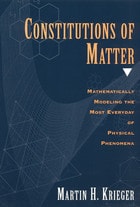
Constitutions of Matter
Mathematically Modeling the Most Everyday of Physical PhenomenaMartin H. Krieger
University of Chicago Press, 1996
In this insightful work, Martin H. Krieger shows what physicists are really doing when they employ mathematical models as research tools. He argues that the technical details of these complex calculations serve not only as a means to an end, but also reveal key aspects of the physical properties they model.
Krieger's lucid discussions will help readers to appreciate the larger physical issues behind the mathematical detail of modern physics and gain deeper insights into how theoretical physicists work. Constitutions of Matter is a rare, behind-the-scenes glimpse into the world of modern physics.
"[Krieger] provides students of physics and applied mathematics with a view of the physical forest behind the mathematical trees, historians and philosophers of science with insights into how theoretical physicists go about their work, and technically advanced general readers with a glimpse into the discipline."—Scitech Book News
[more]
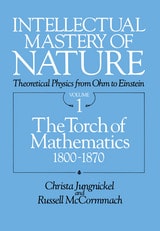
Intellectual Mastery of Nature. Theoretical Physics from Ohm to Einstein, Volume 1
The Torch of Mathematics, 1800 to 1870Christa Jungnickel and Russell McCormmach
University of Chicago Press, 1986
Christina Jungnickel and Russell McCormmach have created in these two volumes a panoramic history of German theoretical physics. Bridging social, institutional, and intellectual history, they chronicle the work of the researchers who, from the first years of the nineteenth century, strove for an intellectual mastery of nature.
Volume 1 opens with an account of physics in Germany at the beginning of the nineteenth century and of German physicists' reception of foreign mathematical and experimental work. Jungnickel and McCormmach follow G. S. Ohm, Wilhelm Weber, Franz Neumann, and others as these scientists work out the new possibilities for physics, introduce student laboratories and instruction in mathematical physics, organize societies and journals, and establish and advance major theories of classical physics. Before the end of the nineteenth century, German physics and its offspring, theoretical physics, had acquired nearly their present organizational forms. The foundations of the classical picture of the physical world had been securely laid, preparing the way for the developments that are the subject of volume 2.
Volume 1 opens with an account of physics in Germany at the beginning of the nineteenth century and of German physicists' reception of foreign mathematical and experimental work. Jungnickel and McCormmach follow G. S. Ohm, Wilhelm Weber, Franz Neumann, and others as these scientists work out the new possibilities for physics, introduce student laboratories and instruction in mathematical physics, organize societies and journals, and establish and advance major theories of classical physics. Before the end of the nineteenth century, German physics and its offspring, theoretical physics, had acquired nearly their present organizational forms. The foundations of the classical picture of the physical world had been securely laid, preparing the way for the developments that are the subject of volume 2.
[more]
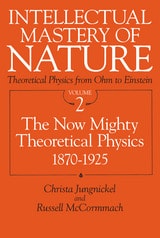
Intellectual Mastery of Nature. Theoretical Physics from Ohm to Einstein, Volume 2
The Now Mighty Theoretical Physics, 1870 to 1925Christa Jungnickel and Russell McCormmach
University of Chicago Press, 1986
Winner of the 1987 Pfizer Award of the History of Science Society
"A majestic study of a most important spoch of intellectual
history."—Brian Pippard, Times Literary Supplement
"The authors' use of archival sources hitherto almost
untouched gives their story a startling vividness. These volumes
are among the finest works produced by historians of physics."—Jed
Z. Buchwald, Isis
"The authors painstakingly reconstruct the minutiae of
laboratory budgets, instrument collections, and student numbers;
they disentangle the intrigues of faculty appointments and the
professional values those appointments reflected; they explore
collegial relationships among physicists; and they document the
unending campaign of scientists to wring further support for
physics from often reluctant ministries."—R. Steven Turner, Science
"Superbly written and exhaustively researched."—Peter Harman,
Nature
[more]
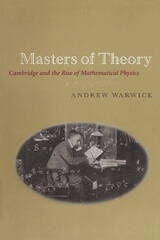
Masters of Theory
Cambridge and the Rise of Mathematical PhysicsAndrew Warwick
University of Chicago Press, 2003
Winner of the the Susan Elizabeth Abrams Prize in History of Science.
When Isaac Newton published the Principia three centuries ago, only a few scholars were capable of understanding his conceptually demanding work. Yet this esoteric knowledge quickly became accessible in the nineteenth and early twentieth centuries when Britain produced many leading mathematical physicists. In this book, Andrew Warwick shows how the education of these "masters of theory" led them to transform our understanding of everything from the flight of a boomerang to the structure of the universe.
Warwick focuses on Cambridge University, where many of the best physicists trained. He begins by tracing the dramatic changes in undergraduate education there since the eighteenth century, especially the gradual emergence of the private tutor as the most important teacher of mathematics. Next he explores the material culture of mathematics instruction, showing how the humble pen and paper so crucial to this study transformed everything from classroom teaching to final examinations. Balancing their intense intellectual work with strenuous physical exercise, the students themselves—known as the "Wranglers"—helped foster the competitive spirit that drove them in the classroom and informed the Victorian ideal of a manly student. Finally, by investigating several historical "cases," such as the reception of Albert Einstein's special and general theories of relativity, Warwick shows how the production, transmission, and reception of new knowledge was profoundly shaped by the skills taught to Cambridge undergraduates.
Drawing on a wealth of new archival evidence and illustrations, Masters of Theory examines the origins of a cultural tradition within which the complex world of theoretical physics was made commonplace.
[more]
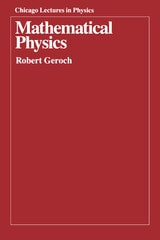
Mathematical Physics
Robert Geroch
University of Chicago Press, 1984
Mathematical Physics is an introduction to such basic mathematical structures as groups, vector spaces, topological spaces, measure spaces, and Hilbert space. Geroch uses category theory to emphasize both the interrelationships among different structures and the unity of mathematics. Perhaps the most valuable feature of the book is the illuminating intuitive discussion of the "whys" of proofs and of axioms and definitions. This book, based on Geroch's University of Chicago course, will be especially helpful to those working in theoretical physics, including such areas as relativity, particle physics, and astrophysics.
[more]
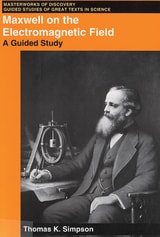
Maxwell on the Electromagnetic Field
A Guided StudyThomas K. Simpson
Rutgers University Press, 1997
In this volume in the Masterworks of Discovery series, Thomas K. Simpson offers readers a chance to watch one of the greatest minds in physics hard at work. In three papers in mathematical physics written between 1855 and 1864, James Clerk Maxwell grappled with his formulation of the theory of the electromagnetic field.
This volume reproduces major portions of the text of Maxwell's classic papers on concepts that are key to both modern physics and the modern world. Through Simpson's engaginbg commentaries and notes and Anne Farrell's illustrations, readers with limited knowledge of math or physics as well as scientists and historians of science will be able to follow the emergence of Maxwell's ideas and to appreciate the magnitude of his achievement. This book includes a long biographical introduction that explores the personal, historical, and scientific context of Maxwell's book.
This volume reproduces major portions of the text of Maxwell's classic papers on concepts that are key to both modern physics and the modern world. Through Simpson's engaginbg commentaries and notes and Anne Farrell's illustrations, readers with limited knowledge of math or physics as well as scientists and historians of science will be able to follow the emergence of Maxwell's ideas and to appreciate the magnitude of his achievement. This book includes a long biographical introduction that explores the personal, historical, and scientific context of Maxwell's book.
[more]
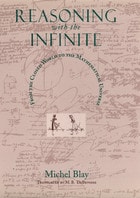
Reasoning with the Infinite
From the Closed World to the Mathematical UniverseMichel Blay
University of Chicago Press, 1998
Until the Scientific Revolution, the nature and motions of heavenly objects were mysterious and unpredictable. The Scientific Revolution was revolutionary in part because it saw the advent of many mathematical tools—chief among them the calculus—that natural philosophers could use to explain and predict these cosmic motions. Michel Blay traces the origins of this mathematization of the world, from Galileo to Newton and Laplace, and considers the profound philosophical consequences of submitting the infinite to rational analysis.
"One of Michael Blay's many fine achievements in Reasoning with the Infinite is to make us realize how velocity, and later instantaneous velocity, came to play a vital part in the development of a rigorous mathematical science of motion."—Margaret Wertheim, New Scientist
"One of Michael Blay's many fine achievements in Reasoning with the Infinite is to make us realize how velocity, and later instantaneous velocity, came to play a vital part in the development of a rigorous mathematical science of motion."—Margaret Wertheim, New Scientist
[more]
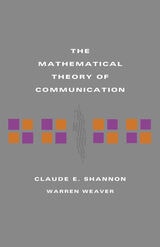
The Mathematical Theory of Communication
Claude E. Shannon and Warren Weaver
University of Illinois Press, 1998
Scientific knowledge grows at a phenomenal pace--but few books have had as lasting an impact or played as important a role in our modern world as The Mathematical Theory of Communication, published originally as a paper on communication theory more than fifty years ago. Republished in book form shortly thereafter, it has since gone through four hardcover and sixteen paperback printings. It is a revolutionary work, astounding in its foresight and contemporaneity. The University of Illinois Press is pleased and honored to issue this commemorative reprinting of a classic.
[more]