Results by title
9 books match the query 'Matters'

A Student's Guide to Law School
What Counts, What Helps, and What MattersAndrew B. Ayers
University of Chicago Press, 2013
As a recent graduate and an appellate lawyer, Andrew Ayers knows how high the stakes are—he’s been there, and not only did he survive the experience, he graduated first in his class. In A Student’s Guide to Law School he shares invaluable insight on what it takes to make a successful law school journey. Originating in notes Ayers jotted down while commuting to his first clerkship with then-Judge Sonia Sotomayor, and refined throughout his first years as a lawyer, A Student’s Guide to Law School offers a unique balance of insider’s knowledge and professional advice.
Organized in four parts, the first part looks at tests and grades, explaining what’s expected and exploring the seven choices students must make on exam day. The second part discusses the skills needed to be a successful law student, giving the reader easy-to-use tools to analyze legal materials and construct clear arguments.
The third part contains advice on how to use studying, class work, and note-taking to find your best path. Finally, Ayers closes with a look beyond the classroom, showing students how the choices they make in law school will affect their career—and even determine the kind of lawyer they become.
The first law school guide written by a recent top-ranked graduate, A Student’s Guide to Law School is relentlessly practical and thoroughly relevant to the law school experience of today’s students. With the tools and advice Ayers shares here, students can make the most of their investment in law school, and turn their valuable learning experiences into a meaningful career.

MATTERS OF FACT
READING NONFICTION OVER THE EDGEDANIEL W. LEHMAN
The Ohio State University Press, 1998
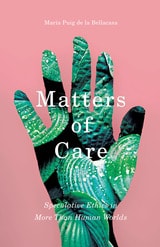
Matters of Care
Speculative Ethics in More than Human WorldsMaría Puig de la Bellacasa
University of Minnesota Press, 2017
To care can feel good, or it can feel bad. It can do good, it can oppress. But what is care? A moral obligation? A burden? A joy? Is it only human? In Matters of Care, María Puig de la Bellacasa presents a powerful challenge to conventional notions of care, exploring its significance as an ethical and political obligation for thinking in the more than human worlds of technoscience and naturecultures.
Matters of Care contests the view that care is something only humans do, and argues for extending to non-humans the consideration of agencies and communities that make the living web of care by considering how care circulates in the natural world. The first of the book’s two parts, “Knowledge Politics,” defines the motivations for expanding the ethico-political meanings of care, focusing on discussions in science and technology that engage with sociotechnical assemblages and objects as lively, politically charged “things.” The second part, “Speculative Ethics in Antiecological Times,” considers everyday ecologies of sustaining and perpetuating life for their potential to transform our entrenched relations to natural worlds as “resources.”
From the ethics and politics of care to experiential research on care to feminist science and technology studies, Matters of Care is a singular contribution to an emerging interdisciplinary debate that expands agency beyond the human to ask how our understandings of care must shift if we broaden the world.
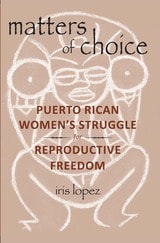
Matters of Choice
Puerto Rican Women's Struggle for Reproductive FreedomLopez, Iris
Rutgers University Press, 2008
In Matters of Choice, Iris Lopez presents a comprehensive analysis of the dichotomous views that have portrayed sterilization either as part of a coercive program of population control or as a means of voluntary, even liberating, fertility control by individual women. Drawing upon her twenty-five years of research on sterilized Puerto Rican women from five different families in Brooklyn, Lopez untangles the interplay between how women make fertility decisions and their social, economic, cultural, and historical constraints. Weaving together the voices of these women, she covers the history of sterilization and eugenics, societal pressures to have fewer children, a lack of adequate health care, patterns of gender inequality, and misinformation provided by doctors and family members.
Lopez makes a stirring case for a model of reproductive freedom, taking readers beyond victim/agent debates to consider a broader definition of reproductive rights within a feminist anthropological context.

Matters of Gravity
Special Effects and Supermen in the 20th CenturyScott Bukatman
Duke University Press, 2003
Considering theme parks, cyberspace, cinematic special effects, superhero comics, and musical films, Matters of Gravity highlights phenomena that make technology spectacular, permit unfettered flights of fantasy, and free us momentarily from the weight of gravity and history, of past and present. Bukatman delves into the dynamic ways pop culture imagines that apotheosis of modernity: the urban metropolis. He points to two genres, musical films and superhero comics, that turn the city into a unique site of transformative power. Leaping in single bounds from lively descriptions to sharp theoretical insights, Matters of Gravity is a deft, exhilarating celebration of the liberatory effects of popular culture.
Matters of Life and Death
Moral Responsibility, Care, and Dignity in DyingStephanie O'Connor
Haus Publishing, 2026
A thoughtful examination of dignity at the end of life and the ethical limits of choice in modern medicine.
For most of human history, death was shaped by circumstance, custom, and human presence. Today, it is increasingly mediated by medicine, law, and the language of choice. Our expanding capacity to prolong life and manage dying has outstripped the moral habits that once helped us make sense of such moments. What confronts us now is not only the question of what may be done, or what is permitted, but also how moral responsibility is borne when knowledge is partial and responsibility is dispersed.
Resisting moral certainty and procedural comfort, Stephanie O’Connor considers what is revealed and obscured when complex situations are reduced to questions of choice or rights alone. Considering dignity as a guiding moral concern at the limits of life, and drawing on healthcare ethics, case law, and contemporary debates—including those surrounding assisted dying and artificial intelligence—this book examines how decisions made under conditions of vulnerability are shaped not only by autonomy and consent, but also by dependence, unequal power, and institutional practice. Acutely attentive to the tensions that exist between compassion and restraint, as well as personal agency and shared responsibility, O’Connor does not propose solutions or offer moral closure. Instead, she asks what is owed: to those whose lives are ending, to those who care for them, and to the fragile shared moral life that binds personal decisions to their public consequences.
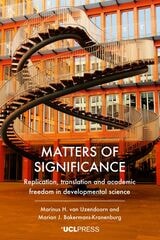
Matters of Significance
Replication, Translation and Academic Freedom in developmental scienceMarinus H. van IJzendoorn and Marian J. Bakermans-Kranenburg
University College London, 2024
Application of scientific findings to effective practice and informed policymaking is an aspiration for much research in the biomedical, behavioral, and developmental sciences. But too often translations of science to practice are conceptually narrow and developed quickly as salves to an urgent problem. For developmental science, widely implemented parenting interventions are prime examples of technical translations from knowledge about the causes of children’s mental distress. Aiming to support family relationships and facilitate adaptive child development, these programs are rushed through when the scientific findings on which they are based remain contested and without enough evidence of success from randomized controlled trials.
In Matters of Significance, the authors draw on forty years of experience with theoretical, empirical, meta-analytic, and translational work in child development research to highlight the complex relations between replication, translation, and academic freedom. They argue that challenging fake facts promulgated by under-replicated and underpowered studies is also a method of translation. Such a challenge can, in the highlighted field of attachment and emotion regulation research, bust popular myths about the decisive role of genes, hormones, or the brain on parenting and child development, with a balancing impact on practice and policy making. The authors argue that academic freedom from interference by pressure groups, stakeholders, funders, or university administrators in the core stages of research is a necessary but besieged condition for adversarial research and myth-busting.
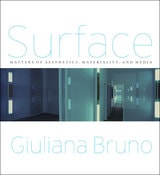
Surface
Matters of Aesthetics, Materiality, and MediaGiuliana Bruno
University of Chicago Press, 2014
Arguing that materiality is not a question of the materials themselves but rather the substance of material relations, Bruno investigates the space of those relations, examining how they appear on the surface of different media—on film and video screens, in gallery installations, or on the skins of buildings and people. The object of visual studies, she contends, goes well beyond the image and engages the surface as a place of contact between people and art objects. As Bruno threads through these surface encounters, she unveils the fabrics of the visual—the textural qualities of works of art, whether manifested on canvas, wall, or screen. Illuminating the modern surface condition, she notes how façades are becoming virtual screens and the art of projection is reinvented on gallery walls. She traverses the light spaces of artists Robert Irwin, James Turrell, Tacita Dean, and Anthony McCall; touches on the textured surfaces of Isaac Julien’s and Wong Kar-wai’s filmic screens; and travels across the surface materiality in the architectural practices of Diller Scofidio + Renfro and Herzog & de Meuron to the art of Doris Salcedo and Rachel Whiteread, where the surface tension of media becomes concrete. In performing these critical operations on the surface, she articulates it as a site in which different forms of mediation, memory, and transformation can take place.
Surveying object relations across art, architecture, fashion, design, film, and new media, Surface is a magisterial account of contemporary visual culture.
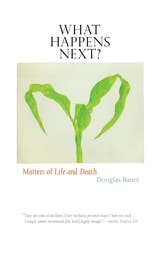
What Happens Next?
Matters of Life and DeathDouglas Bauer
University of Iowa Press, 2013