Results by title
4 books match the query 'Mauritius'
Creating the Creole Island
Slavery in Eighteenth-Century MauritiusMegan Vaughan
Duke University Press, 2005
Combining archival research with an engaging literary style, Vaughan juxtaposes extensive analysis of court records with examinations of the logs of slave ships and of colonial correspondence and travel accounts. The result is a close reading of life on the island, power relations, colonialism, and the process of cultural creolization. Vaughan brings to light complexities of language, sexuality, and reproduction as well as the impact of the French Revolution. Illuminating a crucial period in the history of Mauritius, Creating the Creole Island is a major contribution to the historiography of slavery, colonialism, and creolization across the Indian Ocean.
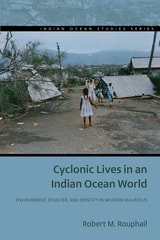
Cyclonic Lives in an Indian Ocean World
Environment, Disaster, and Identity in Modern MauritiusRobert M. Rouphail
Ohio University Press, 0
Disasters as historical processes shaping identity, governance, and diasporic memory in colonial and postcolonial Mauritius
In a world marked by increasingly destructive ecological and meteorological upheavals, Cyclonic Lives in an Indian Ocean World offers a historical analysis of how these catastrophes shape people’s understanding of themselves, their collective history, and their relationship to the institutions that govern them. An examination of cyclonic disasters in the multiethnic Indian Ocean island of Mauritius throws into stark relief how deep histories of diasporic identity formation, of imperial governance, and of the informal practices of racial difference making graft onto how everyday people interpret these moments of loss and the futures that emerge in their wake.
Cyclonic Lives shows that disasters are not only events; they are also processes through which people evaluate and rethink the most elemental social and cultural categories that give meaning to their lives. Beginning in the late nineteenth century and continuing until the early postcolonial era, this book tracks, for example, how Mauritians of African descent integrated these disasters into broader collective histories and memories of the Indian Ocean slave trade, how Hindu Indo-Mauritians understood cyclones’ ecological effects as material elements to be accounted for in a broader Hindu diasporic space, and how the late colonial and early postcolonial state built infrastructures—material, conceptual, and financial—to mitigate the threats posed by these storms and ensure their own long-term durability.
The increasing political, social, and economic instability that climate change has already triggered demands that humanists develop analytical geographies and methodologies that shed light on how power can modulate in asymmetrical ways at moments of crisis. If there is one central takeaway from this historical study of this small island in a big ocean, it is that catastrophic events are not things that merely happen to people; they are processes that remake them.
Lineages of Despotism and Development
British Colonialism and State PowerMatthew Lange
University of Chicago Press, 2009
Traditionally, social scientists have assumed that past imperialism hinders the future development prospects of colonized nations. Challenging this widespread belief, Matthew Lange argues in Lineages of Despotism and Development that countries once under direct British imperial control have developed more successfully than those that were ruled indirectly.
Combining statistical analysis with in-depth case studies of former British colonies, this volume argues that direct rule promoted cogent and coherent states with high levels of bureaucratization and inclusiveness, which contributed to implementing development policy during late colonialism and independence. On the other hand, Lange finds that indirect British rule created patrimonial, weak states that preyed on their own populations. Firmly grounded in the tradition of comparative-historical analysis while offering fresh insight into the colonial roots of uneven development, Lineages of Despotism and Development will interest economists, sociologists, and political scientists alike.

When the White House Calls
From Immigrant Entrepreneur to U.S. AmbassadorJohn Price
University of Utah Press, 2011
When the White House Calls tells the life story of John Price, one of Utah’s most prominent citizens, beginning with his birth in Germany through his years as a successful builder and real estate developer—with business interests in broadcasting, manufacturing, distribution, and banking—to his life as a diplomat. Born in Berlin on August 18, 1933, Hans Joachim Praiss was five years old when he and his family fled Nazi Germany in April 1939. The family found temporary refuge in Panama, finally arriving at Ellis Island in September 1940 and settling in New York City. Following the advice of a professor at CCNY, Price traveled west to fulfill a geology fieldwork course requirement, but upon seeing the snow-capped mountains surrounding Salt Lake City, knew he would stay. He earned his Bachelor of Science in Geological Engineering from the University of Utah in 1956. He practiced in that field before tiring of the often rigorous travel requirements and the desolate nature of the work. He soon turned to new opportunities.
Years later, after operating successful business enterprises throughout the Intermountain region and nationally, and serving on numerous local, state, and national boards, Price had become the consummate entrepreneur, businessman, and community leader. He was ready to serve his country when the White House called. In February 2002 he was sworn in as U.S. Ambassador to the Republic of Mauritius, the Republic of Seychelles, and the Union of the Comoros, three Indian Ocean island nations off the east coast of Africa, where he served until 2005.
In this telling autobiography, John Price focuses on his years as an ambassador and includes his thoughts on the future of sub-Saharan Africa. The account of his service as a diplomat offers readers a view of the daily life of an ambassador—the protocol for official meetings with heads of state, the routine of the office, the process of handling official communications, and the intricacies of diplomacy. More than that, in a world concerned with the global war on terror, he reflects on the three island nations where he served and on the region’s increasing strategic importance to the national security of the United States.
In the years since the 2001 attacks on the World Trade Center and the Pentagon, the al-Qaeda movement has grown and its members have dispersed throughout the world, including the region known as the Horn of Africa and East Africa. Price calls attention to the vulnerability of sub-Saharan Africa as a haven for terrorists, and the critical need for our engagement of this desperate continent with economic development, health care, and education to counter this threat. His concern for this region of Africa is carefully articulated in the text, as well as in interviews (included as appendixes) with notable country leaders. When the White House Calls is a compelling story of the American Dream realized, and the importance of service to country. This is a book that will both educate and inspire young people, their mentors, and others, as they work to make a difference in the world.