Results by title
5 books match the query 'Maxwell, Judith M.'
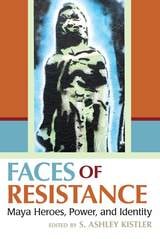
Faces of Resistance
Maya Heroes, Power, and IdentityEdited by S. Ashley Kistler
University of Alabama Press, 2018
In the sixteenth century, Q’eqchi’ Maya leader Aj Poop B’atz’ changed the course of Q’eqchi’ history by welcoming Spanish invaders to his community in peace to protect his people from almost certain violence. Today, he is revered as a powerful symbol of Q’eqchi’ identity. Aj Poop B’atz’ is only one of many indigenous heroes who has been recognized by Maya in Mexico and Guatemala throughout centuries of subjugation, oppression, and state-sponsored violence.
Faces of Resistance: Maya Heroes, Power, and Identity explores the importance of heroes through the analyses of heroic figures, some controversial and alternative, from the Maya area. Contributors examine stories of hero figures as a primary way through which Maya preserve public memory, fortify their identities, and legitimize their place in their country’s historical and political landscape. Leading anthropologists, linguists, historians, and others incorporate ethnographic, ethnohistoric, and archival material into their chapters, resulting in a uniquely interdisciplinary book for scholars as well as students.
The essays offer the first critical survey of the broad significance of these figures and their stories and the ways that they have been appropriated by national governments to impose repressive political agendas. Related themes include the role of heroic figures in the Maya resurgence movement in Guatemala, contemporary Maya concepts of “hero,” and why some assert that all contemporary Maya are heroes.
Kaqchikel Chronicles
The Definitive EditionWith translation and exegesis by Judith M. Maxwell and Robert M. Hill II
University of Texas Press, 2006
The collection of documents known as the Kaqchikel Chronicles consists of rare highland Maya texts, which trace Kaqchikel Maya history from their legendary departure from Tollan/Tula through their migrations, wars, the Spanish invasion, and the first century of Spanish colonial rule. The texts represent a variety of genres, including formal narrative, continuous year-count annals, contribution records, genealogies, and land disputes.
While the Kaqchikel Chronicles have been known to scholars for many years, this volume is the first and only translation of the texts in their entirety. The book includes two collections of documents, one known as the Annals of the Kaqchikels and the other as the Xpantzay Cartulary. The translation has been prepared by leading Mesoamericanists in collaboration with Kaqchikel-speaking linguistic scholars. It features interlinear glossing, which allows readers to follow the translators in the process of rendering colonial Kaqchikel into modern English. Extensive footnoting within the text restores the depth and texture of cultural context to the Chronicles. To put the translations in context, Judith Maxwell and Robert Hill have written a full scholarly introduction that provides the first modern linguistic discussion of the phonological, morphological, syntactic, and pragmatic structure of sixteenth-century Kaqchikel. The translators also tell a lively story of how these texts, which derive from pre-contact indigenous pictographic and cartographic histories, came to be converted into their present form.
Kik’aslemal ri Kaqchikela’
An Advanced Kaqchikel Maya Language TextbookWaqi’ Kan (Walter E. Little), Ixq’anil (Judith M. Maxwell), Kawoq (Baldomero Cuma Chávez), Ixnal (Ambrocia Cuma Chávez). Illustrations: Yaxche’ Chanquin Cuma
University of Texas Press, 2026
An advanced Kaqchikel textbook that blends language learning with Maya culture.
About half a million Maya in the highlands of Guatemala speak Kaqchikel, making it one of the most widely used Mayan languages. Following the 2006 publication of ¿La ütz awäch?, an introduction to Kaqchikel, Kik’aslemal ri Kaqchikela’ offers guidance for advanced students. Unlike many language textbooks, it is designed with not only fluency but also cultural competency in mind.
Inspired by conversations with native speakers, Kaqchikel teachers, and anthropologists focused on Maya communities, Kik’aslemal ri Kaqchikela’ supports language learning through readings on topics important to speakers in Guatemala, including Maya’ Nimab’äl K’u’x (Maya cosmology); Ri Tiko’n (agriculture); Yab’il rik’in Aq’om (disease and medicine); Samaj pa Jay, pa Tinamït (work at home and in town); and more. Chapters present readings on each theme, alongside worksheets, discussion questions framed around Maya history and culture, and a contextualizing essay in English. A Kaqchikel/Spanish/English glossary, extensive grammar appendix, and English translations of the readings support learning. The result is not the usual explanation of language mechanics but instead a nuanced lesson in communication across porous boundaries of cultural difference.
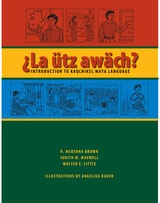
La ütz awäch?
Introduction to Kaqchikel Maya LanguageBy R. McKenna Brown, Judith M. Maxwell, and Walter E. Little
University of Texas Press, 2006
Kaqchikel is one of approximately thirty Mayan languages spoken in Belize, Guatemala, Mexico, and, increasingly, the United States. Of the twenty-two Mayan languages spoken in Guatemala, Kaqchikel is one of the four "mayoritarios," those with the largest number of speakers. About half a million people living in the central highlands between Guatemala City and Lake Atitlán speak Kaqchikel. And because native Kaqchikel speakers are prominent in the field of Mayan linguistics, as well as in Mayan cultural activism generally, Kaqchikel has been adopted as a Mayan lingua franca in some circles.
This innovative language-learning guide is designed to help students, scholars, and professionals in many fields who work with Kaqchikel speakers, in both Guatemala and the United States, quickly develop basic communication skills. The book will familiarize learners with the words, phrases, and structures used in daily communications, presented in as natural a way as possible, and in a logical sequence. Six chapters introduce the language in context (greetings, the classroom, people, the family, food, and life) followed by exercises and short essays on aspects of Kaqchikel life. A grammar summary provides in-depth linguistic analysis of Kaqchikel, and a glossary supports vocabulary learning from both Kaqchikel to English and English to Kaqchikel. These resources, along with sound files and other media on the Internet at ekaq.stonecenter.tulane.edu, will allow learners to develop proficiency in all five major language skills—listening comprehension, speaking, reading, writing, and sociocultural understanding.
Mayas in Postwar Guatemala
Harvest of Violence RevisitedEdited by Walter E. Little and Timothy J. Smith
University of Alabama Press, 2009