Results by title
9 books match the query 'Maya literature'
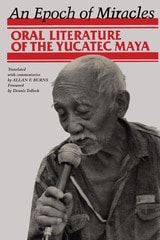
An Epoch of Miracles
Oral Literature of the Yucatec MayaTranslated with Commentaries by Allan F. Burns
University of Texas Press, 1983
“Mr. Allan Burns, I am here to tell you an example, the example of the Hunchbacks.” So said Paulino Yamá, traditionalist and storyteller, to Allan Burns, anthropologist and linguist, as he began one story that found its way into this book.
Paulino Yamá was just one of several master storytellers from the Yucatán Peninsula of Mexico from whom Burns learned not only the Mayan language but also the style and performance of myths, stories, riddles, prayers, and other forms of speech of their people. The result is An Epoch of Miracles, a wonderfully readable yet thoroughly scholarly set of translations from the oral literature of the Yucatec Maya, an important New World tradition never before systematically described.
An Epoch of Miracles brings us over thirty-five long narratives of things large, small, strange, and “regular” and as many delightful short pieces, such as bird lore, riddles, and definitions of anteaters, rainbows, and other commonplaces of the Mayan world. Here are profound narratives of the Feathered Serpent, the mighty Rain God Chac and his helpers, and the mysterious cult of the Speaking Cross. But because these are modern, “Petroleum Age” Maya, here too are a discussion with Cuba’s Fidel Castro and a greeting to former president Richard Nixon.
All pieces are translated ethnopoetically; examples of several genres are presented bilingually. An especially valuable feature is the indication of performance style, such as pauses and voice quality, given with each piece.
Caracoleando Among Worlds
Reconstructing Maya Worldviews in ChiapasSilvia Soto
University of Arizona Press, 2024
This shared vision emerges in Caracoleando Among Worlds, which provides an in-depth analysis of poetry, short stories, and one of the first novels written by a Maya Tsotsil writer of Chiapas alongside close readings of the EZLN’s six declarations of the Lacandon Jungle. Themes echoing ancestral connections, informing epistemologies, and sustaining cultural and spiritual practices emerge and weave the texts to each other. The work brings into the conversation literature that has been translated into English for the first time and places Maya writers of Chiapas in discussion with other Native American and Indigenous scholars.
This work shows how literature, culture, and activism intertwine, and offers a compelling narrative that transcends boundaries and fosters a deeper understanding of Maya identities and resilience.

Caste War Now and Never
Unreading Gender, Race, and Land in YucatánS. B. West
University of Arizona Press, 2026
In Caste War Now and Never scholar S. B. West considers Yucatán’s nineteenth-century Caste War, the longest and most violent Indigenous uprising of the Western Hemisphere, to argue that it actually never occurred.
Instead, West writes that the violent events grouped under the “Caste War” label must be understood through alternative frameworks that resist the emergent logics of race war and include related regulatory matrices like gender and land. Through this lens, the Caste War emerges as a discursive construct rooted in an anti-Indigenous archive that served the political interests of a frustrated regional elite during the rise of liberalism and nationhood. West argues that Caste War discourse unfolds as a technology that mobilized and legitimized genocidal actions against racialized rebels and inspired assimilation into hegemonic political and social structures.
In the second half of the book, West looks at the Caste War to engage its contemporary polysemic nature through close readings of Yucatec Maya texts, stories, and other forms of knowledge production. These sources reframe the Caste War as an important part of a framework of resistance that defies colonial time and reclaims narrative control of its events.
Caste War Now and Never captures how Maya communities understand the conflict as ongoing and demonstrates that although the Caste War never occurred as such, it continues to endure presently.
Parallel Worlds
Genre, Discourse, and Poetics in Contemporary, Colonial, and Classic Maya LiteratureKerry M. Hull
University Press of Colorado, 2012
In this volume, contributions from leading scholars in Maya literary studies examine Maya discourse from Classic period hieroglyphic inscriptions to contemporary spoken narratives, focusing on parallelism to unite the literature historically. Contributors take an ethnopoetic approach, examining literary and verbal arts from a historical perspective, acknowledging that poetic form is as important as narrative content in deciphering what these writings reveal about ancient and contemporary worldviews.
Encompassing a variety of literary motifs, including humor, folklore, incantation, mythology, and more specific forms of parallelism such as couplets, chiasms, kennings, and hyperbatons, Parallel Worlds is a rich journey through Maya culture and pre-Columbian literature that will be of interest to students and scholars of anthropology, ethnography, Latin American history, epigraphy, comparative literature, language studies, indigenous studies, and mythology.
Telling and Being Told
Storytelling and Cultural Control in Contemporary Yucatec Maya LiteraturesPaul M. Worley
University of Arizona Press, 2013
Through performance, storytellers place the past in dynamic relationship with the present, each continually evolving as it is reevaluated and reinterpreted. Yet non-indigenous actors often manipulate the storyteller in their firsthand accounts of the indigenous world. Moreover, by limiting the field of literary study to written texts, Worley argues, critics frequently ignore an important component of Latin America’s history of conquest and colonization: The fact that Europeans consciously set out to destroy indigenous writing systems, making orality a key means of indigenous resistance and cultural continuity.
Given these historical factors, outsiders must approach Yucatec Maya and other indigenous literatures on their own terms rather than applying Western models. Although oral literature has been excluded from many literary studies, Worley persuasively demonstrates that it must be included in contemporary analyses of indigenous literatures as oral texts form a key component of contemporary indigenous literatures, and storytellers and storytelling remain vibrant cultural forces in both Yucatec communities and contemporary Yucatec writing.
The Maya Art of Speaking Writing
Remediating Indigenous Orality in the Digital AgeTiffany D. Creegan Miller
University of Arizona Press, 2022
Based on nearly a decade of fieldwork in the Guatemalan highlands, Tiffany D. Creegan Miller discusses images that are sonic, pictorial, gestural, and alphabetic. She reveals various forms of creativity and agency that are woven through a rich media landscape in Indigenous Guatemala, as well as Maya diasporas in Mexico and the United States. Miller discusses how technologies of inscription and their mediations are shaped by human editors, translators, communities, and audiences, as well as by voices from the natural world.
These texts push back not just on linear and compartmentalized Western notions of media but also on the idea of the singular author, creator, scholar, or artist removed from their environment. The persistence of orality and the interweaving of media forms combine to offer a challenge to audiences to participate in decolonial actions through language preservation.
The Maya Art of Speaking Writing calls for centering Indigenous epistemologies by doing research in and through Indigenous languages as we engage in debates surrounding Indigenous literatures, anthropology, decoloniality, media studies, orality, and the digital humanities.
Unwriting Maya Literature
Ts'íib as Recorded KnowledgePaul M. Worley and Rita M. Palacios
University of Arizona Press, 2019
As ts’íib refers to a broad range of artistic production from painted codices and textiles to works composed in Latin script, as well as plastic arts, the authors argue that texts by contemporary Maya writers must be read as dialoguing with a multimodal Indigenous understanding of text. In other words, ts’íib is an alternative to understanding “writing” that does not stand in opposition to but rather fully encompasses alphabetic writing, placing it alongside and in dialogue with a number of other forms of recorded knowledge. This shift in focus allows for a critical reexamination of the role that weaving and bodily performance play in these literatures, as well as for a nuanced understanding of how Maya writers articulate decolonial Maya aesthetics in their works.
Unwriting Maya Literature places contemporary Maya literatures within a context that is situated in Indigenous ways of knowing and being. Through ts’íib, the authors propose an alternative to traditional analysis of Maya cultural production that allows critics, students, and admirers to respectfully interact with the texts and their authors. Unwriting Maya Literature offers critical praxis for understanding Mesoamerican works that encompass non-Western ways of reading and creating texts.
Words of the True Peoples/Palabras de los Seres Verdaderos
Anthology of Contemporary Mexican Indigenous-Language Writers/Antología de Escritores Actuales en Lenguas Indígenas de México: Volume One/Tomo Uno: Prose/ProsaEdited by Carlos Montemayor and Donald Frischmann
University of Texas Press, 2005
As part of the larger, ongoing movement throughout Latin America to reclaim non-Hispanic cultural heritages and identities, indigenous writers in Mexico are reappropriating the written word in their ancestral tongues and in Spanish. As a result, the long-marginalized, innermost feelings, needs, and worldviews of Mexico's ten to twenty million indigenous peoples are now being widely revealed to the Western societies with which these peoples coexist. To contribute to this process and serve as a bridge of intercultural communication and understanding, this groundbreaking, three-volume anthology gathers works by the leading generation of writers in thirteen Mexican indigenous languages: Nahuatl, Maya, Tzotzil, Tzeltal, Tojolabal, Tabasco Chontal, Purepecha, Sierra Zapoteco, Isthmus Zapoteco, Mazateco, Ñahñu, Totonaco, and Huichol.
Volume 1 contains narratives and essays by Mexican indigenous writers. Their texts appear first in their native language, followed by English and Spanish translations. Frischmann and Montemayor have abundantly annotated the English, Spanish, and indigenous-language texts and added glossaries and essays that trace the development of indigenous texts, literacy, and writing. These supporting materials make the anthology especially accessible and interesting for nonspecialist readers seeking a greater understanding of Mexico's indigenous peoples.
The other volumes of this work will be Volume 2: Poetry/Poesía and Volume 3: Theater/Teatro.
Words of the True Peoples/Palabras de los Seres Verdaderos
Anthology of Contemporary Mexican Indigenous-Language Writers/Antología de Escritores Actuales en Lenguas Indígenas de México: Volume Two/Tomo Dos: Poetry/PoesíaEdited by Carlos Montemayor and Donald Frischmann
University of Texas Press, 2005
As part of the larger, ongoing movement throughout Latin America to reclaim non-Hispanic cultural heritages and identities, indigenous writers in Mexico are reappropriating the written word in their ancestral tongues and in Spanish. As a result, the long-marginalized, innermost feelings, needs, and worldviews of Mexico's ten to twenty million indigenous peoples are now being widely revealed to the Western societies with which these peoples coexist. To contribute to this process and serve as a bridge of intercultural communication and understanding, this groundbreaking, three-volume anthology gathers works by the leading generation of writers in thirteen Mexican indigenous languages: Nahuatl, Maya, Tzotzil, Tzeltal, Tojolabal, Tabasco Chontal, Purepecha, Sierra Zapoteco, Isthmus Zapoteco, Mazateco, Ñahñu, Totonaco, and Huichol.
Volume Two contains poetry by Mexican indigenous writers. Their poems appear first in their native language, followed by English and Spanish translations. Montemayor and Frischmann have abundantly annotated the Spanish, English, and indigenous-language texts and added glossaries and essays that discuss the formal and linguistic qualities of the poems, as well as their place within contemporary poetry. These supporting materials make the anthology especially accessible and interesting for nonspecialist readers seeking a greater understanding of Mexico's indigenous peoples.