Results by title
3 books match the query 'McFarland, Gerald W.'
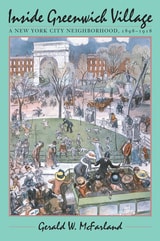
Inside Greenwich Village
A New York City Neighborhood, 1898-1918Gerald W. McFarland
University of Massachusetts Press, 2001
In the popular imagination, New York City's Greenwich Village has long been known as a center of bohemianism, home to avant-garde artists, political radicals, and other nonconformists who challenged the reigning orthodoxies of their time. Yet a century ago the Village was a much different kind of place: a mixed-class, multiethnic neighborhood teeming with the energy and social tensions of a rapidly changing America. Gerald W. McFarland reconstructs this world with vivid descriptions of the major groups that resided within its boundaries—the Italian immigrants and African Americans to the south, the Irish Americans to the west, the well-to-do Protestants to the north, and the New York University students, middle-class professionals, and artists and writers who lived in apartment buildings and boarding houses on or near Washington Square.
McFarland examines how these Villagers, so divided along class and ethnic lines, interacted with one another. He shows how clashing expectations about what constituted proper behavior in the neighborhood's public spaces—especially streets, parks, and saloons—often led to intergroup conflict, political rivalries, and campaigns by the more privileged Villagers to impose middle-class mores on their working-class neighbors. Occasionally, however, a crisis or common problem led residents to overlook their differences and cooperate across class and ethnic lines. Throughout the book, McFarland connects the evolution of Village life to the profound transformations taking place in American society at large during the same years.
McFarland examines how these Villagers, so divided along class and ethnic lines, interacted with one another. He shows how clashing expectations about what constituted proper behavior in the neighborhood's public spaces—especially streets, parks, and saloons—often led to intergroup conflict, political rivalries, and campaigns by the more privileged Villagers to impose middle-class mores on their working-class neighbors. Occasionally, however, a crisis or common problem led residents to overlook their differences and cooperate across class and ethnic lines. Throughout the book, McFarland connects the evolution of Village life to the profound transformations taking place in American society at large during the same years.
[more]

Mugwumps, Morals and Politics 1884-1920
Gerald W. McFarland
University of Massachusetts Press, 1975
Differing significantly from previous studies, McFarland's approach to the Mugwumps provides a balanced portrait of these Yankee reformers and their campaigns against boss rule in cities, corruption in national affairs, and American imperialism abroad.
The conventional approach has been to concentrate on only a dozen or so of the best known Mugwumps and to trace their careers no further than 1900. In contrast, McFarland greatly extends the number of individuals whose activities must be considered reflections of the movement, discussing a sample of hundreds of active Mugwumps, and traces their careers well into the twentieth century.
Mugwump orthodoxy is demonstrated by an examination of their largely negative goals in the anti-Blaine bolt of 1884, their narrow political program during the late 1880s, and their politically disastrous loyalty to Grover Cleveland. But their innovative side is also highlighted by a searching analysis of their successes, including their participation in the movement to professionalize such occupations as law, medicine, and higher education, and their contributions to urban, political, and social reform.
[more]
The "Counterfeit" Man
The True Story of the Boorn-Colvin Murder CaseGerald W. McFarland
University of Massachusetts Press, 1993
When Russell Colvin disappeared in 1812, no one in Manchester thought much of it. He tended, after all, to wander. But by 1819 people began to suspect Stephen and Jesse Boorn of murdering their brother-in-law. To understand why so many neighbors believed the Boorns innocent for so long, and why seven years passed before town authorities launched an investigation of Colvin's disappearance, it is, of course, important to learn what facts were known, when, and by whom. However, it is equally important to ascertain how these facts were interpreted, and why they were interpreted as they were. What, in other words, was it about Russell Colvin, the Boorns, and the town of Manchester that shaped the public's response in such a way that an official inquiry into Colvin's disappearance was delayed so long? Or did it all have to do with ghostly sightings of Colvin?
[more]