Results by title
4 books match the query 'McGinn, Thomas A.J.'
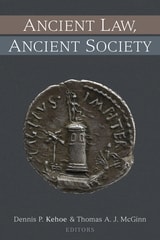
Ancient Law, Ancient Society
Dennis P. Kehoe and Thomas A. J. McGinn, editors
University of Michigan Press, 2017
Essays cover topics such as using collective sanctions to enforce legal norms; the Greek elite’s marriage strategies for amassing financial resources essential for a public career; defenses against murder charges under Athenian criminal law, particularly in cases where the victim put his own life in peril; the interplay between Roman law and provincial institutions in regulating water rights; the Severan-age Greek author Aelian’s notions of justice and their influence on late-classical Roman jurisprudence; Roman jurists’ approach to the contract of mandate in balancing the changing needs of society against respect for upper-class concepts of duty and reciprocity; whether the Roman legal authorities developed the law exclusively to serve the Roman elite’s interests or to meet the needs of the Roman Empire’s broader population as well; and an analysis of the Senatus Consultum Claudianum in the Code of Justinian demonstrating how the late Roman government adapted classical law to address marriage between free women and men classified as coloni bound to their land.
In addition to volume editors Dennis P. Kehoe and Thomas A. J. McGinn, contributors include Adriaan Lanni, Michael Leese, David Phillips, Cynthia Bannon, Lauren Caldwell, Charles Pazdernik, and Clifford Ando.
Obligations in Roman Law
Past, Present, and FutureEdited by Thomas A. J. McGinn
University of Michigan Press, 2013
Long a major element of classical studies, the examination of the laws of the ancient Romans has gained momentum in recent years as interdisciplinary work in legal studies has spread. Two resulting issues have arisen, on one hand concerning Roman laws as intellectual achievements and historical artifacts, and on the other about how we should consequently conceptualize Roman law.
Drawn from a conference convened by the volume's editor at the American Academy in Rome addressing these concerns and others, this volume investigates in detail the Roman law of obligations—a subset of private law—together with its subordinate fields, contracts and delicts (torts). A centuries-old and highly influential discipline, Roman law has traditionally been studied in the context of law schools, rather than humanities faculties. This book opens a window on that world.
Roman law, despite intense interest in the United States and elsewhere in the English-speaking world, remains largely a continental European enterprise in terms of scholarly publications and access to such publications. This volume offers a collection of specialist essays by leading scholars Nikolaus Benke, Cosimo Cascione, Maria Floriana Cursi, Paul du Plessis, Roberto Fiori, Dennis Kehoe, Carla Masi Doria, Ernest Metzger, Federico Procchi, J. Michael Rainer, Salvo Randazzo, and Bernard Stolte, many of whom have not published before in English, as well as opening and concluding chapters by editor Thomas A. J. McGinn.

The Art of the Roman Jurists
An American PerspectiveEssays by Bruce W. Frier Edited by Thomas A.J. McGinn Introduction by Paul J. du Plessis
University of Michigan Press, 2027
The Art of the Roman Jurists offers a clear, detailed, and thorough account of the relationship between Roman law and society from 100 BCE to 235 CE and traces the rise of the group of legal experts known as jurists. While prominent in the first century BCE, they consolidated their position in the first years of the Principate. But it is only in the second century, starting in the reign of Antoninus Pius (138–161), that, in author Bruce W. Frier’s view, they most emphatically come into their own. The collection reveals how the jurists can evince an awareness of the impact their holdings portend for the social and economic reality. Frier's method is anchored in the ancient sources, extending far beyond the legal evidence, offering a perspective on Roman jurisprudence as it was lived. This collection of published and unpublished articles from Frier examines crucial aspects of his methodology and looks to the future of the study of Roman law.
The Economy of Prostitution in the Roman World
A Study of Social History and the BrothelThomas A. J. McGinn
University of Michigan Press, 2004