Results by title
12 books match the query 'Measure'
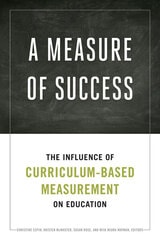
A Measure of Success
The Influence of Curriculum-Based Measurement on EducationChristine A. Espin
University of Minnesota Press, 2012
Simple in concept, far-reaching in implementation, Curriculum-Based Measurement (CBM) was developed in the 1980s as an efficient way to assess the progress of struggling students, including those with disabilities. Today, there are few areas of special education policy and practice that have not been influenced by CBM progress monitoring. The impact of CBM is reflected in recent education reforms that emphasize improvements in assessment and data-based decision making. Gathering an international group of leading researchers and practitioners, A Measure of Success provides a comprehensive picture of the past, present, and possible future of CBM progress monitoring. The book will be instrumental for researchers and practitioners in both general and special education, particularly those involved in the rapidly growing Response to Intervention (RTI) approach, an approach used to determine the performance and placement of students with learning difficulties.
A Measure of Success presents a nuanced examination of CBM progress monitoring in reading, math, and content-area learning to assess students at all levels, from early childhood to secondary school, and with a wide range of abilities, from high- and low-incidence disabilities to no disabilities. This study also evaluates how the approach has affected instructional practices, teacher training, psychology and school psychology, educational policy, and research in the United States and beyond.
Timely and unique, this volume will interest anyone in education who wants to harness the potential advantage of progress monitoring to improve outcomes for students.
Contributors: Laurence Bergeron; Lionel A. Blatchley; Renee Bradley; Mary T. Brownell, U of Florida; Todd W. Busch, U of St. Thomas; Heather M. Campbell, St. Olaf College; Ann Casey; Theodore J. Christ, U of Minnesota; Kelli D. Cummings, U of Oregon; Eric Dion, U du Québec à Montréal; Isabelle Dubé, U du Québec à Montréal; Hank Fien, U of Oregon; Anne Foegen, Iowa State U; Douglas Fuchs, Vanderbilt U; Lynn S. Fuchs, Vanderbilt U; Gary Germann; Kim Gibbons; Roland H. Good III, U of Oregon; Anne W. Graves, San Diego State U; John L. Hosp, U of Iowa; Michelle K. Hosp; Joseph R. Jenkins, U of Washington; Ruth A. Kaminski; Panayiota Kendeou, Neapolis U Pafos, Cyprus; Dong-il Kim, Seoul National U, South Korea; Amanda Kloo, U of Pittsburgh; Danika Landry, U du Québec à Montréal; Erica Lembke, U of Missouri; Francis E. Lentz Jr., U of Cincinnati; Sylvia Linan-Thompson, U of Texas at Austin; Charles D. Machesky; Doug Marston; James L. McLeskey, U of Florida; Timothy C. Papadopoulos, U of Cyprus; Kelly A. Powell-Smith; Greg Roberts, U of Texas at Austin; Margaret J. Robinson; Steven L. Robinson, Minnesota State U, Mankato; Catherine Roux, U du Québec à Montréal; Barbara J. Scierka; Edward S. Shapiro, Lehigh U; Jongho Shin, Seoul National U, South Korea; Mark R. Shinn, National Louis U; James G. Shriner, U of Illinois, Urbana-Champaign; Paul T. Sindelar, U of Florida; Deborah L. Speece, U of Maryland; Pamela M. Stecker, Clemson U; Martha L. Thurlow, U of Minnesota; RenátaTichá, U of Minnesota; Gerald Tindal, U of Oregon; Paul van den Broek, Leiden U, the Netherlands; Sharon Vaughn, U of Texas at Austin; Dana L. Wagner, Augsburg College; Teri Wallace, Minnesota State U, Mankato; Jeanne Wanzek, Florida State U; Mary Jane White, U of Minnesota; Mitchell L. Yell, U of South Carolina; Naomi Zigmond, U of Pittsburgh.

Catholic Collecting
Catholic Reflection 1538-1850: Objects as a Measure of Reflection on a Catholic Past and the Construction of Recusant Identity in England and AmericaVirginia C. Raguin
Catholic University of America Press, 2006

Is There a Measure on Earth?
Foundations for a Nonmetaphysical EthicsWerner Marx
University of Chicago Press, 1987
The poet Hölderlin posed the question, "Is there a measure on earth?" His own answer was emphatic, "There is none," for he was convinced that the measure for man was to be found only in the domain of the heavenly beings. Such metaphysical assumptions, as well as the attempt to found ethical conduct in the nature of man as a rational being, have been rejected by many contemporary thinkers, particularly Heidegger. Yet these thinkers have not been able to provide a satisfactory alternative to metaphysical foundations of the standards for responsible human conduct.
Marx, therefore, goes beyond Heidegger in demonstrating how several of his most basic notions could be relevant to a secular morality in our age. It is death, Marx claims, that unsettles man and transforms his conduct toward his fellow man. the common experience of mortality nourishes ethical life—and leads to the measures of compassion, love, and recognition of one's fellow human beings.
"It is only on the basis of these 'traditional virtues,'" Marx writes, "that we can find a motive for averting the impending dangers which have often enough been described so vividly and convincingly."
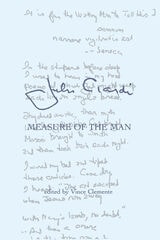
John Ciardi
Measure of the ManVince Clemente
University of Arkansas Press, 1989
Some men make so indelible a mark on the lives of others that a place in time is reserved for them. In this memorial volume, some whose lives have been touched by such a man share their thoughts and memories of the poet, translator, editor , teacher, student, father, son, and husband they knew as John Ciardi.
X.J. Kennedy and Lewis Turco discuss Lives of X, a neglected American classic, which chronicles the years Ciardi spent growing up in Medford, Massachusetts, studying at Tufts, and serving as a gunner in World War II.
Richard Eberhart remembers Ciardi’s unforgettable presence, while John Holmes and Roy W. Cowden remember him as a brilliant student and poet at Tufts and at Michigan, where he won the Avery Hopwood Award. Others remember him as a teacher at Harvard and Rutgers. Dan Jaffe writes, “If John Ciardi held to any cause, it was the notion of precision, to an uncompromising excellence, to the notion that to strive was in itself not enough that one needed to judge honestly, to assess courageously, and to respond without flinching.”
William Heyden and Norbert Krapf tell how the books I Marry You and How Does a Poem Mean? influenced them as young men. In “john Ciardi: the Many Lives of Poetry,” John Nims claims Ciardi as our Chaucer. John Williams, Maxine Kumin, Diane Wakoski, and John Stone write about the Ciardi they knew at the Bread Loaf Writers’ Conference.
Gay Wilson Allen describes the list of contributors to Measure of the Man as a “Who’s Who” in American literature. Certainly it is an impressive gathering of poets, critics, and friends who have been touched by John Ciardi. “We are all in his debt,” Norman Cousins writes in his essay “Ciardi at The Saturday Review,” “and it is important that we say so.”
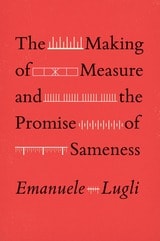
The Making of Measure and the Promise of Sameness
Emanuele Lugli
University of Chicago Press, 2019
Measurement is all around us—from the circumference of a pizza to the square footage of an apartment, from the length of a newborn baby to the number of miles between neighboring towns. Whether inches or miles, centimeters or kilometers, measures of distance stand at the very foundation of everything we do, so much so that we take them for granted. Yet, this has not always been the case.
This book reaches back to medieval Italy to speak of a time when measurements were displayed in the open, showing how such a deceptively simple innovation triggered a chain of cultural transformations whose consequences are visible today on a global scale. Drawing from literary works and frescoes, architectural surveys, and legal compilations, Emanuele Lugli offers a history of material practices widely overlooked by historians. He argues that the public display of measurements in Italy’s newly formed city republics not only laid the foundation for now centuries-old practices of making, but also helped to legitimize local governments and shore up church power, buttressing fantasies of exactitude and certainty that linger to this day.
This ambitious, truly interdisciplinary book explains how measurements, rather than being mere descriptors of the real, themselves work as powerful molds of ideas, affecting our notions of what we consider similar, accurate, and truthful.
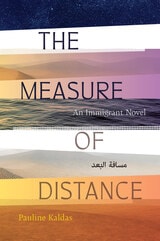
The Measure of Distance
An Immigrant NovelPauline Kaldas
University of Arkansas Press, 2023
This family saga begins when Salim, the eldest of three brothers, moves to Cairo at the start of the twentieth century with dreams of opening his own bakery. His decision to leave his ancestral village of Kom Ombo despite his parents’ objections reverberates across generations, kicking off a series of migrations that shape the lives of his family and their descendants throughout the decades that follow. These migrations only intensify after the revolution of 1952—with Misha, Salim’s eldest grandchild, being the first to flee to “Amreeka,” his annual phone calls home becoming briefer and briefer with each passing year.
Culminating with the 2011 protests in Tahrir Square, Pauline Kaldas’s The Measure of Distance is a detailed portrait of immigration against the backdrop of an Egypt in constant flux and an America that is always falling short of the fantasy. Alternating between tales of those who migrate and those who stay, this expansive novel follows its characters as they determine the course of their lives, often choosing one uncertainty over another as they migrate to new lands or plant their roots more firmly in their homeland.
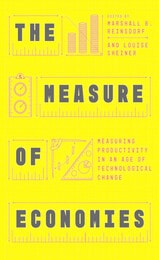
The Measure of Economies
Measuring Productivity in an Age of Technological ChangeEdited by Marshall B. Reinsdorf and Louise Sheiner
University of Chicago Press, 2024
Innovative new approaches for improving GDP measurement to better gauge economic productivity.
Official measures of gross domestic product (GDP) indicate that productivity growth has declined in the United States over the last two decades. This has led to calls for policy changes from pro-business tax reform to stronger antitrust measures. But are our twentieth-century economic methods actually measuring our twenty-first-century productivity?
The Measure of Economies offers a synthesis of the state of knowledge in productivity measurement at a time when many question the accuracy and scope of GDP. With chapters authored by leading economic experts on topics such as the digital economy, health care, and the environment, it highlights the inadequacies of current practices and discusses cutting-edge alternatives.
Pragmatic and forward-facing, The Measure of Economies is an essential resource not only for social scientists, but also for policymakers and business leaders seeking to understand the complexities of economic growth in a time of rapidly evolving technology.
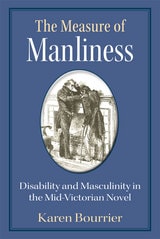
The Measure of Manliness
Disability and Masculinity in the Mid-Victorian NovelKaren Bourrier
University of Michigan Press, 2015
The Measure of Times Past
Pre-Newtonian Chronologies and the Rhetoric of Relative TimeDonald J. Wilcox
University of Chicago Press, 1987
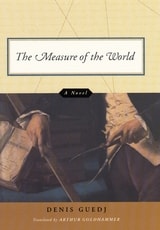
The Measure of the World
A NovelDenis Guedj
University of Chicago Press, 2001
The Measure of the World by Denis Guedj tells the story of this strange and wonderful effort. Not a traditional history of science, the book is a novelistic account of the measurement project that relies heavily on archival sources. A more "traditional" history could not possibly describe how a sober scientific enterprise could turn into a journey filled with adventures and experiences so bizarre as to be hardly credible. In the tumultuous days of revolutionary and postrevolutionary France, Méchain and Delambre were objects of suspicion as they traveled through the provinces, climbing steeples and deploying strange instrumentsthey were detained as spies, taken for charlatans or fleeing royalists, and arrested for debt. Their perilous labors lasted until 1799, when the meter was formally established.
Arthur Goldhammer's crisp translation of this wonderful novel retains the flavor of the original, and an appendix explaining Guedj's use of historical materials is included. A vivid re-creation of a fascinating and troubling period in history juxtaposed with the achievement of a complicated scientific undertaking, The Measure of the World is a marvelous book-not science fiction, but fiction about science.
Denis Guedj is the author of La évolution des savants and L'Empire des nombres, among other books. La Mesure du monde was awarded the Prix d'Institut in 1989. Arthur Goldhammer is an award-winning translator who has translated works by Emmanuel Le Roy Ladurie, Jacques Le Goff, and Jean Starobinski.
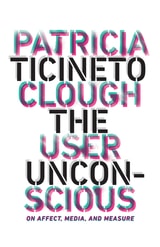
The User Unconscious
On Affect, Media, and MeasurePatricia Ticineto Clough
University of Minnesota Press, 2018
Wide-ranging essays and experimental prose forcefully demonstrate how digital media and computational technologies have redefined what it is to be human
Over the past decade, digital media has expanded exponentially, becoming an essential part of daily life. The stimulating essays and experimental compositions in The User Unconscious delve into the ways digital media and computational technologies fundamentally affect our sense of self and the world we live in, from both human and other-than-human perspectives.
Critical theorist Patricia Ticineto Clough’s provocative essays center around the motif of the “user unconscious” to advance the challenging thesis that that we are both human and other-than-human: we now live, think, and dream within multiple layers of computational networks that are constantly present, radically transforming subjectivity, sociality, and unconscious processes.
Drawing together rising strains of philosophy, critical theory, and media studies, as well as the political, social, and economic transformations that are shaping the twenty-first-century world, The User Unconscious points toward emergent crises and potentialities in both human subjectivity and sociality. Moving from affect to data, Clough forces us to see that digital media and computational technologies are not merely controlling us—they have already altered what it means to be human.
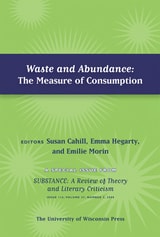
Waste and Abundance
The Measure of Consumption: Special Issue of SubStance, Issue 116, 37:2 (2008)Susan Cahill
University of Wisconsin Press, 2008
This collection of articles relates to a research area currently developing in the Humanities, which calls for philosophical and historical approaches to questions of sustainable development and waste management. The title of the issue reflects the central questions raised by all contributors: how are waste and abundance represented, how may we conceptualize these representations, and what ethical problems do they raise?
Particular attention is paid to the cultural and moral factors that condition our attitudes to waste and the ways in which literature addresses the problematic relationship that binds production, consumption and waste to social and political systems.