Results by title
5 books match the query 'Media History'
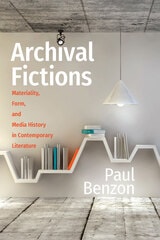
Archival Fictions
Materiality, Form, and Media History in Contemporary LiteraturePaul Benzon
University of Massachusetts Press, 2021
Taking up works from Andy Warhol, Kevin Young, Don DeLillo, and Hari Kunzru, Archival Fictions considers how these writers have constructed a speculative history of media technology through formal experimentation. Although media technologies have determined the extent of what can be written, recorded, and remembered in the immediate aftermath of print's hegemony, Paul Benzon argues that literary form provides a vital means for critical engagement with the larger contours of media history. Drawing on approaches from media poetics, film studies, and the digital humanities, this interdisciplinary study demonstrates how authors who engage technology through form continue to imagine new roles for print literature across the late twentieth and early twenty-first centuries.
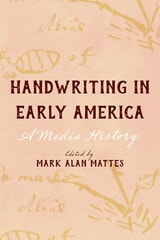
Handwriting in Early America
A Media HistoryEdited by Mark Alan Mattes, Foreword by Karen Sánchez-Eppler, Afterword by Christopher Hager
University of Massachusetts Press, 2023
As digital communication has become dominant, commentators have declared that handwriting is a thing of the past, a relic of an earlier age. This volume of original essays makes it clear that anxiety around handwriting has existed for centuries and explores writing practices from a variety of interdisciplinary fields, including manuscript studies, Native American studies, media history, African American studies, book history, bibliography, textual studies, and archive theory.
By examining how a culturally diverse set of people grappled with handwriting in their own time and weathered shifting relationships to it, Handwriting in Early America uncovers perspectives that are multiethnic and multiracial, transatlantic and hemispheric, colonial and Indigenous, multilingual and illiterate. Essays describe a future of handwriting as envisioned by practitioners, teachers, and even government officials of this time, revealing the tension between the anxiety of loss and the need to allow for variations going forward.
Contributors include James Berkey, Blake Bronson-Bartlett, John J. Garcia, Christopher Hager, Desirée Henderson, Frank Kelderman, Michelle Levy, Lisa Maruca, Christen Mucher, Alan Niles, Seth Perlow, Carla L. Peterson, Sarah Robbins, Patricia Jane Roylance, Karen Sánchez-Eppler, and Danielle Skeehan.
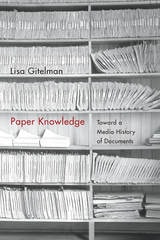
Paper Knowledge
Toward a Media History of DocumentsLisa Gitelman
Duke University Press, 2014
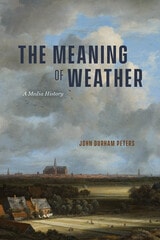
The Meaning of Weather
A Media HistoryJohn Durham Peters
University of Chicago Press, 0
A sweeping history of our relationship with weather in art, media, philosophy, religion, and science—and how the climate continually defies demystification.
We moderns tend to take the weather for granted. We know it through hourly timetables and radar maps and otherwise make it the subject of predictable and safe conversation. But weather is not safe or predictable and never has been. People have long used all their ingenuity to imagine and portray its shifty ways. As John Durham Peters argues, a closer look at the history of these efforts, from painting and poetry to cartography and close observation, has the potential to disclose something important about what it means to live in the world.
In The Meaning of Weather, John Durham Peters shows how the long history of understanding the weather has seen dreamers and data-crunchers alike craft remarkable visions of the world around us. From Babylonian astronomy to the Event Horizon Telescope, from illuminated manuscripts to television, and more, Peters explores the kaleidoscopic ways people have sought to understand, tame, or manage the weather—and how the climate resists being bridled. In this magisterial telling, Peters reimagines Western culture as a continuing struggle to know ourselves and each other through an ever-changing environment.
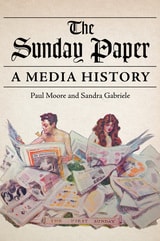
The Sunday Paper
A Media HistoryPaul Moore and Sandra Gabriele
University of Illinois Press, 2022