Results by title
3 books match the query 'Medicine, Greek and Roman'
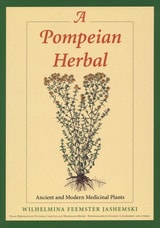
A Pompeian Herbal
Ancient and Modern Medicinal PlantsBy Wilhelmina Feemster Jashemski,
University of Texas Press, 1999
When workmen excavating the ruins of Pompeii eagerly gathered the native medicinal plants growing there, Wilhelmina Jashemski discovered that this was another example of the continuity of life in the shadow of Vesuvius. Many of the plants used for herbal medicine around Pompeii today are the same ones that ancient authorities such as Pliny the Elder and Dioscorides recommended for treating the same types of disorders.
In this book, Jashemski presents an herbal of thirty-six medicinal plants, most of them known to the ancients and still employed today. She describes each plant's contemporary medicinal uses and compares them to ancient practices as recorded in literary sources. Scientific, English, and Italian names and the plant's mythological associations complete the entries, while elegant, full-page portraits depict each plant visually.
Dioscorides on Pharmacy and Medicine
By John M. Riddle
University of Texas Press, 1985
For 1,600 years Dioscorides (ca. AD 40–80) was regarded as the foremost authority on drugs. He knew mild laxatives and strong purgatives, analgesics for headaches, antiseptics for wounds, emetics to rid one of ingested poisons, chemotherapy agents for cancer treatments, and even oral contraceptives. Why, then, have his works remained obscure in recent centuries? Because of one small oversight (Dioscorides himself thought it was self-evident): he failed to describe his method for organizing drugs by their affinities. This omission led medical authorities to use his materials as a guide to pharmacy while overlooking Dioscorides' most valuable contribution—his empirically derived method for observing and classifying drugs by clinical testing.
Dioscorides' De materia medica, a five-volume work, was written in the first century. Here revealed for the first time is the thesis that Dioscorides wrote more than a lengthy guide book. He wrote a great work of science. He had said that he discovered the natural order and would demonstrate it by his arrangement of drugs from plants, minerals, and animals. Until John M. Riddle's pathfinding study, no one saw the genius of his system. Botanists from the eighteenth century often attempted to find his unexplained method by identifying the sequences of his plants according to the Linnean system but, while there are certain patterns, there remained inexplicable incoherencies. However, Dioscorides' natural order as set down in De materia medica was determined by drug affinities as detected by his acute, clinical ability to observe drug reactions in and on the body. So remarkable was his ability to see relationships that, in some cases, he saw what we know to be common chemicals shared by plants of the same and related species and other natural product drugs from animal and mineral sources.
Western European and Islamic medicine considered Dioscorides the foremost authority on drugs, just as Hippocrates is regarded as the Father of Medicine. They saw him point the way but only described the end of his finger, despite the fact that in the sixteenth century alone there were over one hundred books published on him. If he had explained what he thought to be self-evident, then science, especially chemistry and medicine, would almost certainly have developed differently. In this culmination of over twenty years of research, Riddle employs modern science and anthropological studies innovatively and cautiously to demonstrate the substance to Dioscorides' authority in medicine.
Tools and the Organism
Technology and the Body in Ancient Greek and Roman MedicineColin Webster
University of Chicago Press, 2023
Medicine is itself a type of technology, involving therapeutic tools and substances, and so one can write the history of medicine as the application of different technologies to the human body. In Tools and the Organism, Colin Webster argues that, throughout antiquity, these tools were crucial to broader theoretical shifts. Notions changed about what type of object a body is, what substances constitute its essential nature, and how its parts interact. By following these changes and taking the question of technology into the heart of Greek and Roman medicine, Webster reveals how the body was first conceptualized as an “organism”—a functional object whose inner parts were tools, or organa, that each completed certain vital tasks. He also shows how different medical tools created different bodies.
Webster’s approach provides both an overarching survey of the ways that technologies impacted notions of corporeality and corporeal behaviors and, at the same time, stays attentive to the specific material details of ancient tools and how they informed assumptions about somatic structures, substances, and inner processes. For example, by turning to developments in water-delivery technologies and pneumatic tools, we see how these changing material realities altered theories of the vascular system and respiration across Classical antiquity. Tools and the Organism makes the compelling case for why telling the history of ancient Greco-Roman medical theories, from the Hippocratics to Galen, should pay close attention to the question of technology.