Results by title
2 books match the query 'Medieval Spain'
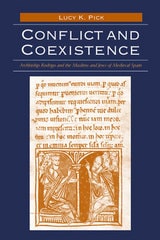
Conflict and Coexistence
Archbishop Rodrigo and the Muslims and Jews of Medieval SpainLucy K. Pick
University of Michigan Press, 2004
"An outstanding contribution not only to Spanish but to European history at large. Pick's book is the first to clarify the unity of purpose that drove Archbishop Rodrigo, a major figure not only as a historian and controversialist, but as a churchman whose military campaigns advanced the conquest of Muslim Spain and shifted the whole balance of power in the Iberian peninsula."
---J. N. Hillgarth, Professor Emeritus, University of Toronto
"By focusing on the diversified activities of the talented mid-thirteenth-century archbishop of Toledo, Lucy Pick brilliantly illuminates the complex relations between the Christian conquerors of Spain and the conquered Muslim and Jewish populations. Students of medieval Spain, of the medieval Roman Catholic Church, of medieval Muslims and Islam, and of medieval Jews and Judaism will benefit from this excellent study."
---Robert Chazan, New York University.
In Conflict and Coexistence, Lucy Pick sets out to explain how Christians, Muslims, and Jews lived alongside one another in medieval Spain. By examining the life and works of Rodrigo Jiménez de Rada, the Archbishop of Toledo (1209-47), Pick explains that the perceived threat of the non-Christian presence was managed through the subordination of Muslims and Jews.
Rodrigo stood at the center of a transformative period of history in the Iberian peninsula. During his long and varied career as archbishop, he acted as scholar, warrior, builder, and political leader. The wave of victories he helped initiate were instrumental in turning back the tide of Muslim attacks on Christian Spain and restarting the process of Christian territorial conquest. However, Toledo was still a multiethnic city in which Christians lived side by side with Jews and Muslims. As archbishop, he was faced with the considerable challenge of maintaining peace and prosperity in a city where religious passions and intolerance were a constant threat to stability.
This work seeks to examine Rodrigo's relations with the Muslims and Jews of his community both as he idealized them on paper and as he worked through them in real life. Though Rodrigo wrote an anti-Jewish polemic, and set out to conquer Muslim-held lands, he also used scholarly patronage and literary creation to combat internal and external, Christian and non-Christian threats alike. His intended and actual consequences of these varied techniques were to allow Christians, Muslims, and Jews to live together under Christian authority. Rodrigo was bound by practical necessity to find a means of accommodating these groups that was both effective and theologically satisfactory. Throughout this influential work, Pick examines the various aspects of Rodrigo's life and career that led to his policies and the consequences that his work and beliefs brought about in medieval Spain.
This book will be of interest to anyone who studies the history, religion, and literature of medieval Spain, to those interested in the transmission of learning from the Muslim to the Christian world, and to those who study intellectual life and development in medieval Europe.
[more]
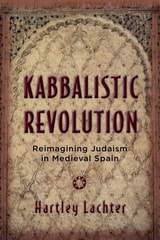
Kabbalistic Revolution
Reimagining Judaism in Medieval SpainLachter, Hartley
Rutgers University Press, 2014
The set of Jewish mystical teachings known as Kabbalah are often imagined as timeless texts, teachings that have been passed down through the millennia. Yet, as this groundbreaking new study shows, Kabbalah flourished in a specific time and place, emerging in response to the social prejudices that Jews faced.
Hartley Lachter, a scholar of religion studies, transports us to medieval Spain, a place where anti-Semitic propaganda was on the rise and Jewish political power was on the wane. Kabbalistic Revolution proposes that, given this context, Kabbalah must be understood as a radically empowering political discourse. While the era’s Christian preachers claimed that Jews were blind to the true meaning of scripture and had been abandoned by God, the Kabbalists countered with a doctrine that granted Jews a uniquely privileged relationship with God. Lachter demonstrates how Kabbalah envisioned this increasingly marginalized group at the center of the universe, their mystical practices serving to maintain the harmony of the divine world.
For students of Jewish mysticism, Kabbalistic Revolution provides a new approach to the development of medieval Kabbalah. Yet the book’s central questions should appeal to anyone with an interest in the relationships between religious discourses, political struggles, and ethnic pride.
[more]