Results by title
3 books match the query 'Meiji Japan'
Christian Converts and Social Protests in Meiji Japan
Irwin Scheiner
University of Michigan Press, 2002
Nowhere has there been a discussion of the confusion necessarily generated by the rapidity of the change or of the agony created in the lives of many whose attitudes, expectations, and even success depended on the continuance of now abolished institutions. Historians have ignored the settled conditions of most samurai and instead concentrated on the study of the minority of activist samurai leaders who, with the backing of only a few Han (feudal domains) sought to overthrow the old order and whose success in doing so has made the study of the modernization of Japan the prime concern of historians. The history of the Meiji period may have been an overall political and industrial success story, but for a fuller understanding of the conditions of that success it is also necessary to understand "what it was really like" for the members of the old elite to be estranged from the proponents of revolution and what many members did to assure their own social and psychological position in a world they had not expected.
In this book the author attempts to show that the impact of the Meiji Restoration destroyed the meaningfulness of the Confucian doctrine for these declasse samurai. Through Christianity, the samurai attempted to revive their status in society by finding a doctrine that offered a meaningful path to power. But in doing so, they had to accept a new theory of social relations. Ultimately, as the convert's understanding of society became totally informed by the Christian doctrine, they accepted a transcendent authority that brought them into conflict with society about them. Therefore, to understand the development of a Christian opposition in Meiji society we must begin with the conversion experience itself. [intro]
[more]
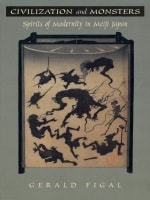
Civilization and Monsters
Spirits of Modernity in Meiji JapanGerald Figal
Duke University Press, 2000
Monsters, ghosts, the supernatural, the fantastic, the mysterious. These are not usually considered the “stuff” of modernism. More often they are regarded as inconsequential to the study of the modern, or, at best, seen as representative of traditional beliefs that are overcome and left behind in the transformation toward modernity. In Civilization and Monsters Gerald Figal asserts that discourse on the fantastic was at the heart of the historical configuration of Japanese modernity—that the representation of the magical and mysterious played an integral part in the production of modernity beginning in Meiji Japan (1868–1912).
After discussing the role of the fantastic in everyday Japan at the eve of the Meiji period, Figal draws new connections between folklorists, writers, educators, state ideologues, and policymakers, all of whom crossed paths in a contest over supernatural terrain. He shows the ways in which a determined Meiji state was engaged in a battle to suppress, denigrate, manipulate, or reincorporate folk belief as part of an effort toward the consolidation of a modern national culture. Modern medicine and education, functioning as a means for the state to exercise its power, redefined folk practices as a source of evil. Diverse local spirits were supplanted by a new Japanese Spirit, embodied by the newly constituted emperor, the supernatural source of the nation’s strength. The monsters of folklore were identified, catalogued, and characterized according to a new regime of modern reason. But whether engaged to support state power and forge a national citizenry or to critique the arbitrary nature of that power, the fantastic, as Figal maintains, is the constant condition of Japanese modernity in all its contradictions. Furthermore, he argues, modernity in general is born of fantasy in ways that have scarcely been recognized.
Bringing unexplored and provocative new ideas to the Japan specialist, Civilization and Monsters will also appeal to readers concerned with issues of modernity in general.
[more]
Essays on the Modern Japanese Church
Christianity in Meiji JapanYamaji Aizan; Translated by Graham Squires, with Introductory Essays by Graham Squires and A. Hamish Ion
University of Michigan Press, 2000
Essays on the Modern Japanese Church (Gendai Nihon kyokai shiron), published in 1906, was the first Japanese-language history of Christianity in Meiji Japan. Yamaji Aizan’s firsthand account describes the reintroduction of Christianity to Japan—its development, rapid expansion, and decline—and its place in the social, political, and intellectual life of the Meiji period. Yamaji’s overall argument is that Christianity played a crucial role in shaping the growth and development of modern Japan.
Yamaji was a strong opponent of the government-sponsored “emperor-system ideology,” and through his historical writing he tried to show how Japan had a tradition of tolerance and openness at a time when government-sponsored intellectuals were arguing for greater conformity and submissiveness to the state on the basis of Japanese “national character.”
Essays is important not only in terms of religious history but also because it highlights broad trends in the history of Meiji Japan. Introductory chapters explore the significance of the work in terms of the life and thought of its author and its influence on subsequent interpretations of Meiji Christianity.
[more]